
**This post is sponsored by Semrush. When you purchase through links in this article, we may earn an affiliate commission from Semrush.**
Why AI Alone Is No Longer Enough
If you already use AI tools like ChatGPT, Claude, or Cursor in your daily workflow, you know how helpful they are for getting ideas off the ground. They make it easy to brainstorm, outline strategies, and explore different directions quickly, but without real marketing data, those ideas can only take you so far.
But there’s a point where that momentum slows down.
You start with a great idea, then realize you need real data to back it up. So you open another tab, check your SEO tools, compare numbers, and then go back to your AI chat. It works, but it breaks your focus.
This is exactly where Semrush One changes the experience.
Table of contents
Bringing Real Marketing Data into AI Conversations
Semrush recently introduced MCP, a feature that allows AI tools to securely access Semrush data through its APIs. In simple terms, it means your AI assistant can pull in keyword data, competitor insights, and traffic metrics while you are still inside the same conversation.
Instead of relying on general knowledge, your AI tool can now respond using real marketing data that reflects current trends and performance.
With Semrush One, this turns a simple chat into something much more practical. You are no longer just exploring ideas, you are working with actual data at the same time.
The Problem with the Usual Workflow
Most marketers follow a similar routine. AI helps with the thinking part, but validation still happens somewhere else.
You ask about keyword opportunities, then check search volume in your SEO platform. You explore competitor strategies, then open another tool to confirm traffic data. The constant switching slows everything down and makes it harder to consistently apply real marketing data in your decision-making.
That gap between conversation and verification is what Semrush One is designed to remove.
By connecting AI tools directly to Semrush data, the assistant can provide answers that are already backed by real metrics. There is less guessing and fewer extra steps.
What This Looks Like in Practice
Once everything is connected, the workflow feels much smoother.
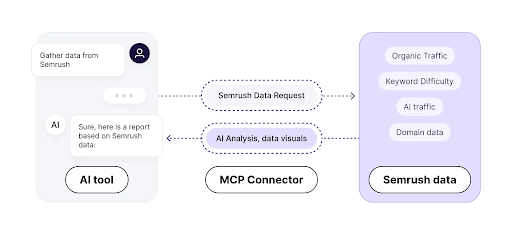
An AI assistant powered by Semrush One can monitor keyword performance and highlight changes that matter. If rankings drop or new opportunities appear, you can catch them early without checking multiple dashboards.
Competitor tracking becomes more immediate as well. Instead of manually reviewing reports, you can get updates on traffic shifts or visibility changes directly in your workflow.
Reporting is another area where this setup helps. Many teams spend hours pulling data together each month. With Semrush MCP, an AI assistant can gather key metrics, summarize performance, and organize everything into a clear update that is ready to share.
How to Get Started
One of the best parts is how simple it is to begin.
Access to Semrush MCP is already included in Semrush One and the SEO Toolkit, so there is no need for additional tools or complicated setup. Once connected, your AI assistant can start pulling in data almost immediately.
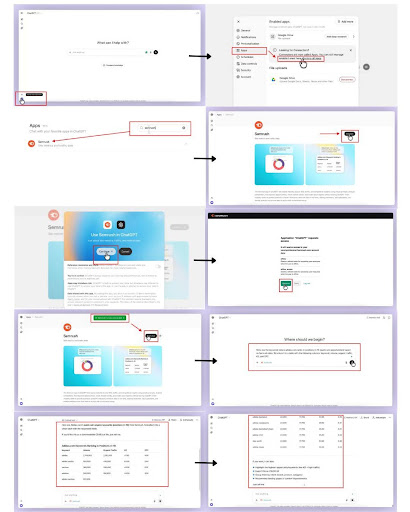
If you want to see how this works in practice, here’s a short walkthrough that shows the full setup from start to finish using OpenAI. It gives a clear picture of how everything connects. You can also check the step-by-step screenshots below to follow along and set it up on your own.
A More Practical Way to Use AI
At its core, this is not about adding another tool to your stack. It is about making the tools you already use more effective.

With Semrush One Solution, AI becomes more than just a place to brainstorm. It becomes part of your research process, helping you move from idea to insight using real marketing data without breaking your flow.
For marketers, founders, developers, and content teams, that means fewer tabs, less manual work, and faster decisions.
If you are already using AI-driven strategies every day, this kind of upgrade is hard to ignore. When your workflow is powered by both AI and real marketing data, everything starts to work a little more smoothly.