Building a new business involves significant risk, but you do not need to guess what your customers want. According to CB Insights, 42% of startups fail simply because there is no market need for their product. You can avoid becoming part of that statistic by carefully planning your page startup and testing your concept early.
A Page Startup approach makes it easy to find the right financial or product fit for your audience. Instead of spending months coding a complex platform, you create a simple, focused web page to gauge real interest. Our experts researched the best product validation techniques so you don’t have to.
This guide will show you how to move beyond intuition and rely on data-backed validation. We will break down exactly how to design, test, and optimize a landing page so you can validate your startup idea online quickly and affordably.
Key Takeaways
- A Page Startup helps validate business ideas with minimal risk by focusing on data rather than intuition.
- Essential components include a clear value proposition, a prominent call to action, and addressing customer pain points.
- Use specific metrics to measure success, such as click-through rates and conversion rates, for effective data-backed validation.
- Leverage AI tools to quickly create and optimize your Page Startup, enhancing its effectiveness without needing coding skills.
- The evolving approach emphasizes predicting market needs and iterating quickly, making validation more data-driven and precise.
Table of Contents
Understanding the Core Principles of a Page Startup
A Page Startup is not a complete company website. It is a targeted learning tool. You use it to test a hypothesis.
What Defines a Page Startup?
A successful Page Startup relies on two things: laser-focused goal setting and extreme simplicity. You want to answer one question: Does the market want this? You do this by presenting a clear offer and asking users to take one specific action.
- Laser-Focused Goal Setting: Your landing page should target a single metric. This might be email signups, waitlist joins, or pre-orders.
- Clarity and Simplicity: A startup landing page must be easy to read. Remove complex menus and distracting links.
The “Story” of Your Page Startup: One Audience, One Promise
Your landing page needs a clear narrative. You must speak directly to one specific audience and make one core promise. If you try to appeal to everyone, you will appeal to no one. Your landing page for startups should address specific Customer Pain Points and show exactly how your solution fixes them.
Page Startup as a Learning Tool, Not a Final Brand
Do not stress over perfect logos or brand colours. Your landing page is an experiment. You are using the Lean Startup Methodology to gather Data-Driven Market Research. Treat your landing page as a disposable asset. If the idea fails, you can easily discard the landing page and try a new concept.
Crafting Your High-Converting Page Startup
Building a landing page requires specific components. You need a layout that drives action and builds trust.
Essential Elements of an Effective Landing Page
Every landing page needs these core features to succeed:
- Clear Value Proposition: Your Unique Value Proposition (UVP) must explain why your product matters.
- Prominent Call to Action (CTA): Give visitors a clear next step. This is essential for a lead generation landing page.
- Addressing the Problem Section: Show the user you understand their struggles.
- Solution Overview and Benefits: Highlight how you make their life easier. Focus on benefits, not just technical features.
- Social Proof and Founder Story: Include Customer Testimonials & Social Proof to build credibility.
Structuring Your Page Startup for Maximum Impact
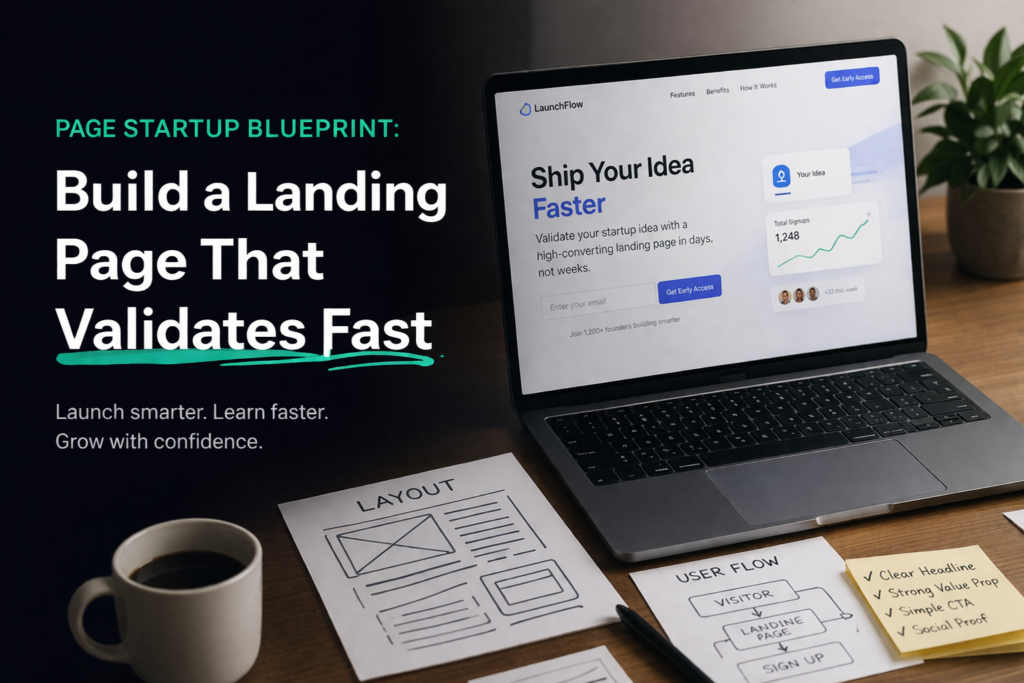
Your landing page layout guides the user’s eye. Good User Experience (UX) Design keeps them engaged.
- Headline: Make it sharp and value-driven. It should grab attention instantly.
- Subheading: Explain exactly what you do and who you help. This ensures Search Intent Alignment.
Page Startup Best Practices
Follow these landing page copywriting tips to boost your startup website conversion rate:
- Avoid Jargon: Speak in plain English. Vague language confuses visitors and creates Landing Page Friction Points.
- Focus on User Benefits: People care about how you improve their day.
- Review landing page best practices 2026 to ensure your landing page meets modern mobile and speed standards.
Page Startup Validation Strategies: Beyond the Click
A Page Startup is only helpful if you measure the results accurately. You must track user behavior to validate your concept.
Testing Your Hypothesis with a Landing Page
Every landing page starts with a hypothesis. You must identify a specific audience and formulate a testable solution. For example, if you want to validate a startup idea online, you might test if independent contractors will pay $10 a month for an invoice tracker. Your landing page will offer this exact tool and measure the response.
Data-Backed Validation with Your Page Startup
You need hard data to make smart choices. A strong A/B Testing Framework helps you compare different versions of your landing page.
- A/B Testing and Engagement Tracking: Use A/B testing on landing pages to test different headlines or CTA buttons.
- Using Real-Time User Data: Track clicks and signups to shape your business plan. This feeds directly into your startup growth marketing strategies.
Advanced Page Startup Techniques and Tools
You do not need to be a developer to launch your landing page. You can build a landing page without coding using modern software.
AI-Powered Page Startup Generation
New tools allow you to generate a landing page in minutes. You can use an AI builder to diagnose customer pain and generate suitable copy. This accelerates your Minimum Viable Product (MVP) launch.
Leveraging AI for Market Insight and Optimization
AI helps you uncover hidden market needs. You can simulate user behavior and refine your landing page copy. This helps you identify unexpressed pain points and tailor your messaging.
Page Startup Integrations and Features
Your Page Startup can integrate with other tools to capture leads seamlessly.
- Location-Specific Customization: Adjust your landing page based on where the visitor lives.
- Financial System Integrations: Connect payment processors to test actual purchase intent.
Validation Metrics to Track on Your landing page:
| Metric | Target Goal | What it Tells You |
|---|---|---|
| Click-Through Rate (CTR) | 3% – 5% | Are your ads bringing the right people to your Page Startup? |
| Conversion Rate | 10% – 15% | Is your Page Startup convincing people to sign up? |
| Sean Ellis Test Score | > 40% | Would users be very disappointed if this solution vanished? |
The Future of Page Startup Validation
The way we use a landing page is evolving. Validation is becoming more data-driven and precise.
From “Build-Measure-Learn” to “Predict-Validate-Iterate”
The old model was slow. Today, you predict the market need, validate it with a landing page, and iterate based on fast feedback.
Proof of Demand (PoD) and Generative Engine Optimization (GEO)
Proof of Demand requires hard evidence. Investors want to see that your landing page delivered actual success with the Waitlist Conversion Strategy. Generative Engine Optimization ensures AI tools can understand and recommend your startup’s landing page.
The Page Startup in the Agentic Era
As AI agents become common, your landing page must be legible to both humans and machines. Landing page design for startups will focus heavily on structured data and clear value propositions.
Your Launchpad to Success with a Page Startup
A landing page is the smartest way to test your business idea. It saves you time, preserves your capital, and gives you real market feedback.
Recap of Key Page Startup Principles
Focus on one audience and one promise. Use your landing page as an experiment. Apply Conversion Rate Optimization (CRO) to improve your results. Follow Lead Generation Best Practices to build a strong list of early adopters.
The Ongoing Journey of landing page Optimization
Your first Page Startup will not be perfect. You will need to refine your Growth Marketing Funnel as you learn more about your users. Keep testing, keep tweaking your landing page optimization strategies, and let your customers guide your product development.
FAQs
A startup landing page allows you to validate your business idea quickly and cheaply. It measures real market demand before you spend time and money building a full product.
You can launch a landing page in just a few hours. Using intuitive website builders and AI tools, you can create a high-quality page without any coding experience.
A website provides comprehensive information about your company with multiple pages and navigation links. A landing page is a single, focused page designed for a specific goal, such as capturing email addresses. To validate a landing page idea, you can use it to capture email addresses.
Yes. AI tools can generate compelling landing page copywriting tips, suggest layouts, analyze competitor data, and help structure your landing page for maximum conversions.
The exact number depends on your industry and business model. However, you should look for a steady pattern of engagement. A strong landing page conversion rate (around 10%) from your target audience provides solid validation that your startup growth marketing strategies are working.