
As enterprises accelerate into an AI-first economy, one truth is becoming unavoidable: the companies leading the next decade are those treating their local business data as strategic infrastructure, not a marketing accessory. In a world where customers rely on real-time signals to make hyper-local decisions, accuracy isn’t just helpful; it has become operational currency.
AI systems now evaluate and rank businesses using millions of micro-signals: store hours, geolocation freshness, service availability, product stock, accessibility details, and LLM-generated summaries. When these signals fall out of sync, visibility drops instantly. This shift has elevated platforms like Getpin beyond traditional marketing tools; they now function as mission-critical systems that maintain the integrity of an enterprise’s public-facing data across all discovery channels.
Recent research reinforces this shift. Forbes Advisor reports that 65% of consumers still trust businesses that openly use AI, indicating that transparency and modern technologies do influence customer confidence. However, the same finding highlights an important nuance: AI alone does not create trust. What ultimately sustains credibility is the accuracy, consistency, and reliability of the underlying business data that AI systems depend on.
Key Takeaways
- Companies must treat local business data as strategic infrastructure to thrive in an AI-first economy.
- AI systems use numerous micro-signals to evaluate businesses; fragmented local data creates systemic failures.
- Platforms like Getpin centralize updates and maintain the integrity of public-facing data for better visibility and trust.
- Hyper-local data integrity is becoming a key performance indicator as it directly affects revenue and customer presence.
- Forward-thinking enterprises will adopt automated local presence management, ensuring that data remains accurate and consistent.
Table of Contents
- Local Data Is Now an Enterprise Asset, And AI Treats It That Way
- The Hidden Problem: Fragmented Local Data Creates Systemic Failure
- Why Getpin Represents a New Class of Digital Infrastructure
- AI-Driven Local Discovery Is Ruthless About Data Quality
- Hyper-Local Data Integrity Is Becoming an Enterprise KPI
- The Future: Autonomous Local Presence Management
- Final Thought: The Future Belongs to Companies Treating Local Data as Currency
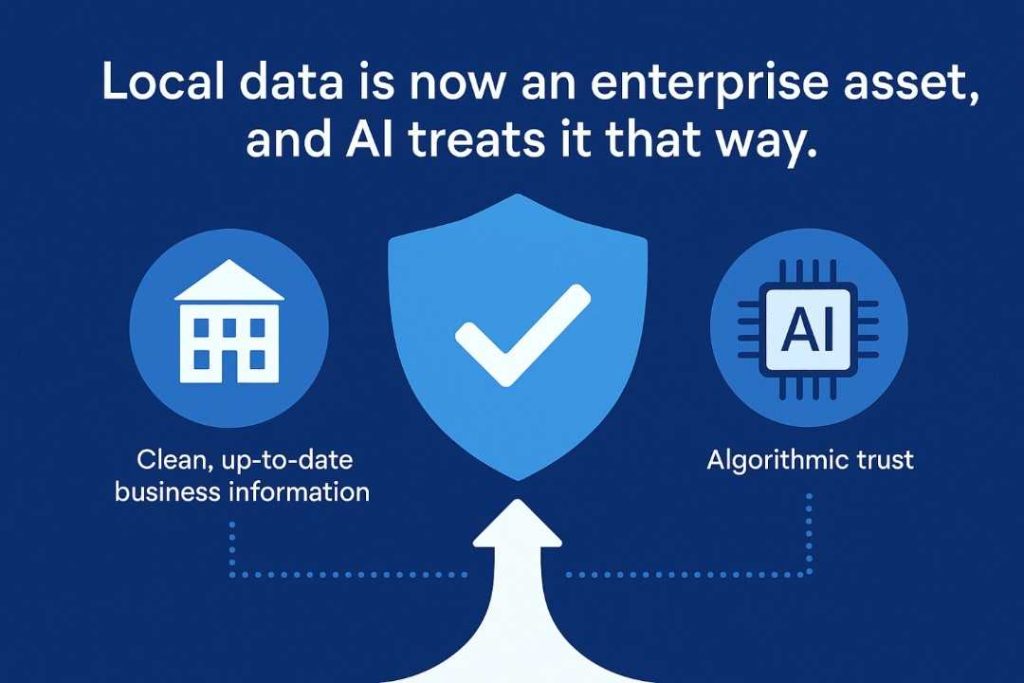
Local Data Is Now an Enterprise Asset, And AI Treats It That Way
AI-driven search doesn’t evaluate campaigns; it evaluates data reliability. The reason is simple: the customer journey today is algorithm-led, not ad-led. When someone searches for “urgent laptop repair near me,” the AI powering the platform simultaneously compares thousands of signals. If your business metadata isn’t synchronized, you’ll experience outdated hours, conflicting listings, and inconsistent engagement, and your ranking drops regardless of product quality.
This is why hyper-local data integrity now functions like a genuine asset class. It carries economic value, operational risk, and competitive significance.
The Hidden Problem: Fragmented Local Data Creates Systemic Failure
Many enterprises still manage their local presence through disjointed teams and disconnected workflows. Social platforms are handled separately from maps, reviews are scattered across tools, and operational updates trickle inconsistently across channels. These minor mismatches accumulate into a major problem: algorithms lose trust in the business.
When AI detects inconsistent data, it does the one thing enterprises cannot afford: it quietly downranks them. Revenue pipelines break long before a customer even attempts to visit a store. This is why advanced local SEO tools are no longer optional but foundational.
Why Getpin Represents a New Class of Digital Infrastructure
Getpin isn’t merely optimizing listings; it is creating an operational backbone for multi-location brands. By centralizing updates, reviews, local signals, and customer insights into a single, synchronized ecosystem, Getpin ensures that every interaction point, whether customer or AI, receives clean, real-time data.
In an era when LLMs and machine verification are shaping search discovery, this shift is critical. Getpin prevents algorithmic erosion, where outdated or inconsistent data quietly weakens a brand’s digital footprint.
A modern listing management tool like Getpin strengthens enterprise-wide trust by offering automated governance rather than relying on fragmented manual updates.
AI-Driven Local Discovery Is Ruthless About Data Quality
AI models continuously cross-reference signals across multiple platforms to assess how reliable a business appears. If published hours say a location closes at 8 PM, but real-world behavior or customer reports indicate otherwise, the system flags the mismatch as a reliability issue. When service details, menus, or availability differ between platforms, AI interprets this as operational inconsistency. And when reviews go unanswered for long periods, algorithms often read that pattern as weak or irregular engagement.
Because of this, clean, synchronized, and frequently updated data has become a fundamental requirement for maintaining strong visibility in AI-driven discovery systems. Businesses that uphold this consistency gain something deeper than higher rankings; they build algorithmic trust, which increasingly determines how often and how confidently AI surfaces them to local customers.
Hyper-Local Data Integrity Is Becoming an Enterprise KPI
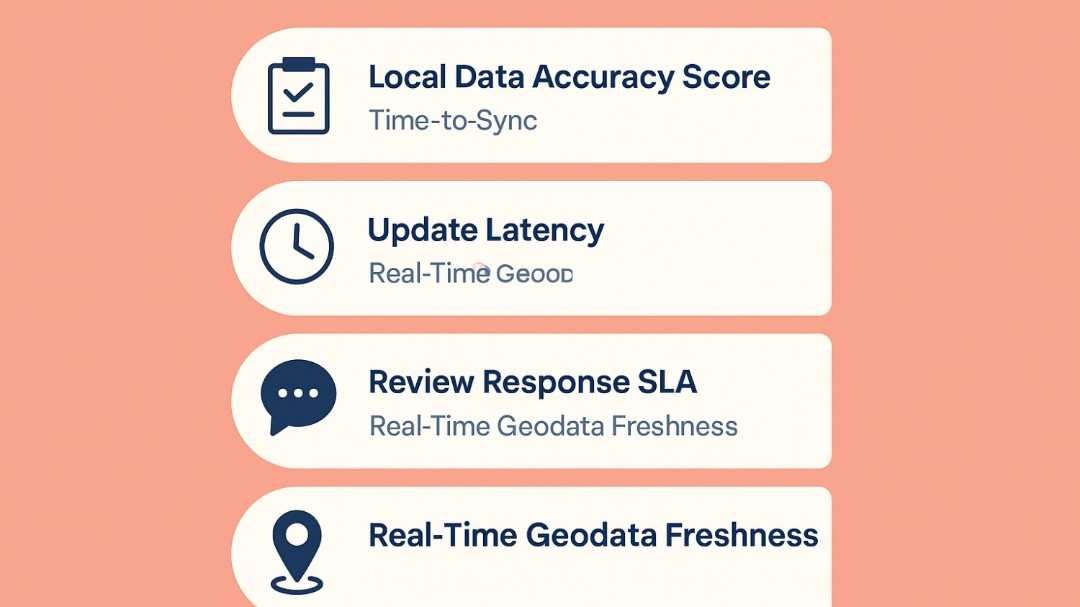
Forward-thinking enterprises are already measuring new operational health indicators:
- Local data accuracy levels
- Time-to-sync across platforms
- Review response performance
- Geodata freshness
- AI discovery strength
These KPIs determine revenue because they determine presence. If algorithms guide customer traffic, then hyper-local data integrity guides revenue.
The Future: Autonomous Local Presence Management
Within the next few years, enterprise discovery will rely heavily on automated intelligence. AI systems will generate real-time business summaries, predict service availability, interpret customer sentiment, and map local user intent as it changes throughout the day. These capabilities only function when the underlying local data is accurate, verified, and consistently updated. Any mismatch of outdated hours, incomplete service details, or inconsistent listings disrupts how AI interprets and represents the business.
Because of this, centralized data platforms are becoming a foundational layer in digital operations. They provide a single, reliable source of truth that supports autonomous, AI-native presence management. As a result, every AI interaction, from search results to voice assistants, can accurately and instantly reflect the business, reducing errors and strengthening overall discoverability.
Final Thought: The Future Belongs to Companies Treating Local Data as Currency
The enterprises moving ahead in the AI-first era share a clear mindset shift: local business data is no longer viewed as a marketing component or an optional enhancement. It has become a structural asset, one that must be maintained with the same rigor as inventory systems, financial records, or compliance data. When treated as a renewable operational resource, local data strengthens discovery pathways, improves algorithmic trust, and supports more accurate customer interactions across digital channels.
Organizations that prioritize hyper-local data integrity today are positioning themselves to benefit from the next generation of AI-led discovery and service automation. Those that overlook this shift risk becoming increasingly difficult for algorithms to validate or surface, leading to diminished visibility even if their offline operations remain strong.