In the past, buyers evaluating a company mainly focused on financial results, market position, and growth potential. Technology was often considered a secondary factor, except in the software industry. Today, this is no longer the case.
Most businesses now rely heavily on digital systems to run their operations. Internal software, cloud infrastructure, and data platforms support everything from customer management to financial reporting. Because of this, investors need to understand how reliable and secure these systems are before completing an acquisition.
This is where structured due diligence becomes important. A technology review helps investors see how the company’s IT environment is built, whether there are security risks, and whether the systems can support future growth.
To manage this process efficiently, many deal teams rely on IT due diligence services and specialized tools. One of the most common tools used in transactions is a virtual data room, which allows companies to organize and securely share important documents with investors and advisors.
Understanding how technology due diligence works can help founders, executives, and investors approach transactions with better preparation and fewer surprises.
Table of contents
Why technology risk is now a deal breaker in M&A
Technology problems rarely appear in financial statements, yet they can dramatically affect the outcome of a transaction. A company may report strong revenue growth while quietly running on outdated infrastructure or unsupported software. In other cases, security practices might be inconsistent, or key systems may depend on undocumented custom integrations. Issues like these rarely surface during early negotiations, but they often arise quickly once technical experts begin reviewing the environment during due diligence.
Cybersecurity is one of the most visible risks. According to IBM’s Cost of a Data Breach Report, the average global breach cost reached $4.45 million in 2023. For an acquiring company, inheriting a vulnerable infrastructure can create immediate operational and reputational exposure.
However, security is only part of the picture. Technology concerns discovered during IT due diligence M&A reviews often include:
- systems that rely on unsupported legacy software
- incomplete documentation of infrastructure and architecture
- fragmented data management practices
- lack of disaster recovery planning
- technical debt that increases long-term maintenance costs
Even when these issues are not severe enough to cancel a transaction, they often influence negotiations. Buyers may request price adjustments or additional investment commitments to account for future modernization work.
Another factor that investors consider carefully is post-merger integration. If the acquiring organization cannot easily connect the target company’s systems with its own infrastructure, operational efficiency may suffer. Research published by McKinsey shows that technology integration challenges are a frequent reason why expected merger synergies fail to materialize.
Because of these risks, technology reviews have become a standard component of due diligence IT assessments across many industries.
What investors evaluate during IT due diligence
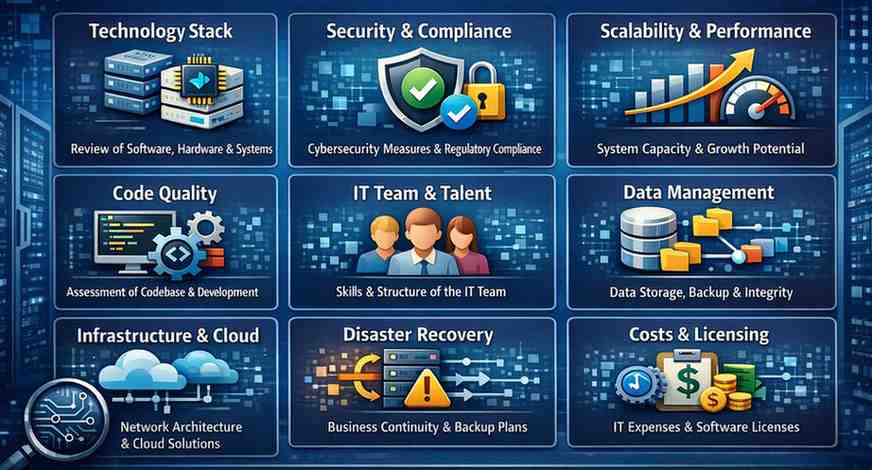
There are various types of due diligence, each tailored to assess specific aspects of a business during mergers, acquisitions, or partnerships. These include financial, commercial, legal, ESG, sanctions, and IT due diligence. IT due diligence is a specialized type of due diligence focused on evaluating technology systems, infrastructure, and associated risks.
When investors examine a company’s technology environment, their goal is not simply to identify problems. They also want to understand whether the systems supporting the business are sustainable over the long term.
A typical IT due diligence services engagement focuses on several core areas.
Infrastructure and system architecture
First, analysts look at how the organization’s infrastructure is structured. They examine whether systems are hosted in the cloud, maintained on-premise, or distributed across multiple environments.
This part of the review usually includes:
- network architecture and connectivity
- hosting environments and cloud providers
- data storage and backup systems
- performance monitoring tools
Well-structured infrastructure often signals that the company has invested in scalable operational practices.
Cybersecurity and access management
Security policies are another critical area of analysis. Investors want to confirm that the company has implemented basic protections against unauthorized access and data breaches.
Typical areas of review include:
- identity and access management controls
- incident response procedures
- vulnerability management processes
- encryption and data protection practices
- ongoing monitoring of security controls and user activity
Organizations must conduct ongoing monitoring to ensure that security measures remain effective and compliant with evolving threats.
Many companies structure their internal policies around frameworks such as the NIST Cybersecurity Framework, which provides widely recognized guidance for managing cybersecurity risks.
Software ownership and licensing
Another step involves verifying that the company has legitimate rights to use the software supporting its operations. Licensing disputes or improper use of open-source software can create legal complications after acquisition.
Reviewing software ownership typically includes:
- application inventories
- vendor contracts
- licensing agreements
- open-source compliance policies
Typical documentation reviewed during IT due diligence
| Area | Examples of documents |
| Infrastructure | Network diagrams, hosting architecture |
| Applications | Software inventory, licensing records |
| Security | Access policies, incident response plans |
| Compliance | Regulatory documentation, privacy policies |
When documentation is incomplete or scattered across different systems, the diligence process often slows down significantly. This is one of the reasons why companies increasingly organize materials in centralized platforms before investor reviews begin.
The role of virtual data rooms in technology due diligence
Modern transactions involve reviewing thousands of documents across multiple teams. Without a structured platform, coordinating this process would be extremely difficult.
This is why VDR software has become a standard tool in mergers and acquisitions. A virtual data room for investors provides a secure online environment in which companies can upload and share confidential documents during the due diligence phase.
Instead of exchanging files via email or unsecured file-sharing tools, deal teams manage information in a centralized, controlled environment. Virtual data rooms also help organizations meet reporting obligations by providing audit trails and secure documentation management, ensuring compliance with legal and regulatory requirements.
Why investors rely on virtual data rooms
Virtual data rooms support the diligence process through several important capabilities:
- Secure document storage and sharing
- Role-based permissions for different stakeholders
- Activity tracking and audit logs
- Encryption and compliance features
- Centralized document organization
These features ensure that sensitive information remains protected while still being accessible to authorized participants.
Benefits of a virtual data room for investors
Using a structured platform also improves the efficiency of the review process.
Key advantages include:
- Faster document discovery and analysis
- Improved collaboration between deal teams
- Transparent communication between buyers and sellers
- Reduced risk of accidental data exposure
For these reasons, many organizations consider VDR platforms an essential component of the best data room for investors when preparing for a transaction.
How companies can prepare for technology due diligence
Companies that prepare their technology documentation early tend to experience smoother and faster deal processes. Preparation allows potential buyers to assess risks quickly and reduces uncertainty during negotiations.
Founders and executives can take several steps to prepare effectively for IT due diligence M&A reviews.
1. Document system architecture
Clear documentation of infrastructure and application architecture helps investors understand how systems interact.
This documentation should include:
- Network diagrams
- Infrastructure configurations
- Application dependencies
- Integration points between systems
2. Conduct internal technology audits
Performing internal IT audits before approaching investors can help identify potential risks early. Addressing these issues proactively strengthens investor confidence.
3. Organize documentation in a virtual data room
Uploading documentation into a VDR software platform before investor discussions begin allows deal teams to access information quickly and efficiently.
Common folder categories include:
- Corporate documents
- Financial information
- Legal contracts
- Technology and infrastructure documentation
- Security and compliance policies
4. Address cybersecurity gaps
Cybersecurity vulnerabilities discovered during diligence can significantly impact negotiations. Conducting security assessments and implementing strong access controls reduces this risk.
5. Work with experienced IT due diligence services providers
Specialized advisors can help companies prepare the required documentation and identify technical risks that investors are likely to investigate.
Taking these steps early helps companies avoid delays and strengthens their credibility during the
Why proactive due diligence strengthens deal outcomes
Technology transparency plays a crucial role in modern acquisitions. When companies provide clear documentation and well-structured technology environments, investors can evaluate risks more confidently and efficiently.
Proactive IT due diligence can significantly improve the overall transaction experience. Buyers gain a clearer understanding of the company’s technology assets, while sellers demonstrate operational maturity and transparency.
This preparation often leads to several advantages:
- Faster deal timelines
- Reduced negotiation friction
- Increased investor trust
- Improved post-merger integration planning
When technology environments are well-documented and secure, the integration process after acquisition becomes significantly easier. Systems can be aligned more quickly, and operational disruptions are minimized.
Conclusion
Technology plays a major role in how modern companies operate, so it naturally becomes an important focus during acquisitions. Buyers today want more than financial reports and growth numbers. They also want to understand how the company’s systems work, how secure they are, and whether the technology can support future growth.
A careful due diligence review helps investors spot potential risks before a deal is finalized. It is essential to perform systematic due diligence to ensure that all relevant risks are identified. Problems such as outdated systems, weak security practices, or poorly documented infrastructure can create serious challenges after an acquisition. Identifying these issues early allows both sides to address them before they become costly surprises.
For companies preparing for investment or a sale, preparation makes a real difference. When technology documentation is organized and systems are clearly explained, the review process becomes faster and easier for everyone involved. Using a virtual data room also helps keep important information structured and securely shared with investors.
In the end, technology due diligence is not only about finding weaknesses. It is also an opportunity to show that a company’s systems are reliable and well-managed. Businesses that approach this process openly and with proper preparation often build stronger trust with investors and move through deals more smoothly. A thorough risk assessment is a critical component of successful due diligence.