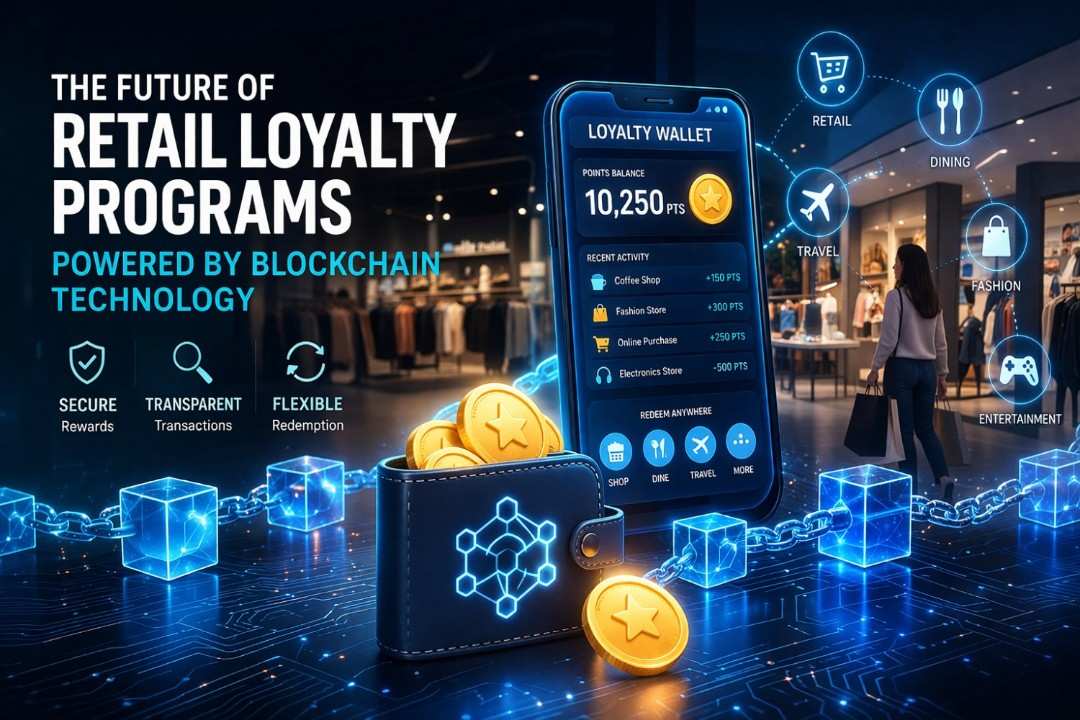
What if your loyalty points worked like money? You could spend them anywhere, and they would always be safe. Today, reward programs often cause more frustration than happiness. In fact, the average consumer is enrolled in nearly 19 loyalty programs, but actively uses only about 49% of them. The points you earn are tied to one store, they take time to use, and there are too many rules.
Stores have changed a lot. Reward programs have not. That is where blockchain technology comes in. It makes reward programs better by adding transparency, automation, and flexibility. This means customers get real value from their points.
Table of contents
Challenges in Traditional Loyalty Programs
Loyalty programs were designed for a simpler retail setup. Most brands operated through their own channels. Customer journeys were predictable. As retail expanded, these programs stayed the same. That gap is where the friction comes from.
Here are the main problems with reward programs:
1. Points are stuck with one store
Most reward programs only work with one store. If you earn points at one store, you cannot use them at another store. This means you have points at many stores, and it is hard to use them in a way that matters.
2. The experience is different depending on how you shop
You might shop on an app, website, or in person. Your reward points do not always follow you smoothly. Your points might not update, you might get different offers, and using your points might not be easy. This creates gaps in what should be an experience.
3. The systems do not work together
Reward programs often use existing systems such as cash registers, online shopping, and customer information. These systems do not always work well together. This makes it hard to keep track of what you have. It is hard to use your rewards in the way you want.
4. The programs are not flexible
Most traditional programs have fixed rules about how you earn and use points. While these rules are stable, they are hard to change. It is hard to try things that work with other companies or change how you reward customers.
How Blockchain Can Revolutionize Loyalty Programs
Blockchain technology can change reward programs. If you look at the problems with programs, most of them are about control, visibility, and flexibility. Blockchain technology solves these problems by changing how reward systems work behind the scenes.
Enhanced transparency
You can see everything that happens with your points. Today, you have to trust the store to tell you how many points you have and what each point is worth. With blockchain technology, every transaction is recorded in a way that cannot be changed. You can see how you earned and used your points, and there is no confusion. There is a record that you and the store can see, which reduces confusion and builds trust.
Fraud prevention
Your points are safer. Traditional reward systems can have issues, such as points, mistakes, or changes that should not happen. These problems are not always visible. They affect how reliable the program seems. Blockchain technology reduces this risk because once a transaction is recorded, it cannot be changed. Every action is trackable, which makes it hard to misuse the system. For you, this means your rewards are more secure and consistent.
Cross-retailer loyalty points
You can use your points at stores. One of the problems today is that your points are stuck with one store. Blockchain technology allows many stores to work together. By having points at many stores, you can earn points at one store and use them at another. This makes your points more useful in life, rather than just being limited to one store.
Tokenization of rewards
Your rewards are like money. In programs, points only exist within the store’s system. With blockchain technology, points can be turned into tokens. This changes how you use them. You can store, transfer, or use them across platforms. Your rewards start to feel like something you own and control.
Smart contracts for automated rewards
You get your rewards away. Traditional reward programs often rely on the store to give you your rewards, which can take time and be inconsistent. Blockchain technology uses contracts, which are like automatic rules. When you shop for something, you get your reward. There is no need for the store to do anything. The process is more predictable and efficient.
Data privacy and security
Your information is safe. Traditional reward programs rely on databases, which can be vulnerable and hard to manage. Blockchain technology. Secures data across a network, reducing the risk of problems. It also limits who can see your information. This means your transactions and rewards are handled securely and under control.
Why is Blockchain Technology the Future of Loyalty Programs?
One reason is its cost-effectiveness. Reward programs are expensive to create, implement, and maintain. In fact, companies in the United States spent around $2 billion on reward programs in 2014.
Blockchain technology does require some investment. It helps reduce ongoing costs. With contracts that handle rewards automatically and maintain secure, transparent records, the need for manual work, mistakes, and fraud management is lower.
At the time, blockchain technology changed how loyalty programs work. While the technology itself is spread out, it allows for a unified experience for you. With the management of many loyalty accounts, your rewards can be accessed and used more smoothly from one place. Stores still decide how rewards are given.
You have more control over how you use them. This is a change from how traditional programs work today. With the support of retail IT services, businesses can implement blockchain-based loyalty programs efficiently, making them easier to manage and more rewarding for customers.
How does a Blockchain-based Loyalty Program Work?
Blockchain technology is changing reward programs by making them more transparent, secure, and flexible. You can. Use rewards across many stores and businesses to benefit from fewer mistakes, lower costs, and more engagement. Compared to programs, blockchain delivers a seamless, reliable experience that aligns with how people shop today.
Your rewards are turned into tokens. Loyalty points are turned into tokens that you can store in a digital wallet. These tokens are like assets that you own. You can hold onto them, transfer them to others, or trade them like cryptocurrency.
You get your rewards away. Smart contracts automatically give you points when you do something. This eliminates the wait between doing something and getting your reward. The process is automatic and transparent. Does not require the store to do anything.
All transactions are recorded in a way. All transactions are recorded in a way that cannot be changed. This record is spread across many computers. Because no one person controls this record, it is almost impossible to alter or forge transactions. This brings security, builds trust, and reduces the risk of fraud.
Many stores can work together. Many stores can work together on the blockchain network, creating a connected loyalty program. This means you can earn points at one store and use them at another. This makes loyalty programs more attractive. Encourages customers to stay engaged.
You can manage your rewards in one place. You can manage all your rewards through a digital wallet, which is like a simple and intuitive interface. With juggling many apps or membership cards, everything is in one place.
From this wallet, you can see your point balances, exchange tokens, and transfer points to friends or family. Track your transactions in real time.
Does Blockchain Technology have Business Value?
Blockchain technology is proving its value beyond cryptocurrency. Companies are starting to pay attention to blockchain technology. More and more companies are investing in blockchain technology, not for digital currency but for applications that improve security, transparency, and efficiency.
The fact that blockchain provides a system that can’t be tampered with makes it appealing for many business applications. These include things like loyalty programs, managing supply chains, and handling data securely. Blockchain technology helps to keep data safe and honest.
Many big companies are using blockchain technology, including American Express, Facebook, and IBM. Some of these companies have already implemented blockchain-based loyalty programs. This shows how the technology can deliver benefits, streamline operations, reduce costs, and enhance customer experiences.
Conclusion
Blockchain technology is changing loyalty programs by making them more transparent, secure, and flexible. You can. Use rewards across many stores and businesses to benefit from fewer mistakes, lower costs, and more engagement. Compared to programs, blockchain delivers a seamless, reliable experience that aligns with how people shop today.
To implement solutions, you need deep expertise in technology and retail operations. With RBMSoft, retailers can deliver more effective and engaging loyalty experiences that drive customer satisfaction and long-term business value.