
Most TikTok ad spy lists look thorough. Few reflect on how buyers actually research.
If you run paid traffic, you are not comparing feature counts. You are trying to answer practical questions before spending money. Is this product moving units? Is this brand scaling or testing? Are these creatives repeating because they convert or because they are cheap to produce? After all, 68% of TikTok users say they have purchased a product after seeing it on TikTok, making accurate.
Inside agency teams and ecommerce groups, the evaluation criteria have shifted. Ad libraries are common. What matters now is how clearly a tool connects creative activity, product demand, and store behavior.
This guide covers the best TikTok AdSpy tools practitioners rely on, the structural shifts behind those choices, and how to decide what fits your workflow.
Table of contents
Tools Practitioners Quietly Swear By
PiPiADS
PiPiAds focuses heavily on TikTok ad intelligence. Its database allows filtering by hooks, call-to-action types, engagement signals, and creative formats.
It allows you to study how top-performing ads structure openings and messaging angles within specific niches. Dropshippers and TikTok-focused brands often reference it for detailed creative research.
The strength lies in depth inside a single platform.
Key features:
- TikTok-focused ad database
- Hook and call-to-action filtering
- Engagement and performance signal sorting
- Niche-based creative search
Pros:
- Strong TikTok depth
- Detailed hook-level filtering
- Well-suited for dropshippers
Cons:
- Limited cross-platform coverage
- No built-in revenue or store-level validation
Minea
Minea covers Facebook, TikTok, and Pinterest with a strong e-commerce orientation. Its Magic Search tool lets you enter a product name and uncover related ads across platforms.
Reverse image search adds another layer of discovery. Practitioners often mention Minea when they want cross-platform product intelligence without having to manage multiple tools.
It balances depth of discovery with usability at a mid-tier price.
Key features:
- Magic Search across platforms
- Reverse image search
- Engagement and targeting filters
- Supplier identification angle
Pros
- Cross-platform coverage
- AI-driven discovery
- Structured product research
Cons
- Credit-based usage system
- More product-focused than service-oriented
TikTok Creative Center Advanced Search
TikTok Creative Center remains the native starting point for many experienced buyers.
Its advanced search lets you filter by industry, objective, region, and timeframe. You can review trending ads and creative formats directly from the platform.
Practitioners treat it as a baseline validation layer before turning to paid tools. It gives platform context without cost.
Key features:
- Free access
- Industry and objective filter
- Trending ad discovery
- Hashtag and creative insights
Pros
- No cost
- Direct platform-level data
- Useful for initial validation
Cons
- Limited performance visibility
- Basic filtering compared to paid tools
- No revenue or spend estimates
WinningHunter
WinningHunter is an e-commerce-focused ad intelligence platform built around connecting creatives to store performance. It tracks TikTok and Facebook ads while layering in revenue estimates, ad spend visibility, and store-level data.
You can use Magic AI Search to discover products through image or keyword input, then evaluate whether stores are scaling or testing. For e-commerce operators, this linkage reduces blind product testing.
Practitioners mention it when the conversation shifts from “what is trending” to “what is actually selling.”
WinningHunter key features:
- Revenue and ad spend estimation
- TikTok and Facebook tracking
- Magic AI image and keyword search
- Shopify store monitoring
- Trend and saturation filtering
Pros
- Connects ads to store-level signals
- Reduces product validation time
- Built specifically for e-commerce
Cons
- Designed primarily for online sellers
AutoDS TikTok Spy
AutoDS TikTok Spy is positioned for dropshippers who want fast product discovery aligned with sourcing.
It highlights trending TikTok products and connects insights to supplier workflows. Sellers moving quickly from ad discovery to fulfillment often mention it in dropshipping communities.
It fits speed-focused operators who prioritize execution over deep performance analysis.
Key features:
- Trending product discovery
- Dropshipping-oriented filtering
- Supplier integration angle
- TikTok-focused database
Pros
- Aligned with dropshipping workflows
- Simple product first interface
- Good for rapid testing cycles
Cons
- Less emphasis on deep ad performance data
- Narrower scope outside dropshipping
Quick reference: Which tool fits your workflow
| Tool | Best For | Primary Strength | Limitation |
|---|---|---|---|
| PiPiADS | TikTok-focused brands and dropshippers | Deep TikTok filtering by hooks and creative patterns | Limited cross-platform visibility |
| Minea | Cross-platform ecommerce brands | Magic Search and reverse image discovery | Credit-based usage model |
| WinningHunter | E-commerce sellers focused on validation | Connects ads to revenue and store-level signals | Built mainly for product-based businesses |
| TikTok Creative Center Advanced Search | Beginners and baseline validation | Free native trend and format insights | No revenue or spend visibility |
| AutoDS TikTok Spy | Dropshippers | Fast product discovery tied to sourcing | Limited advanced performance data |
3 TikTok Ad Spy Shifts That Changed Everything in 2026
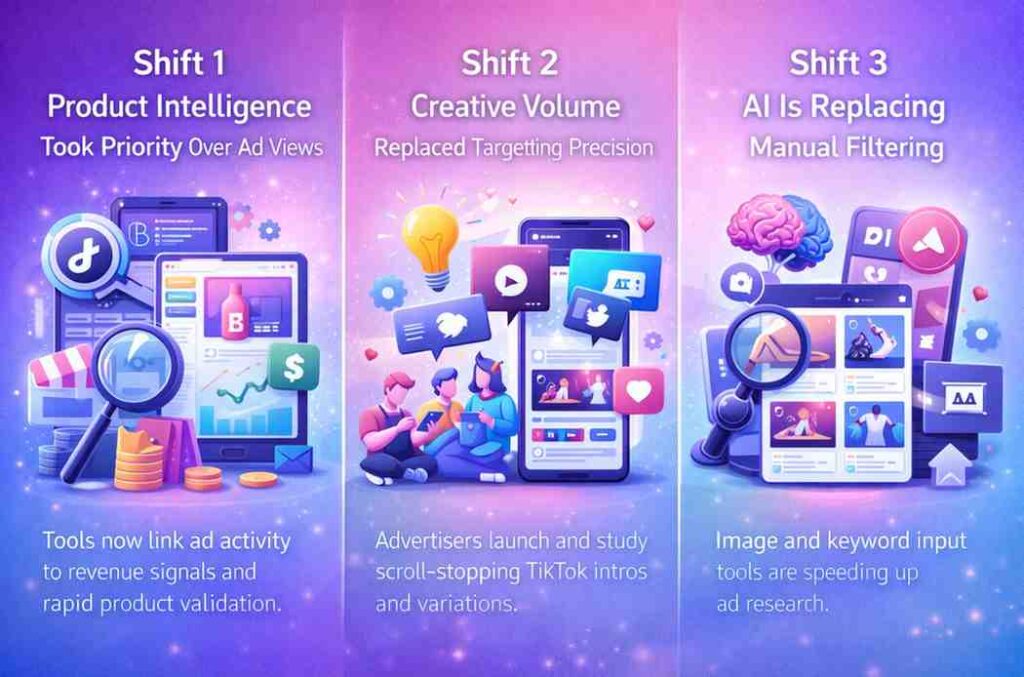
Shift 1: Product Intelligence Took Priority Over Ad Views
A few years ago, most TikTok ad research followed a simple formula. Find a viral video. Copy the angle and launch fast.
That approach worked when competition was thinner, and trends lasted longer. By 2026, views alone tell you very little. A video can rack up engagement while the product behind it barely converts. Another creative might look average on the surface, yet drive steady sales through smart targeting and backend optimization.
Today, experienced performance marketers ask different questions before testing anything. Is the product generating consistent sales? Is the store increasing spend over time or running small experiments? Has the niche already been flooded with similar offers? Does the estimated revenue make sense relative to the visible ad activity?
This shift changed what advertisers expect from ad spy platforms. Surface-level engagement is no longer enough. The focus has shifted toward tools that connect ad activity to product performance and revenue data, providing a clearer signal before you commit budget.
Practitioner-Used Tools in This Category
1. WinningHunter
WinningHunter operates as an all-in-one ecommerce ad intelligence platform. You can track TikTok and Facebook ads inside a single dashboard while analyzing the stores behind them.
For e-commerce sellers who consistently test products, this linkage helps reject weak ideas earlier. It is designed primarily for product-based businesses, not for app or lead-generation campaigns.
2. Minea
Minea is typically used for cross-platform monitoring when brands test on TikTok and Facebook simultaneously. It helps track product movement across channels without switching between separate tools.
3. PiPiAds
PiPiAds is commonly used for TikTok-specific creative research. It is valued for hook-level filtering and detailed creative breakdowns within the TikTok ecosystem.
SHIFT 2: Creative Volume Replaced Targeting Precision
Media buyers once spent most of their time refining targeting layers. Interests, stacked audiences, lookalike variations. That level of control carries less weight on TikTok today.
The algorithm now manages audience discovery, broad distribution, and expansion once performance signals appear. Your edge rarely comes from narrowing who sees the ad. It comes from what appears on screen in the first seconds.
Hooks, UGC style execution, scroll-stopping openings, and rapid iteration now drive performance. Teams launch multiple creative variations quickly instead of over-tuning audience settings. Interestingly, branding moments receive more attention, viewed by 88% of people when TV ads precede TikTok ads, compared to 72% when TikTok ads run alone, highlighting the power of sequencing and cross-channel synergy.
This shift led to the development of creative first-intelligence tools. Advertisers use them to analyze patterns in intros, messaging styles, and formats, treating creative output as the primary driver of scale.
Practitioner-Used Tools in This Category
1. Foreplay
Foreplay does not compete on database size. It focuses on workflow. You can build structured swipe files, tag creatives by theme, hook style, or niche, and organize ideas for later testing. Many agencies prefer it because it supports how teams actually collaborate on creative development.
If you treat ad research as an ongoing system rather than random browsing, this tool fits naturally into your process.
2. BigSpy
BigSpy offers a large multi-platform creative archive. It is useful when you want to scan trends across networks and quickly identify volume patterns.
Its strength lies in breadth. You gain wide visibility across platforms, though it offers less TikTok-specific depth compared to more specialized tools.
3. PowerAdSpy
PowerAdSpy stands out for its geographic coverage, with data across more than 100 countries. That makes it practical for brands operating in multiple markets.
Historical pattern tracking adds another layer, helping you observe how campaigns evolve across regions.
4. AdSpyder
AdSpyder leans into engagement metrics and estimated click-through rates. Instead of simple browsing, you can benchmark creatives against performance signals.
This makes it useful when you want a competitive context layered over ad discovery rather than scrolling through raw archives.
Shift 3: AI Is Replacing Manual Filtering
Scrolling through filters, stacking keywords, and narrowing results one layer at a time slows research. When competition moves fast, that delay costs opportunity.
Newer tools apply AI to compress that process. You can upload an image to locate similar creatives. You can describe a niche and surface relevant ads. Pattern recognition models highlight similarities across hooks, formats, and product categories without forcing you to guess the right filter combination.
Manual filtering is no longer the standard.
Practitioner-Used Tools in This Category
1. WinningHunter
WinningHunter fits this AI-driven shift through its Magic AI Search and product discovery layer. Sellers use it when they want image-based discovery and faster filtering tied to store-level signals.
2. PiPiAds AI Filtering
PiPiAds applies keyword clustering and creative performance grouping to reduce manual search steps inside its TikTok-focused database.
3. TikTok Creative Center
TikTok Creative Center remains a free reference point for reviewing trending ads and hashtag performance before moving into paid tools.
The $0 / $200 / $1,000 TikTok Ad Spy Stack
$0/mo: Bootstrapped
Stack
- TikTok Creative Center
- TikTok Ads Library
- Manual competitor tracking
- Notion swipe file
If you are working with limited capital, this setup is enough. Creative Center shows which formats and hooks are trending. The Ads Library reveals who is actively spending and how long specific products stay in rotation. Manual competitor tracking helps you see price changes, bundle shifts, and landing page adjustments. A simple Notion board keeps your findings organized so ideas do not disappear.
~$200/mo: Growing Brand
- WinningHunter ($58/month for basic and $93/month for standard)
- Foreplay ($49 per month)
- TikTok Creative Center (free)
WinningHunter Basic gives you access to both TikTok and Facebook ad data, revenue estimation, store tracking, and Magic AI search without an enterprise price tag. Foreplay sits in the entry pricing tier of ad workflow tools, helping you build and tag swipe files and organize creative research within its workspace. TikTok Creative Center remains valuable and free, giving baseline insight into trending formats and hashtag activity.
$1,000+/mo: Scaling Brand or Agency
- WinningHunter Premium: $294/month
- Minea: $99/month
- Foreplay: $149/month
- BigSpy or PowerAdSpy: $149/month
WinningHunter Premium anchors the stack with deep product validation, store revenue estimation, ad spend visibility, and AI-driven discovery. You see which products scale and which stores commit real budget. Guesswork drops sharply.
Minea expands cross-platform visibility, giving you broader ecommerce trend signals across TikTok and Facebook. You avoid platform blind spots. Foreplay keeps creative development structured. Concepts get tagged, saved, and reused across accounts without chaos.
BigSpy or PowerAdSpy adds volume and geographic coverage. You monitor creative saturation, regional pushes, and campaign patterns at scale.
A quick comparison of each TikTok ad spy stack by budget level:
| Budget Level | Tools Included | What You Get | Best For |
| $0 per month | TikTok Creative CenterTikTok Ads LibraryManual competitor trackingNotion swipe file | Native trend visibility, competitor monitoring, structured idea tracking | Beginners building research discipline |
| ~$200 per month | WinningHunter Basic or StandardForeplayTikTok Creative Center | Revenue validation, store tracking, AI product discovery, and organized creative workflow | Growing brands testing products consistently |
| $1,000+ per month | WinningHunter PremiumMineaForeplayBigSpy or PowerAdSpy | Full product validation, cross-platform intelligence, creative volume monitoring, geographic coverage | Scaling brands and agencies managing serious spend |
The 5-Question Framework Before Buying Any TikTok Ad Spy Tool
Before you subscribe to anything, run it through this filter.
1. Does it only display ads, or does it show commercial traction?
Seeing creatives is basic. You need signals that indicate whether the product behind the ad is moving units. Store activity, spend consistency, and revenue indicators matter more than view counts.
2. Does it remove steps from your research process?
If you still export screenshots, juggle tabs, and cross-check data manually, the tool isn’t saving you time. It should simplify the process of moving from idea to decision.
3. Is your niche actually represented?
Search your category and country. If results are thin or outdated, the size of the overall database is irrelevant.
4. Can you spot momentum early?
Look for repeat testing, growing creative volume, or expanding offers. If everything looks saturated, you are seeing the aftermath, not the rise.
5. Does it fit how you already operate?
Your research flow should connect naturally to product pages, creative planning, and campaign launches. If it feels disconnected, it will gather dust.
Save this checklist. It prevents expensive subscriptions and forces clarity before commitment.
Conclusion: Choosing the Right TikTok Ad Spy Tool
The best TikTok ad spy tool depends on what you need.
If you only want to see ads, free libraries cover that. If you test products every week, you need visibility into store activity and signals that indicate real demand. If you manage multiple accounts and organizations, creative tracking starts to matter as much as discovery.
Across the tools covered here, the dividing line is simple. Some platforms help you browse, whereas others help you validate.
Choose based on how you operate today and where you are trying to go next. The right stack should reduce hesitation, not add more tabs to manage.