
Video is central to modern digital marketing. This reflects how users consume content today. Short-form clips lead social platforms, while explainer and branded videos are now expected across campaigns. In 2025, 89% of businesses use video as a core marketing tool. This underscores how deeply video is embedded in overall marketing strategy. As this demand increases, marketers face a practical challenge. They need to produce high volumes of video content without proportional increases in cost, time, or technical complexity.
This challenge has accelerated interest in software-based video creation systems. Rather than relying solely on traditional production workflows, many teams are turning to automated and AI-assisted platforms. These platforms streamline video generation while preserving creative control. These tools are not replacing human creativity; instead, they are reshaping how video content is planned, generated, and iterated at scale. This is much like how strong marketing basics guide strategy across digital channels
Key Takeaways
- Video generation software is revolutionizing digital marketing by enhancing efficiency and scalability in content production.
- AI-driven platforms streamline video creation, allowing teams to automate tasks while maintaining creative control.
- These systems integrate various video production layers, enabling rapid deployment and multi-channel distribution.
- Marketers can easily adapt content for trends and audience needs without reworking entire videos, thanks to flexible workflows.
- Overall, video generation software represents a crucial evolution in marketing technology, meeting modern demands effectively.
Table of Contents
The Software Shift in Video Marketing Workflows
Historically, video production involved multiple specialized tools: scripting software, editing suites, animation tools, and rendering engines. Coordinating these components required skilled professionals and long production cycles. Software-based video generation platforms consolidate much of this workflow into a single interface, abstracting technical complexity behind user-friendly systems.
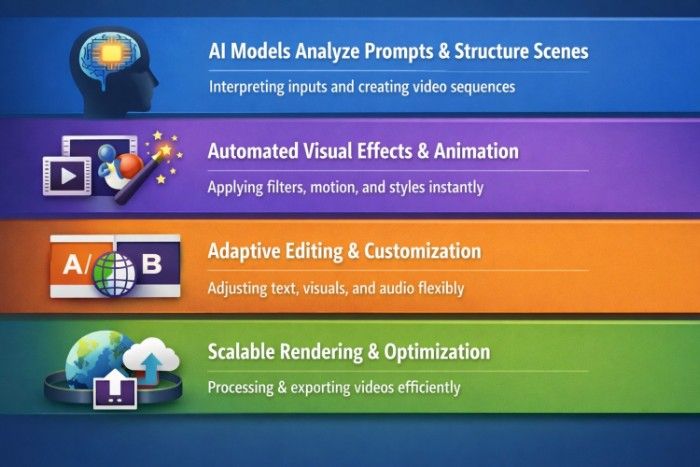
From a technical standpoint, these platforms integrate several software layers. This includes generative models, rendering engines, asset libraries, and export optimization tools. This integration allows marketers to move from concept to publishable video with fewer manual steps. The result is a workflow better suited to iterative testing and rapid deployment. It also supports multi-channel distribution capabilities. This is increasingly associated with an AI Video Generator approach to content creation.
How AI Enhances Video Creation at the System Level
AI-driven video platforms rely on trained models that can interpret prompts, structure scenes, and automatically apply visual effects. Different models target specific outputs. This includes realistic motion, animated storytelling, and short-form social content. This modular approach allows teams to select the appropriate model based on campaign goals rather than starting from scratch each time.
From a software architecture perspective, these systems emphasize scalability and adaptability. Marketers can adjust text, visuals, pacing, and audio without reworking the entire video. This flexibility enables fast localization, A/B testing, and personalized video variations. In this area, platforms like ImagineArt are often cited as examples of adaptable AI-driven tooling.
Balancing Automation With Creative Oversight
One key strength of modern video generation software is that it does not remove human decision-making from the process. While AI automates repetitive or technical tasks, users still define messaging, branding strategies, and narrative direction. This balance is critical for organizations. They need a consistent visual identity across campaigns while operating at speed. From a software standpoint, this trend favors assistive AI that supports scale without replacing creative control.
Strategic Value for Digital Marketing Teams
For marketing teams, the adoption of AI-driven video software is less about novelty and more about operational efficiency. Faster production cycles enable quicker responses to trends, more frequent content updates, and improved experimentation. At the same time, centralized platforms simplify collaboration by keeping assets, versions, and workflows in one system.
As video drives customer engagement, strong software infrastructure becomes a core requirement. AI-assisted video generation tools represent a practical evolution of marketing technology. They are designed to meet modern content demands without sacrificing quality or control.
Conclusion
Video generation software is reshaping how digital marketing teams create content. By combining automation, generative models, and flexible workflows, AI-driven platforms make video production more scalable and efficient. AI-driven video generation systems, exemplified by tools like ImagineArt, show how software innovation is driving the future of video marketing through adaptability.