Artificial intelligence continues to reshape industries and everyday life, and one of the most intriguing developments in this field is the rise of agentic AI. Agentic AI operates with a degree of autonomy, enabling it to make decisions, pursue goals, and interact independently with its environment, unlike traditional AI systems that follow pre-programmed instructions.
This article delves into the concept of this type of AI, its uses, and the potential effects on businesses and society. According to Gartner, 40% of enterprise applications will feature task-specific AI agents by 2026, showing how quickly this AI is becoming a core part of enterprise automation. This article explores what agentic AI is, its applications, and the potential implications for businesses and society.
Key Takeaways
- Agentic AI operates autonomously, making decisions and interacting with its environment, unlike traditional AI systems.
- It has numerous applications in business, healthcare, robotics, and finance, improving efficiency and decision-making.
- Despite its advantages, challenges include accountability, transparency, and the need for technical expertise for implementation.
- As technology evolves, agentic ML is expected to become more sophisticated, offering a competitive edge for early adopters.
- Understanding and leveraging agentic intelligence is crucial as it transforms automation and intelligent decision-making across industries.
Table of Contents
What Is Agentic AI?
Agentic AI denotes artificial intelligence systems capable of functioning as independent agents, proficient in evaluating scenarios, making judgments, and implementing actions without direct human involvement. These systems surpass mere automation or rule-based programming by integrating decision-making frameworks, enabling them to adjust to ever-changing environments.
Unlike traditional AI models that react passively to user commands, agentic AI is proactive. It can identify goals, devise strategies, and initiate actions to achieve desired results. For instance, an agentic system employed in a supply chain could detect a disruption in logistics, assess alternatives, and redirect shipments to uphold efficiency—all autonomously without the need for human intervention.
This type of AI is often discussed in research circles and detailed in resources such as agentic AI, which highlights its ability to act independently while pursuing complex objectives.

Applications of Agentic AI
The potential applications of agentic AI are vast and varied across multiple sectors:
- Business and Operations: Agentic AI can optimize workflows, monitor performance, and suggest operational improvements. In customer service, for instance, agentic chatbots can handle complex inquiries, make recommendations, and even escalate issues when necessary, all autonomously.
- Healthcare: In healthcare, agentic bots can assist in patient monitoring, treatment planning, and drug discovery. By analyzing data from various sources, such as patient records and research databases, these systems can propose interventions, flag anomalies, and support medical professionals in making informed decisions.
- Robotics and Autonomous Vehicles: Robotics and autonomous vehicle technology extensively profit from agentic AI. For instance, self-driving cars depend on AI agents that sense their environment, make instant decisions, and safely navigate through uncertain conditions. Likewise, warehouse robots can oversee inventory and adjust to modifications in storage layouts independently.
- Financial Services: In finance, agentic bots can monitor market trends, execute trades, and manage risk with minimal human input. By continuously learning from data patterns, these systems can respond to market fluctuations faster than human traders, offering a competitive advantage.
Benefits and Challenges
The advantages of agentic intelligence are manifold, encompassing heightened efficiency, scalable capabilities, and the ability to manage intricate, repetitive tasks with the utmost accuracy. This technology empowers businesses to slash operational expenses, refine decision-making processes, and enables consumers to enjoy quicker, more tailored services.
Nevertheless, the advent of this type of AI also presents obstacles. Its self-governing nature raises concerns about accountability and transparency. The decisions executed by AI agents may prove challenging to track or elucidate, particularly in critical scenarios such as healthcare or law enforcement. To ensure responsible deployment, ethical considerations such as decision-making bias and the potential for inadvertent repercussions must be carefully addressed.
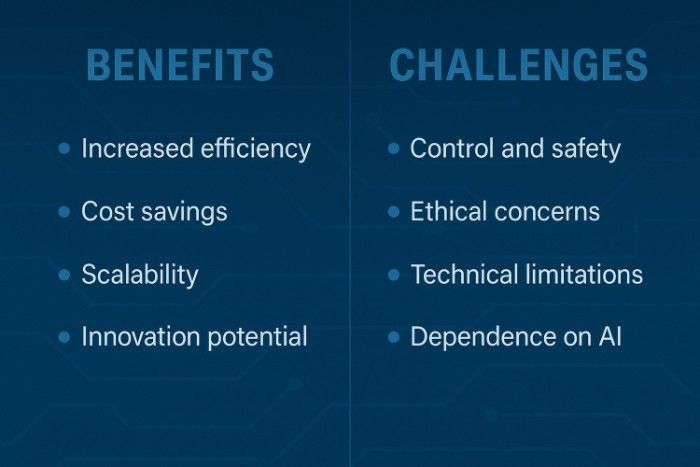
Moreover, implementing this type of AI requires substantial technical expertise and robust infrastructure. Organizations must carefully plan their integration strategies and continuously monitor these systems to mitigate risks.
Looking Ahead: The Future of Agentic AI
Agentic AI represents a significant step toward creating truly autonomous systems that can function independently in complex environments. As technology continues to advance, these AI agents are expected to become more sophisticated, capable of handling tasks that were once thought to require human intelligence.
For businesses and innovators, understanding and leveraging agents and bots is becoming increasingly important. Companies that adopt these systems early may gain a competitive edge, while those that fail to adapt could risk falling behind in a rapidly evolving technological landscape.
In conclusion, agentic AI is transforming the way we approach automation and intelligent decision-making. By combining autonomy with the ability to learn and adapt, these AI agents hold the potential to revolutionize industries ranging from healthcare to finance to transportation. Organizations looking to stay ahead should explore the possibilities of this type of AI and consider how these autonomous systems can enhance efficiency, innovation, and strategic decision-making.