
Commercial trucking rarely makes the front page of technology publications. It doesn’t have the cultural cachet of Silicon Valley or the headline appeal of consumer AI. But if you pulled every tech-enabled truck off the road tomorrow, the U.S. economy would grind to a halt within days. Nearly 71% of all freight moved in America travels by truck. The industry generates over $800 billion in annual revenue and employs more than 3.5 million drivers. The trucking industry is, in every meaningful sense, the circulatory system of the country.
And right now, it is undergoing one of the most significant technological transformations in its history — largely invisible to the tech world watching from the outside.
AI, telematics, and predictive analytics are reshaping how fleets operate, how vehicles are maintained, and how commercial operators compete in an industry where a single unplanned breakdown can cost thousands of dollars in lost revenue and repair expenses. For technology leaders and founders looking to understand where industrial AI is quietly winning, commercial trucking deserves serious attention.
Key Takeaways
- The commercial trucking industry significantly impacts the U.S. economy, transporting nearly 71% of all freight and generating over $800 billion in revenue.
- The digital transformation began with the Electronic Logging Device mandate, enabling real-time data to improve fleet operations and vehicle maintenance.
- Predictive maintenance, driven by AI, reduces unexpected breakdowns by up to 45% and overall maintenance costs by 25–30%.
- A lack of infrastructure for repair services challenges the effectiveness of predictive systems, prompting technology solutions like structured digital directories.
- The rise of telematics is laying the groundwork for future autonomous fleets, transforming trucking into a tech-savvy industry despite perceptions of being a laggard.
Table of contents
From Paper Logbooks to Live Dashboards
The digital transformation of commercial trucking has a clear starting point: the Federal Motor Carrier Safety Administration’s Electronic Logging Device (ELD) mandate, which took full effect in 2019. For the first time, millions of commercial vehicles were legally required to generate and transmit real-time data. Hours-of-service records, location data, engine diagnostics — all flowing continuously from truck to fleet management system.
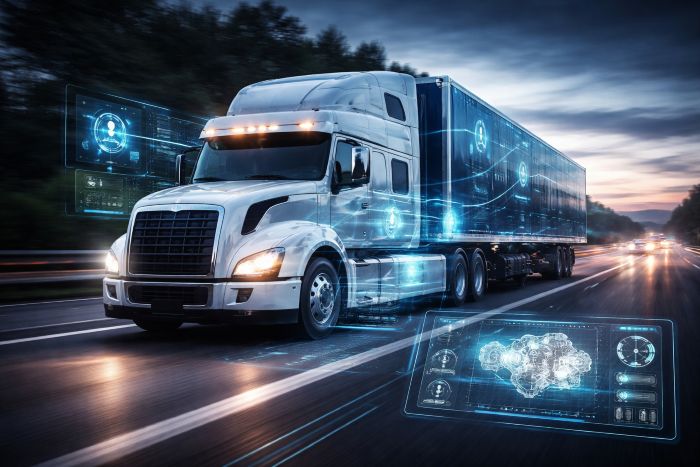
That mandate was, in hindsight, the on-ramp to something much larger. The moment fleets were required to install connected hardware, the infrastructure for AI-powered operations was in place. Telematics platforms built on top of ELD data gave fleet managers visibility they had never had before: live vehicle health monitoring, driver behavior scoring, fuel consumption analysis, and route optimization running simultaneously across dozens or hundreds of assets.
For large carriers, this shift was transformational. For small fleets and owner-operators — who make up the majority of trucking companies in the U.S. — it represented an entirely new way of running a business. Decisions that were once made on gut instinct and clipboard notes are now backed by continuous data streams from sensors embedded throughout the vehicle.
Predictive Maintenance: The Highest-ROI Application of Fleet AI
If there is one area where AI is delivering measurable, proven returns in the commercial trucking industry, it is predictive maintenance. The economics are stark. A Class 8 semi-truck sitting unplanned at a roadside breakdown costs an average of $760 per hour in lost productivity, emergency towing, and expedited repair costs. A catastrophic engine failure on a loaded reefer heading cross-country can run $15,000 to $30,000 when lost cargo, driver downtime, and repair are totaled.
Industry research indicates that predictive maintenance reduces unexpected breakdowns by up to 45%, while cutting overall maintenance costs by 25–30% through more efficient, targeted interventions. AI-driven telematics systems can now predict up to 80% of potential vehicle breakdowns before they escalate into roadside failures.
Modern predictive maintenance works by combining data from dozens of onboard sensors — engine temperature, oil pressure, coolant levels, brake performance, tire pressure, transmission behavior — with machine learning models trained on failure histories across large vehicle populations. The system learns what “normal” looks like for a given engine under a given set of operating conditions, and flags deviations before they become failures.
The practical impact is significant. A fleet running 100 long-haul trucks that implements AI-powered predictive diagnostics can realistically expect fuel efficiency improvements of 6–8%, reductions in catastrophic repair events, and maintenance scheduling that no longer disrupts revenue-generating routes. For technicians managing these fleets, understanding how to interpret and act on AI-generated alerts is becoming as fundamental a skill as reading diagnostic trouble codes.
Publications covering heavy-duty fleet operations, such as heavy-duty fleet maintenance resources at Heavy Duty Journal, have been tracking this shift closely — documenting how diesel technicians are adapting their diagnostic workflows to integrate telematics data alongside traditional hands-on inspection.
The Service Network Challenge: Finding Qualified Repair Providers at Scale
Predictive maintenance systems are only as useful as the repair infrastructure that supports them. When an AI platform flags an emerging fault code on a truck running a lane through rural Kansas, the fleet manager’s next question is immediate and practical: who can fix this, and how fast can I get the truck there?
This is a problem that technology is also beginning to solve. Historically, dispatchers relied on informal networks — phone calls, trucker word-of-mouth, dog-eared directories — to locate qualified repair shops with the right certifications for heavy commercial equipment. The fragmentation of the service industry meant that even experienced fleet managers often had limited visibility beyond their regional lanes.
Structured digital directories purpose-built for the commercial trucking industry are beginning to close that gap, connecting fleets with verified repair providers faster and reducing the out-of-service time that costs fleets dearly. Resources like the national truck and trailer repair directory at NTTRDirectory.com represent the kind of vertical infrastructure layer that makes the broader AI-driven maintenance ecosystem functional in the real world. Technology that predicts a failure needs to connect to a network that can fix it.
The Autonomous Horizon: What Fleet Operators Are Actually Preparing For
Autonomous trucking generates enormous coverage in technology circles, often swinging between “revolution imminent” and “perpetually five years away.” The reality on the ground is more nuanced — and more interesting.
Major OEMs and technology companies are not racing toward full autonomy across all trucking segments simultaneously. The most viable near-term applications are hub-to-hub highway driving on defined interstate corridors: routes where conditions are predictable, GPS mapping is detailed, and the economic case for driverless operation is clearest. Waymo Via, Aurora, and Kodiak Robotics have all been advancing commercial deployments in the U.S. Sun Belt, where weather conditions and regulatory frameworks are most favorable.
For fleet operators, the preparation is less about “when will my trucks drive themselves” and more about the operational and data infrastructure required to manage a mixed fleet of autonomous and human-driven assets. The same telematics platforms enabling predictive maintenance today will serve as the backbone of autonomous fleet management tomorrow. Fleets investing in connected vehicle infrastructure now are not just solving today’s maintenance problem — they’re building the foundation for the next decade of operations.
The Larger Technology Story in the Trucking Industry
The commercial trucking industry is not a technology laggard. It is an industry that has adopted AI applications — predictive diagnostics, computer vision for driver safety monitoring, machine learning-powered route optimization — in parallel with more visible enterprise sectors, but under a different set of constraints. Margins are thin, asset costs are enormous, and the consequences of operational failure are immediate and expensive.
That environment has produced something valuable: AI applications that have to work. Fleet telematics and predictive maintenance are not proof-of-concept deployments or innovation theater. They are systems that fleets stake revenue on every day. The $55.6 billion fleet management market projected by MarketsandMarkets through 2028, growing at a compound rate of 14.2% annually, reflects genuine enterprise adoption — not hype-cycle speculation.
For technology leaders evaluating where industrial AI is creating durable competitive advantages, the highway is a better place to look than most people expect. The trucks passing you on the interstate are increasingly intelligent systems, generating, transmitting, and acting on data in real time. The transformation of commercial trucking is quiet, practical, and already well underway.