**This post is sponsored by Semrush. When you purchase through links in this article, we may earn an affiliate commission from Semrush.**
Future-Proof Your Brand Visibility Across Search and AI Platforms
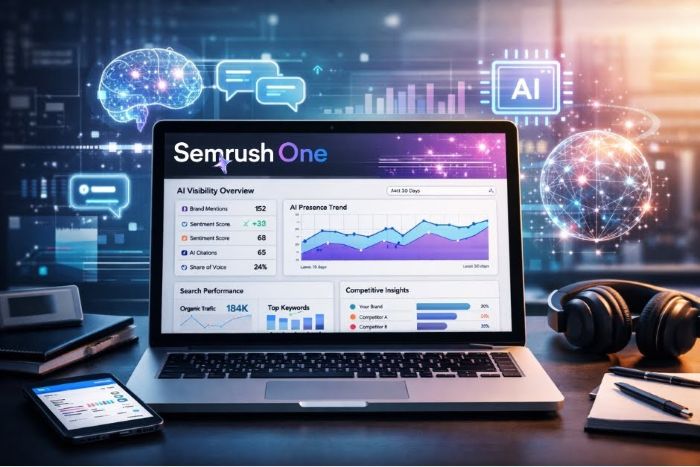
As discovery shifts from search results to AI-generated answers and recommendations, marketers looking to grow brand presence need new ways to measure where—and how—their brands appear. Platforms like Semrush One are emerging to help teams benchmark, track, and optimize visibility across both traditional search and AI-driven environments, ensuring brands remain discoverable as digital behavior evolves.
Key Takeaways
- As discovery shifts to AI-driven recommendations, brands must adapt to remain visible in these new environments.
- Traditional metrics like clicks are less relevant; brands need to focus on presence attribution, including AI mentions and sentiment.
- The AI Visibility Toolkit in Semrush One quantifies brand appearances across AI platforms to guide marketing strategies.
- SEO fundamentals still matter, as strong content and structure help brands succeed in both search and AI contexts.
- Unified measurement within Semrush One connects SEO, content, and AI metrics, offering marketers a comprehensive view of performance.
Table of contents
- Future-Proof Your Brand Visibility Across Search and AI Platforms
- Agentic Commerce Is Changing How People Discover Products
- The Real Problem: Brand Presence Without Measurement
- From Traffic Attribution to Brand Presence Attribution
- Measuring What Matters with the AI Visibility Toolkit
- Why Unified Measurement Is the Strategic Advantage
- Prepare Your Brand for the Next Era of Discovery
Agentic Commerce Is Changing How People Discover Products
OpenAI’s recent advances in native commerce capabilities, including agentic workflows and structured commerce protocols, mark a turning point in digital discovery. Instead of scrolling through search results or marketplace listings, users increasingly rely on AI systems to surface recommendations, compare options, and even complete purchases on their behalf.
This shift has triggered a broader conversation across the marketing industry: if AI agents are making decisions for users, how does brand presence grow inside those decision loops?
Unlike traditional search, where rankings and clicks were the primary success metrics, agentic systems prioritize credibility, relevance, and contextual authority. Brands are no longer competing solely for top positions—they are competing to be cited, referenced, and recommended by AI.
The Real Problem: Brand Presence Without Measurement
As AI platforms like ChatGPT, Perplexity, Claude, and Gemini become central to discovery, a major gap has emerged: marketers lack visibility into how their brands perform inside these systems.
Three critical pain points are driving concern:
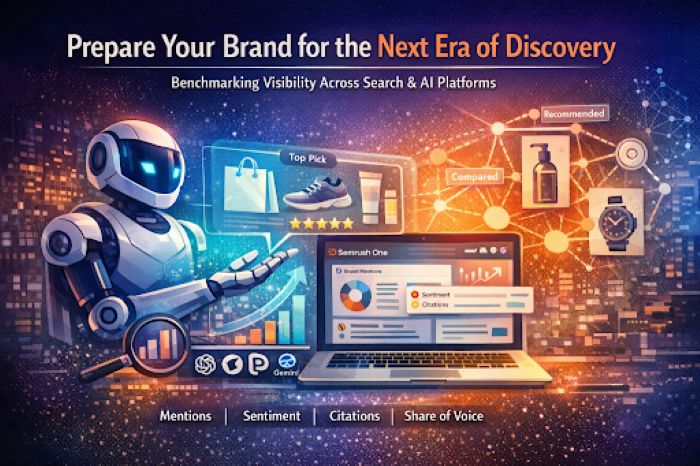
First, there is no clear way to measure brand presence within AI-generated responses. Teams cannot easily track how often a brand is mentioned, whether it appears favorably, or which competitors are being surfaced alongside it.
Second, confusion around Generative Engine Optimization has created strategic paralysis. Many practitioners are unsure whether GEO represents an entirely new discipline or simply SEO principles applied to AI-native environments. Without data, the debate feels theoretical—and often skeptical.
Third, traditional attribution models are breaking down. As AI platforms answer questions directly, click-through rates decline and traffic-based metrics lose relevance. Visibility still matters, but it no longer guarantees a visit to your website.
Together, these challenges create what many marketers feel today: visibility fragmentation anxiety.
From Traffic Attribution to Brand Presence Attribution
In an AI-driven discovery landscape, success is no longer defined solely by traffic. Instead, new indicators matter:
- Brand mentions inside AI answers
- Sentiment associated with those mentions
- Citation frequency and competitive share-of-voice
- Topic-level associations that shape AI recommendations
These metrics represent presence attribution—evidence that your brand exists inside AI’s reasoning process, even when users never click a link.
However, traditional analytics and SEO tools were never designed to capture this layer of visibility.
Measuring What Matters with the AI Visibility Toolkit
This is where the AI Visibility Toolkit within Semrush One becomes essential. It directly addresses the lack of empirical data inside AI platforms by quantifying how brands appear across large language models.
Rather than guessing whether GEO efforts are working, teams can see real signals: where their brand is mentioned, how it compares to competitors, and which topics drive AI citations. This transforms GEO from a buzzword into a measurable extension of existing SEO strategy.
Importantly, this approach reframes the SEO versus GEO debate. AI optimization does not replace SEO fundamentals—it builds on them. Authority, relevance, freshness, and semantic depth still matter. The difference is how those signals are retrieved and expressed by probabilistic AI systems.
Why SEO Fundamentals Still Power AI Discovery
Despite the changing interfaces, AI platforms continue to reward strong content foundations. Semantic coverage, topical authority, and structured clarity remain essential for both search engines and generative models.
Within Semrush One, supporting toolkits reinforce this connection. Keyword intelligence surfaces long-tail, conversational queries aligned with how users prompt AI systems. Content frameworks translate SERP data into structured briefs that increase the likelihood of AI citation. Together, these capabilities ensure brands are not optimizing in silos.
The result is a unified workflow where traditional SEO and AI visibility operate together to increase brand presence rather than competing for budget or attention.
Why Unified Measurement Is the Strategic Advantage
What differentiates Semrush One is integration. Instead of managing fragmented tools for SEO, content, competitive analysis, and AI measurement, teams gain a single workspace for end-to-end visibility growth.
By connecting keyword data, content optimization, competitor insights, and AI-native metrics, Semrush One enables marketers to benchmark performance across every discovery surface that matters today and tomorrow.
In an environment where the most valuable shelf space exists inside AI recommendations rather than search results pages, unified measurement is no longer optional.
Prepare Your Brand for the Next Era of Discovery
Agentic shopping and AI-driven answers are not future concepts. They are already reshaping how people discover, evaluate, and choose brands. The question is no longer whether brand presence and visibility have changed, but whether you can measure and influence it.
Explore how Semrush One helps you benchmark brand presence across search and AI platforms, track sentiment and citations inside LLMs, and future-proof your visibility in an agent-driven economy.