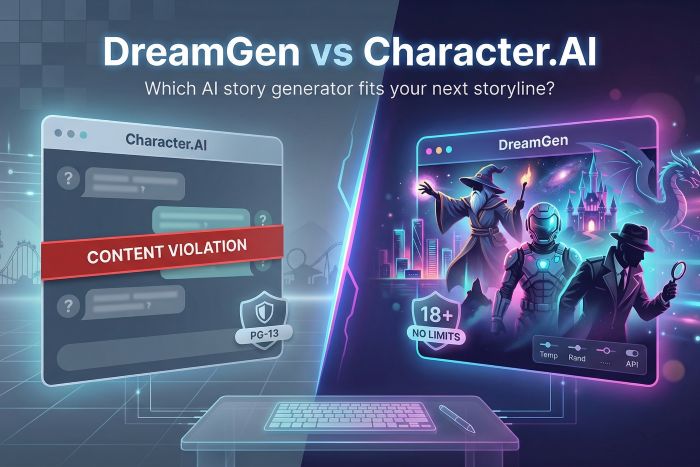
Ever had Character.AI end a scene with a sudden “content violation” block? You’re not alone. Writers who hit that PG-13 wall often jump to DreamGen, a story generator platform built around deep scenario customization, multi-character worlds, and full creative control. But freedom is only one of seven factors: memory span, multi-character play, pricing and community size also shape how far your story can run.
We tested both platforms, read dozens of user threads and traced recent changelogs to give you a crisp, side-by-side verdict. In the next few minutes, you’ll see exactly where DreamGen or Character.AI wins so you can choose the best stage for your next storyline.
Key Takeaways
- Character.AI has strict PG-13 content filters, while DreamGen offers full creative control without interruptions.
- DreamGen supports multi-character scenarios and stores up to 30,000 tokens of context, enhancing long-form storytelling.
- Character.AI boasts a vast library of user-created bots, whereas DreamGen focuses on curated, quality-driven content.
- DreamGen provides extensive customization options and an API, while Character.AI keeps features simple with limited controls.
- Choose Character.AI for quick, free-form conversations, but opt for DreamGen if you need depth and control in long narratives.
Table of contents
- At a Glance: DreamGen vs Character.AI
- 1. Creative Control and Content Approach
- 2. Solo Chat or Living World
- 3. How Much Story Can Each AI Remember?
- 4. Personality, Voice and Staying in Character
- 5. Dials, Switches and APIs That Let You Tinker
- 6. Size of the Sandbox: Community and Ready-Made Content
- 7. What Will This Adventure Cost?
- So, Which Platform Deserves Your Pen
- Quick FAQ
At a Glance: DreamGen vs Character.AI
Need the big picture fast? Scan the grid below to see how the two story generator platforms stack up on the questions writers ask first.
| Feature | DreamGen | Character.AI |
| Content policy | Full creative control, no filter interruptions | PG-13 filter blocks explicit themes |
| Multi-character play | Yes—worlds with many NPCs | Mostly one-on-one; “Scenes” beta for groups |
| Memory window | Up to 30 k tokens on Pro plan | Roughly a few thousand tokens, then summaries |
| Community library | Small but curated | Millions of user-made characters |
| API & tweaking | Full model controls, paid API | No public API, limited settings |
| Premium price | Three tiers, top at ≈ $48/mo | Single Plus plan at $9.99/mo |
Keep this snapshot handy. In the next sections, we’ll explain why each line matters when your plot twists, steamy scenes or epic battles hit the screen.
1. Creative Control and Content Approach
Ask any role-player what kills momentum fastest and you will hear the same answer: the filter.
Character.AI keeps chats firmly at PG-13. Its safety team reviews every message, and content that turns explicit triggers a “content violation” block. Even after a 2025 pledge to soften moderation, the company still promotes a wholesome environment, with stricter safeguards for minors and lawsuits nudging it toward tighter control, according to a 2025 update roundup from TS2 Tech.
The DreamGen official site takes a different approach. The platform gives writers full creative control over their scenarios, and in our testing, we did not encounter filter-related interruptions. Whether the scene calls for a brutal sword fight, a slow-burn romance, or a morally ambiguous villain monologue, DreamGen lets the story flow without unexpected blocks.
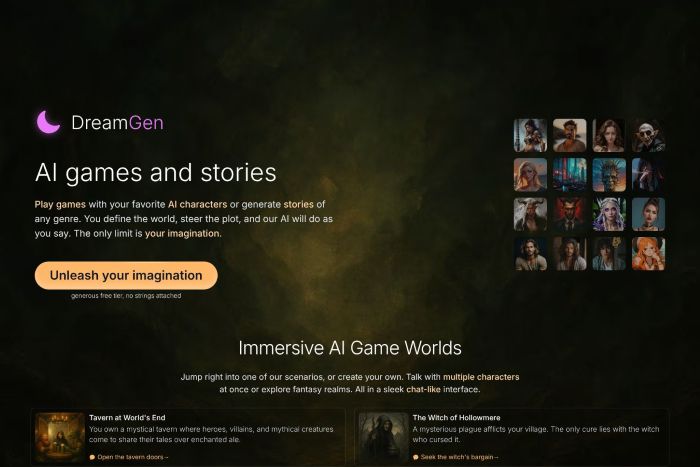
DreamGen Official Site Screenshot
For you, that means scenes stay intact on DreamGen. Character.AI will fade to black or refuse, breaking immersion and forcing work-arounds.
That single rule shapes migration patterns, community tone and the types of stories that flourish. Many writers start on Character.AI, hit the wall, then open DreamGen where they get full creative control over their narratives.
Need a safe, family-friendly space? Choose Character.AI. Want full creative control? Pick DreamGen.
2. Solo Chat or Living World
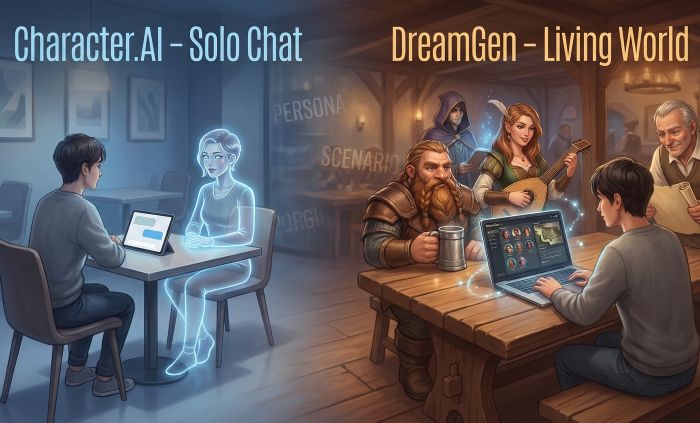
Character.AI feels like speed-dating with fictional personas. You select one of its more than 18 million user-made characters, say hello and the two of you riff back and forth in a single chat bubble. The model focuses on that lone voice, so dialogue often sparkles with personality. Scenes exist, yet the company (not you) controls any extra bots.
DreamGen plays more like a tabletop RPG. Open the Scenario Wizard, add several non-player characters, locations or magical items and watch the AI handle them all in one continuous thread. Picture a tavern where the dwarf orders ale, the bard tunes a lute and the innkeeper whispers a quest hook. The payoff is deep immersion without manual juggling.
What many writers overlook is DreamGen’s message control. You can edit, delete, or add any message in the conversation, including messages from other characters and the narrator. Most platforms lock you out of NPC responses once they’re generated.
DreamGen also offers a dedicated story-writing mode in its story generator with a text editor interface, separate from its chat-based role-play. Novelists who prefer writing to chatting get a workspace that matches their process.
There is a trade-off. Character.AI’s huge library offers instant variety; someone has probably built the exact anime hero or celebrity you want to banter with. DreamGen’s smaller community means you draft personalities first, but once they exist, you can steer the whole cast instead of squeezing your plot into a single character.
Choose Character.AI for quick one-on-one banter with a familiar face. Pick DreamGen when you want a full world to answer back.
3. How Much Story Can Each AI Remember?
Long plots fall apart when the AI forgets early chapters.
Character.AI starts slipping after a few thousand tokens; veteran users peg the ceiling near 3 000–4 000. Side plots vanish, and the bot repeats safe filler. The 2025 “Chat Memories” update pins a handful of facts, yet anything beyond that brief summary still drifts.
DreamGen’s Pro tier stores up to 30 000 tokens of context (about 22,500 words, enough for a short novel). Even the free tier provides 5,000 tokens of context and about 2,000 messages per month with daily credit refills, which matches or beats Character.AI’s range. Higher tiers extend the window six-fold.

In practice, you can weave multi-chapter arcs without constant recaps. A joke from page one still lands on page fifty; a prophecy whispered early returns during the final clash. Less babysitting, more writing.
If you craft sprawling plots, DreamGen’s memory keeps continuity tight. For brief banter, Character.AI is fine, but marathon storytellers soon outgrow it.
4. Personality, Voice and Staying in Character
Character.AI greets you like an actor who already knows the script. Fine-tuning on dialogue data gives each persona a lively, theatrical edge. You might feel Sherlock sizing you up or a K-pop idol dropping fan-service slang, all without extra setup. That instant polish helps the service attract tens of millions of monthly users, filter walls aside.
DreamGen writes like a seasoned ghost writer. You set tone, quirks and verbal tics with the story generator, then the model follows your brief. With full creative control over the scene, it keeps pace through dark turns or emotionally charged exchanges. The upfront cost is a minute of character sketching, but the reward is control: no sudden blocks, no forced topic changes.
Consistency matters. Character.AI holds its style in short chats, yet once context spills past its smaller memory, even sharp personas drift into generic talk. DreamGen’s wider context window preserves voice across chapters, so your gruff dwarf never slips into valley-girl slang in the final act.
Bottom line: choose Character.AI for quick, drop-in role-play with a ready-made script. Pick DreamGen when you prefer to direct the performance and keep every line on theme from prologue to epilogue.
5. Dials, Switches and APIs That Let You Tinker
Writers enjoy fine-tuning. We adjust temperature for lyrical flair, raise top-p for wild ideas and lock key backstory so it never fades.
DreamGen gives you every control. A settings panel exposes temperature, nucleus sampling, repetition penalties and stop sequences. You can save presets per scenario and call them through a paid API to power Discord bots, game mods or personal writing apps. The same panel also adds image generation so you can illustrate a scene without leaving the page.
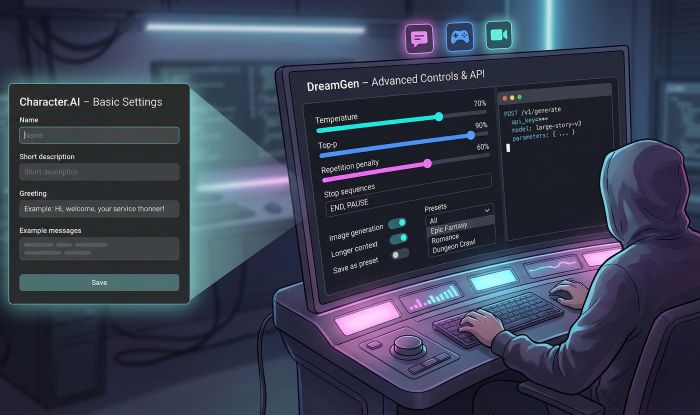
Character.AI sticks to the basics. When you build a bot, you supply a short description, a greeting and a few example messages. No slider changes model behavior, and there is no official API to lift your favorite persona into other software. If the filter clips a line, you rephrase and hope.
Power users notice the gap quickly. In DreamGen you can crank randomness for brainstorming, then lower it for tight edits. In Character.AI you accept the default style and work around its guardrails.
Want to plug an AI bard into a D&D stream or script a custom novel-writing workflow? DreamGen rewards the tinkerer. Prefer to chat and let someone else handle the wiring? Character.AI keeps life simple.
6. Size of the Sandbox: Community and Ready-Made Content
Character.AI is a vast library. With more than 18 million user-made bots, you can chat with a Roman general, a Pixar princess or even a toaster that speaks only in haiku, no prompt-crafting required. Trending feeds and Reddit fan hubs keep fresh personalities rotating daily with the story generator.
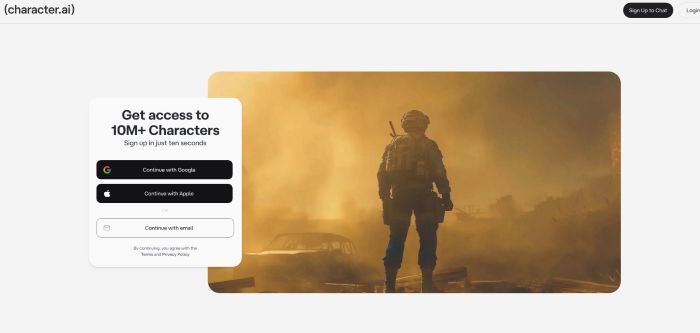
Character.AI User-Made Bots Library Homepage Screenshot
DreamGen’s shelves are lighter. The platform launched later and vets each scenario for quality, so you will not wade through duplicate or meme bots. Instead, it ships a starter pack of curated worlds such as “Neon-punk Night Market” or “Dragon Academy Dorm,” and invites you to publish your own. The Discord stays active, but you join as a builder, not just a browser.
Quantity versus curation sets the mood. Character.AI offers instant variety with uneven quality; beside every inspired role-player sits a five-line joke bot. DreamGen swaps abundance for depth, asking you to craft settings that match your exact taste.
Prefer browsing a ready spread? Character.AI is the obvious pick. Enjoy authorship and a focused community? DreamGen feels like home.
7. What Will This Adventure Cost?
Both platforms let you start free, but long sessions can add up.
Character.AI keeps pricing simple. Stay on the free tier and you face slower queues plus a daily cap of about one hundred messages. Pay $9.99 per month for c.ai Plus and the cap disappears, replies speed up and you get early access to new features. One tier, one price.
DreamGen uses a ladder. Casual writers stay on the free tier with a smaller model and modest daily credits. Heavy users step up to Starter (≈ $8), Advanced (≈ $19) or Pro (≈ $48) plans. Each level unlocks larger models, longer memory and API calls; the Pro tier offers the 30 000-token window covered earlier.

| Plan | DreamGen | Character.AI |
| Free | Full creative control, limited credits | Filtered, slower, ≈ 100 msgs/day |
| Mid-tier | $8–$19/mo, bigger models | N/A |
| Premium | $48/mo, 30 k tokens + API | $9.99/mo unlimited chats |
Value depends on your habits. If you blaze through thousands of filtered messages daily, Character.AI Plus is cheaper. If you need long-form prose with full creative control, export and API hooks, DreamGen Pro pays off.
Think about your writing pace, how explicit your scenes get and whether automation matters. Then choose the pass that fits your story generator budget while keeping creativity flowing.
So, Which Platform Deserves Your Pen
| Category | Edge |
| Creative freedom | DreamGen — full creative control, no interruptions |
| Community size | Character.AI — millions of bots |
| Long-form memory | DreamGen — 30 000-token window |
| Personality polish | Character.AI — instant lively banter |
| Custom controls | DreamGen — full settings and API |
| Price for heavy use | Character.AI — unlimited chats for $9.99 |
If you want fast PG-13 chats with endless characters, Character.AI feels like a theme park.
If you write long-form stories and enjoy fine-tuning your tools, DreamGen fits like a tailored quill. Its scenario codex, multi-character support, and 30,000-token memory give you the depth to craft sprawling narratives. Many storytellers use both platforms, opening Character.AI for quick inspiration from a story generator, then switching to DreamGen for the chapters that need full creative control.
Quick FAQ
Is DreamGen free to try?
Yes. You can sign up, create a scenario with the story generator, and test the base model without a credit card. Heavy users upgrade only when they need longer context windows or API access.
Did Character.AI ever drop its NSFW filter?
No. Despite petitions and rumors, the platform still blocks explicit sexual or violent content. Builders must keep bots safely PG-13.
What model powers each service?
Character.AI runs a proprietary large-language model tuned for dialogue. DreamGen fine-tunes open-source models and lets you choose larger variants as you climb tiers.
Can I move a Character.AI bot to DreamGen?
Not directly. Copy the character description and sample lines into DreamGen’s Scenario Wizard, then adjust personality sliders until it feels right.
How private are my chats?
Character.AI may review conversations to improve safety and its model. DreamGen promotes privacy as a key feature, though any cloud service keeps some logs. Share sensitive details with care on both platforms.