
For most teams, adopting AI is pretty straightforward. Someone picks a model, integrates it into a workflow, and everything runs through that single system, writing, research, summaries, brainstorming, and analysis. One model becomes the default for all of it.
At first, this feels efficient. There is one tool to learn, one bill to pay, one standard to follow. Over time, however, cracks start to show. Outputs vary wildly by task. Costs rise in places they should not. Teams spend more time correcting AI output than benefiting from it.
This pattern mirrors what McKinsey describes, where widespread adoption has not translated into consistent value. The firms seeing real returns are not using AI generically, but deploying it in task-specific, workflow-aligned ways, rather than relying on a single system to handle everything.
The risk is not that a specific model is bad. The risk is assuming any single model can be good at everything. As AI use matures inside organizations, the conversation is quietly shifting. The question is no longer which model is best. It is whether relying on a single model at all still makes sense.
Table of contents
- AI Models Are Built for Tradeoffs, Not Perfection
- The Hidden Cost of Single-Model Dependency
- How High-Performing Teams Are Actually Using AI Today
- Why AI Search Is Replacing Early-Stage Research
- The Role of Paraphrasing Tools in Modern Workflows
- From “Best Model” to “Best Workflow”
- What This Means for Leaders and Decision Makers
- Why Flexibility Matters More Than Loyalty to Any AI Model
- How Multi-Model Thinking Reduces Operational Risk
- What the Future of AI Workflows Is Likely to Look Like
- The Strategic Takeaway for Modern Teams
- Conclusion
AI Models Are Built for Tradeoffs, Not Perfection
Every major AI model is trained with a set of priorities. Some are optimized for reasoning depth. Others are tuned for speed and cost efficiency. Some perform better at structured analysis, while others shine at natural language writing or summarization. This is not a flaw. It is how machine learning systems work.
When teams treat AI like a universal tool, they ignore these tradeoffs. The same model is asked to draft marketing copy, analyze technical documentation, summarize research, and answer nuanced questions. The result is inconsistent quality that feels unpredictable, even when the underlying system is behaving exactly as designed.
In practice, this shows up as subtle friction. Writers complain that outputs feel flat. Analysts notice that summaries miss essential nuance. Researchers double-check everything because they no longer trust first-pass answers. None of these issues is catastrophic on its own, but together they erode confidence in AI as a reliable layer.
The core issue is not model performance. There is a mismatch between the task and the capability.
The Hidden Cost of Single-Model Dependency
Single-model dependency creates costs that rarely appear on a pricing page. One cost is overuse. Teams end up running expensive models for simple tasks that do not require advanced reasoning. Another is underperformance. Complex tasks are pushed through models that were not optimized for depth or accuracy, leading to rework and manual correction.
There is also an organizational cost. When everyone relies on the same model, its limitations become normalized. Teams stop asking whether a task could be done better. They adapt their expectations downward instead of adjusting the system. Over time, this creates a strange outcome. AI adoption increases, but actual productivity gains flatten. Leaders see more usage, not more leverage.
This is where risk quietly enters the picture. When decision-making, research, and communication all depend on a single system, any weakness in that system is amplified throughout the organization.
How High-Performing Teams Are Actually Using AI Today
The most mature teams are no longer asking whether AI chat is useful. That question was answered a while ago. What they are debating now is how different AI capabilities fit into their workflow. In practice, this means separating tasks instead of forcing everything through a single interface.
For example, AI chat is often used for thinking out loud. Teams use it to explore ideas, challenge assumptions, and refine rough thinking. It becomes a conversational space where questions evolve as answers come back.
This is where the question of AI behavior comes into play. The ability to ask follow-up questions, reframe problems, and dig deeper without starting over is what makes AI chat genuinely helpful.
But that same interface is not always ideal for research-heavy tasks.
When teams need to validate facts, compare viewpoints, or quickly understand unfamiliar topics, they increasingly turn to an AI search engine rather than traditional search. The reason is simple. An AI search engine reduces the effort of discovery. It summarizes information, surfaces context, and lets users question the answer directly, rather than having to open 10 different pages.
These are two different needs. Treating them as the same problem is where single-model workflows start to break.
Why AI Search Is Replacing Early-Stage Research
Traditional search engines are optimized for navigation. They are excellent at pointing users to sources. They are less effective at helping users quickly understand those sources.
An AI search engine flips that model. It is optimized for comprehension first and navigation second. Users ask a question, receive a synthesized response, and then decide whether deeper reading is necessary.
This is why AI search has become a default starting point for many teams. It lowers the cost of getting oriented. Instead of spending time filtering irrelevant pages, users can ask direct questions, clarify assumptions, and move forward with more confidence.
This shift matters because it changes how teams evaluate AI tools. The value is no longer measured by how many links are returned, but by how quickly someone can move from confusion to clarity.
For organizations still relying on a single AI model for both conversation and research, this creates friction. The tool may be good at answering questions, but poor at grounding those answers in a verifiable context. Or it may retrieve information well but struggle to explain it clearly.
High-performing teams recognize this gap and design around it.
The Role of Paraphrasing Tools in Modern Workflows
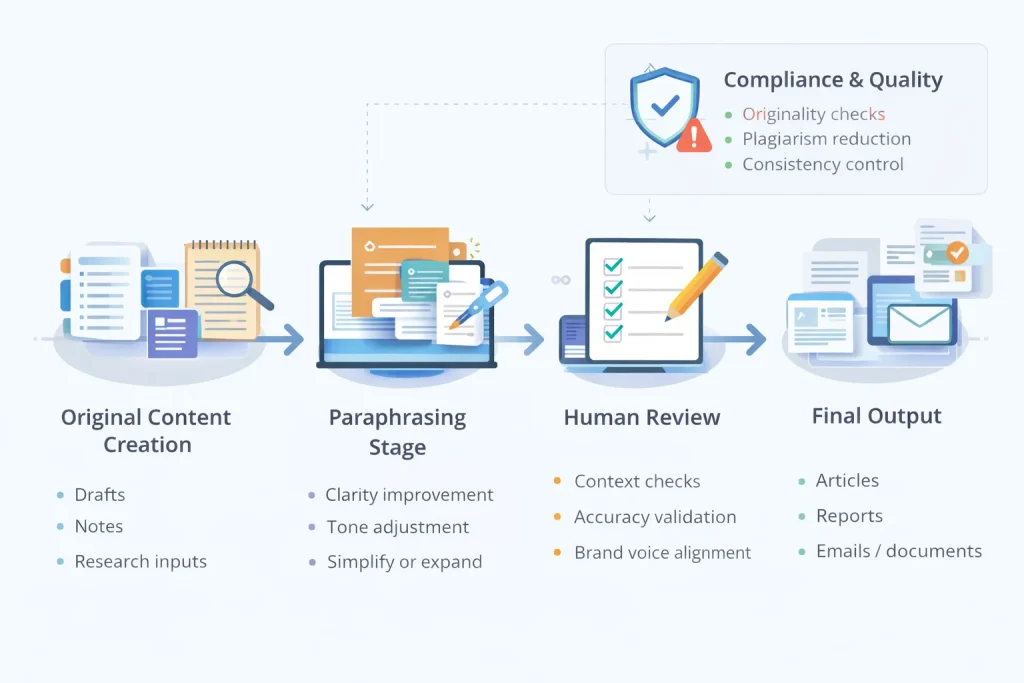
Another overlooked area is how teams handle rewriting and refinement.
Paraphrasing tools are not about changing words for the sake of it. They are used to adapt tone, simplify language, and reframe ideas for different audiences. This is especially important in marketing, documentation, and internal communication.
In a single-model setup, paraphrasing often feels inconsistent. The same request produces wildly different results depending on phrasing and context. Teams compensate by editing manually, which defeats the point of automation.
When paraphrasing is treated as a distinct task, teams can choose tools or models that are optimized for clarity and consistency rather than raw creativity. This leads to cleaner output and less rework.
Again, the pattern is the same. Different tasks benefit from various strengths. Forcing everything through a single system increases cognitive load rather than reducing it.
From “Best Model” to “Best Workflow”
This is where the conversation shifts.
The most effective teams are no longer debating which AI model is best in absolute terms. They are asking which combination of tools produces the best outcome for a given task.
- AI chat for exploration.
- AI search engine for research and validation.
- Question AI capabilities for iterative thinking.
- Paraphrasing tools for refinement and adaptation.
Each of these plays a specific role. Together, they form a workflow that feels intentional instead of accidental. The risk of single-model dependency becomes clear at this point. It locks teams into a one-size-fits-all approach in a world where AI capabilities are increasingly specialized. What once felt simple now becomes a constraint.
What This Means for Leaders and Decision Makers
For leaders, the implication is uncomfortable but necessary. Choosing an AI tool is no longer a one-time decision. It is an ongoing design problem.
The goal should not be standardization at the expense of effectiveness. It should be coherence. Teams need clarity around when to use AI chat, when to rely on an AI search engine, when to question AI outputs more aggressively, and when to use paraphrasing tools to finalize communication.
Organizations that get this right see AI as leverage. Those that do not slowly absorb its limitations into their processes. The difference is rarely visible on a dashboard. It shows up in speed, confidence, and the quality of decisions.
Why Flexibility Matters More Than Loyalty to Any AI Model
One of the quiet mistakes teams make with AI adoption is emotional commitment. A model works well early on, earns trust, and slowly becomes “the way things are done.” Over time, that loyalty turns into inertia.
This is dangerous because AI systems do not improve uniformly.
Some models get better at reasoning but are slower and more expensive. Others improve speed and cost efficiency but sacrifice depth. New releases shift tradeoffs rather than eliminating them. Locking an organization into a single model assumes that progress will always align with the team’s needs. That assumption rarely holds.
Flexibility, on the other hand, treats AI as an evolving layer. Teams that preserve flexibility can adapt without disruption. They switch models when quality drops. They reroute tasks when costs spike. They test alternatives without rewriting their entire workflow.
This is not about chasing the newest model. It is about avoiding single points of failure in thinking, research, and communication.
How Multi-Model Thinking Reduces Operational Risk
Operational risk in AI is rarely dramatic. It accumulates quietly.
It shows up when:
- Research summaries miss important context
- AI chat answers sound confident but are subtly wrong
- Paraphrasing tools introduce ambiguity instead of clarity
- Teams stop questioning outputs because “this is how the model behaves.”
Multi-model thinking reduces this risk by introducing comparison and friction in the right places.
When teams can ask the same question across different AI chat systems, inconsistencies become visible. When an AI search engine is used alongside conversational tools, factual grounding improves. When paraphrasing is handled by tools optimized for clarity rather than creativity, communication becomes more predictable.
This comparison layer acts as a safeguard. It prevents over-reliance on any single system and encourages healthier skepticism.
Significantly, this does not slow teams down. It often speeds them up. Errors are caught earlier. Confidence increases because outputs feel validated rather than assumed.
What the Future of AI Workflows Is Likely to Look Like
The future is not a single interface that does everything perfectly. It is a coordinated system that does different things well. AI chat will continue to dominate exploratory thinking. It is the fastest way to reason through ideas, ask follow-up questions, and pressure-test assumptions.
AI search engines will increasingly replace early-stage research. Instead of navigating links, teams will question AI directly, refine their understanding, and only dive deeper when necessary.
Question: AI behavior will become more intentional. Teams will learn how to interrogate answers, not just accept them. Asking better questions will matter more than prompting clever ones.
Paraphrasing tools will move from novelty to necessity. As organizations communicate with more audiences and across more formats, the ability to reframe ideas cleanly and consistently will be a core capability.
What ties all of this together is workflow design. The teams that win will not be the ones with the most advanced model, but the ones with the most thoughtful system.
The Strategic Takeaway for Modern Teams
Relying on a single AI model is not inherently wrong. It is simply no longer sufficient. As AI becomes embedded in research, communication, and decision-making, the cost of blind trust increases. So does the cost of inflexibility.
The more innovative approach is to treat AI like infrastructure, not software. Infrastructure is evaluated continuously. It is replaced when it no longer serves its purpose. It is designed with redundancy because failure is expected, not exceptional. Teams that adopt this mindset gain more than efficiency. They gain resilience.
Conclusion
The absolute risk of single-model dependency is not poor output. It is complacency.
When teams stop questioning AI because it feels familiar, quality stagnates. When workflows adapt to tool limitations instead of the other way around, productivity gains disappear. When flexibility is traded for convenience, organizations lose the ability to evolve.
The shift already underway is subtle but decisive. From choosing the best AI model to building the best AI workflow. From loyalty to flexibility. From convenience to clarity. The teams that recognize this early will not just use AI more. They will use it better.