Introduction: Why “Undetectable AI” Became a Serious Writing Topic
Let a reader know that AI-generated writing is everywhere now: in every classroom, on hundreds of thousands of blogs, and in your SEO content workflow. And AI detection isn’t only a school problem anymore. Search rankings, user trust, tone authenticity, and content credibility all depend on it, too. And we’re not even trying to “trick detectors” here. We’re trying to make machine text read like natural human prose, with all the rhythm and nuance our brains demand.
Then state the central question of this article:
What makes AI writing detectable, and how NLP-based humanizers can turn that writing into natural prose?
Table of Contents
- Introduction: Why “Undetectable AI” Became a Serious Writing Topic
- What makes AI writing detectable are the linguistic patterns humans overuse
- The Science Behind Human-Like Prose: What NLP Research Actually Shows
- Structural vs. Surface-Level Rewriting: Why Some Tools Work Better
- Gently introduce GPTHumanizer.ai as an example of the best:
- Comparison: Structural Rewriters vs. Basic Paraphrasers
- What Makes AI “Undetectable”? Breaking Down the Transformation Process
- Case Study: How AI Humanizer Enhances Real Text (Objective Discussion)
- Academic, SEO, and Blogging Use Cases: Why Naturalness Matters
- Tool Comparison: How Leading Humanizers Approach the Problem
- Conclusion: The Future of Human-Like AI Writing
What makes AI writing detectable are the linguistic patterns humans overuse
Discuss the core linguistic patterns that AI models tend to repeat. Instead of bullet points, explain them through short paragraphs:
- Repetitive sentence cadence: Large models will make sentences that are evenly paced and don’t surprise or get emotional.
- Predictable clause structure: Subordinate clauses tend to follow the same pattern, creating a uniform flow that only humans do on a sporadic basis.
- Low lexical volatility: AI writing will tend to pick statistically “safe” words, resulting in smooth text that feels a bit robotic.
- Over-clarity: Machines don’t like ambiguity, but humans do. So we will usually see small jumps in logic or stylistic “noise.”
- Also, introduce the detectors (GPTZero, Turnitin AI, Originality) and how they will read these signals in terms of perplexity and burstiness.
The Science Behind Human-Like Prose: What NLP Research Actually Shows
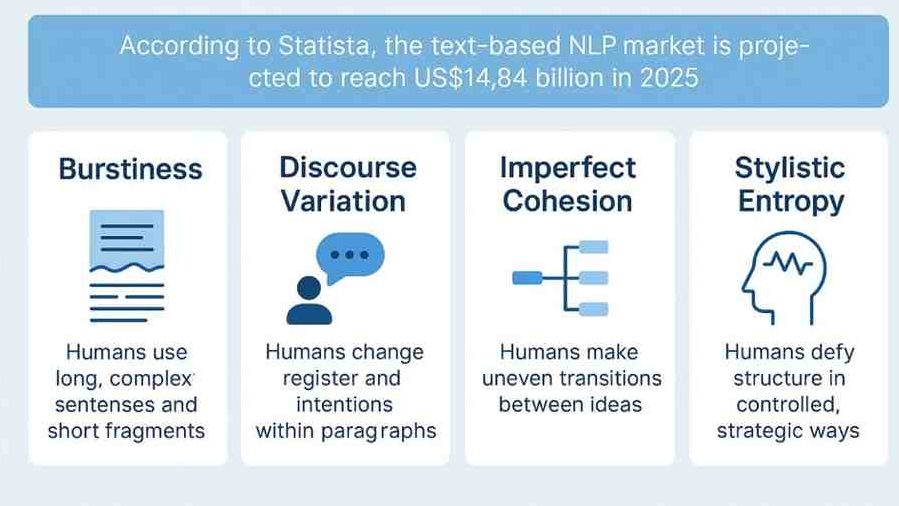
Explain what the scientific community understands human writing to be: variable, humans disrupt and defy structure, humans switch tone mid-sentence, and humans are non-linear thinkers. According to Statista, the text-based NLP market alone is projected to reach US$14.84 billion in 2025. The Americas NLP market is forecast to reach US$15.13 billion in the same year. This rapid expansion explains why AI-generated text is evolving so quickly and why understanding human-like prose has become essential in both academic and SEO environments.
Briefly discuss the key research ideas:
- Burstiness: humans do long, dense, convoluted sentences, and then very short fragments.
- Discourse variation: humans vary in register and intentions within paragraphs
- Imperfect cohesion: humans make imperfect transitions, while AI overuses transitions such as therefore, moreover, and in conclusion
- Stylistic entropy: humans have controlled, strategic unpredictability, which models struggle to emulate
Structural vs. Surface-Level Rewriting: Why Some Tools Work Better
Explain the difference between shallow paraphrasing and deep rewriting. Explain why a mere synonym swap is not enough to beat detectability. Briefly discuss why surface changes don’t change the structural traits the detectors pick up on.
Gently introduce GPTHumanizer.ai as an example of the best:
Some humanizer tools, such as GPTHumanizer AI, don’t substitute nouns or adjectives; instead, they rewrite sentence structure by rearranging clauses and altering rhythm. This more closely mimics human sentence architecture and is therefore more robust in scenarios where detectability is essential, i.e., for a draft for scholarly publication or for an SEO article that must pass as human.
Comparison: Structural Rewriters vs. Basic Paraphrasers
Insert a table to show conceptual differences without marketing language:
| Feature / Method | Basic Paraphrasers | GPTHumanizer AI |
|---|---|---|
| Rewrite Depth | Low mostly synonyms | Medium–High alters structure, rhythm, and pacing |
| Semantic Preservation | Medium | High |
| Variation in Rhythm | Low | High |
| Detector-Resistance | Low | Higher |
| Suitable For | Quick edits | Academic drafts, SEO content, long-form writing |
What Makes AI “Undetectable”? Breaking Down the Transformation Process
Explain the general science of how humanization engines convert machine text:
Step 1: Pattern diagnosis
The system identifies high-perplexity and low-burstiness areas: overly uniform sentence length, repetitive clause openings, predictable adjectives, etc.
Step 2: Structural rearrangement
Humanizers modify hierarchy: swapping main/subordinate clauses, inverting leads, adding natural hesitation markers, and adjusting pacing.
Step 3: Rhythm realignment
Models inject variability, occasional short sentences, more natural transitions, and shifts in tone that humans typically make when changing emotional direction.
Step 4: Semantic preservation
The meaning remains unchanged, ensuring the writing stays academically or professionally accurate.
Case Study: How AI Humanizer Enhances Real Text (Objective Discussion)
Present a small original + rewritten example to illustrate scientific transformation—keep it neutral:
AI-like version:
“Artificial intelligence tools can help students write essays quickly. However, these tools often produce text that lacks emotional depth and natural rhythm, which can make the writing feel mechanical.”
GPTHumanizer’s version:
“AI tools make it easy for students to put an essay together in minutes, but the results rarely feel alive. The rhythm is usually too tidy, and the sentences land with the same predictable beat that signals machine involvement.”
The second sentence reads more human, thanks to AI Humanizer elements like irregular sentence length, tonal movement, figurative phrasing (‘feel alive’), and subtle rhythmic asymmetry.
Academic, SEO, and Blogging Use Cases: Why Naturalness Matters
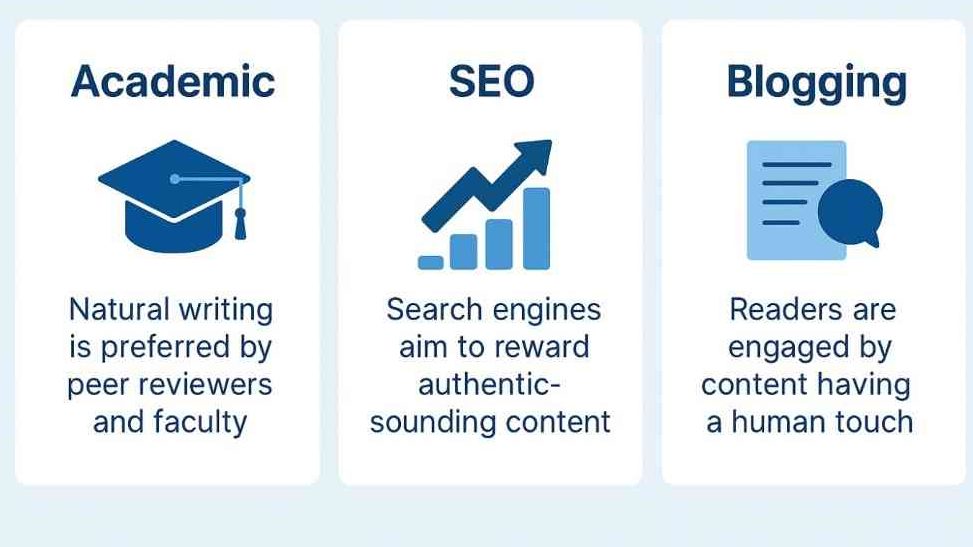
Natural prose is crucial in all three worlds: academic, SEO, and blogging, but its value comes from varied reasons.
Students benefit from natural prose because it facilitates a more effective presentation of an argument; it enhances the author’s credibility; it promotes a more natural authorial voice. All three of these are typically attributes that professors reward when assessing the clarity, logic, and originality of their students’ writing.
In SEO workflows, natural variation in sentence structure and tonality is also rewarded by Google’s E-E-A-T, which values experience-based, human-produced content. Text that reflects machine patterns quickly causes readers to lose interest, increasing bounce rates and shortening session duration.
Bloggers, too, depend on emotional arc, narrative pacing, and conversational rhythm to keep readers engaged. Storytelling-based prose must rely on fluctuations in energy and voice that AI-generated text does not provide, which is why humanized prose is critical to a sense of connection throughout long-form articles.
Tool Comparison: How Leading Humanizers Approach the Problem
| Model Type | Core Approach | Strengths | Limitations |
|---|---|---|---|
| Basic Paraphrasing Tools | Replace words/phrases | Fast, simple | Still detectable, low creativity |
| Hybrid Rewrite Tools | Mix synonyms + light structure shifts | Better readability | Not consistent on long text |
| GPTHumanizer AI | Reorder clauses, rebalance rhythm, add human-like variation | Natural voice, good semantic accuracy | Requires more compute, may alter tone |
| Manual Human Editing | Full stylistic control | Highest authenticity | Time-consuming |
Conclusion: The Future of Human-Like AI Writing
In the end, the quest for “undetectable” AI writing isn’t about avoiding detection, but about bridging the chasm between cold, mechanical text and the expressive, variable, emotional prose that humans naturally produce. The future of AI tools used to support academic work, SEO workflows, and everyday writing may shift from “fast and frugal” to “authentic, clear, and naturally rhythmic.” The best humanization techniques will be those that preserve meaning while tightening the structure, tone, and discourse flow of a given text in a more human-like fashion.
Examples of tools that attempt to model linguistic form beyond content, such as GPTHumanizer AI, show how deeper modeling can help machine-written text approach a more human form. Yet the responsibility of using these tools honestly and transparently will always lie with the author, not the technology.