
There’s a quiet frustration about landing their first remote role shared by a lot of early-career professionals right now.
They want a remote job — not because it’s trendy, but because it offers flexibility, focus, and access to companies far beyond their city limits. But once they start searching, reality sets in. Most remote listings are labeled “Senior.” Five years of experience. Proven remote track record. “Has done it before.”
For recent graduates, career switchers, or anyone hoping to land their first location-independent role, it can feel like hitting a wall.
“How can someone get remote experience,” Ethan says, “if no one is willing to give them their first remote role?”
That paradox — the remote Catch-22 — is real. And yet, every month, thousands of entry-level candidates do break through. The difference isn’t luck. And it’s rarely about blasting out hundreds of generic resumes.
According to Ethan and Eric, the real challenge isn’t skill. It’s trust.
Key Takeaways
- Early-career professionals face a remote trust gap, making it hard to land their first remote role.
- To improve chances, candidates should focus on entry-level positions instead of broadly applying to all remote jobs.
- Candidates must present their skills effectively, highlighting remote collaboration tools and demonstrating autonomy.
- Jobright’s Match Score helps applicants identify suitable roles and avoid rejection fatigue by targeting high-match opportunities.
- Building connections and preparing for remote interviews can significantly boost visibility and trust with hiring managers.
Table of contents
- The Real Barrier: The Remote “Trust Gap”
- Step 1: Stop Competing for Jobs You Were Never Meant to Win
- Step 2: Make Your Resume Sound Remote-Ready
- Step 3: Check Your “Winnability” Before You Apply for Your First Remote Role
- Step 4: Don’t Just Apply for Your First Remote Role — Find an Angle
- Step 5: Prepare for the Remote Interview Mindset
- Use the Tools, Closing the Gap
The Real Barrier: The Remote “Trust Gap”
When companies hire junior employees in an office, managers feel relatively safe. They can see someone sitting at their desk. If there’s confusion, they can step in quickly. Mentorship happens almost passively.
Remote work changes that dynamic.
“The biggest fear hiring managers don’t say out loud,” Eric explains, “is that they’ll assign a task to a junior employee in their first remote role and then hear nothing for three days. Remote removes visibility, and that makes people nervous.”
This is what Jobright internally calls the “Trust Gap.”
For entry-level candidates, proving technical ability isn’t enough. You also have to signal autonomy, visibility, and reliability — especially in asynchronous environments.
That’s where strategy matters.
Step 1: Stop Competing for Jobs You Were Never Meant to Win
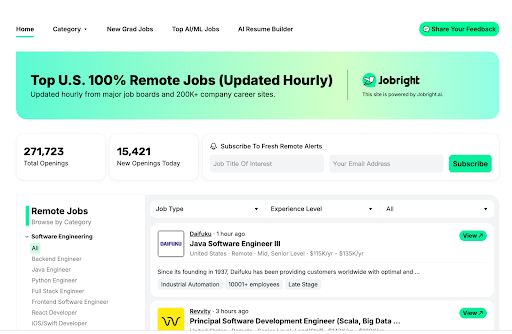
One of the most common mistakes junior applicants make is applying broadly to anything labeled “remote.” The demand for remote jobs is so high that the label alone can be misleading. The result is predictable: hundreds of applications, very few responses, and mounting frustration.
“The remote label attracts everyone,” Ethan says. “If you’re not filtering by experience level properly, you’re competing against candidates with eight or ten years in the field.”
Instead of manually scrolling through endless listings, Jobright encourages a more focused approach:
- Set your location filter to “Remote.”
- Narrow by “Entry Level” or “Associate.”
- Prioritize roles posted within the last 72 hours.
- Look for listings marked “Active” to avoid outdated or ghost jobs.
Speed matters in remote hiring. Because these roles attract large applicant pools quickly, being in the first batch of qualified candidates significantly improves visibility.
“We’ve seen that candidates who apply early to high-match roles get dramatically better outcomes for their first remote role,” Ethan says. “It’s not about volume. It’s about timing and fit.”
Step 2: Make Your Resume Sound Remote-Ready
A second barrier is presentation.
Many junior resumes unintentionally read like academic summaries — coursework, generic skills, broad descriptors like “hard worker” or “team player.” For remote hiring managers, those phrases raise concerns rather than confidence.
“When we look at remote junior resumes,” Eric says, “we’re not asking whether someone knows Microsoft Word. We’re asking: can this person manage tasks independently and communicate clearly without constant supervision?”
This is where language matters.
Using Jobright’s AI Resume Builder, candidates can upload their resume and target a specific job description. The system scans for missing keywords — particularly tools and behaviors associated with remote collaboration.
If the job description references tools like Slack, Jira, documentation practices, or asynchronous communication — and those terms are absent from your resume — the system flags it.
Even experience using Trello for a personal project or Discord in a community setting can signal remote fluency. What matters is demonstrating familiarity with digital workflows.
“You’re not pretending to be senior,” Ethan says. “You’re showing that you already operate comfortably in remote environments.”
Step 3: Check Your “Winnability” Before You Apply for Your First Remote Role
Rejection fatigue is real. And for early-career professionals, it can become discouraging fast.
To counter that, Jobright includes a Match Score system that compares a candidate’s profile against a specific job’s requirements before they apply.
- If the score is <60%: It often means a core hard skill is missing — something unlikely to be overlooked in a remote setting.
- If the score is >80%: That’s typically a strong fit.
“We saw in early testing that when candidates focused only on high-match roles, they landed nearly twice as many interviews,” Ethan says. “They also saved around 80 percent of the time they would normally spend applying.”
Rather than chasing aspirational roles labeled “Junior” but functionally senior, this data-driven approach helps narrow attention to realistic opportunities.
It shifts the search from emotional guessing to calculated targeting to your first remote role.
Step 4: Don’t Just Apply for Your First Remote Role — Find an Angle
For junior candidates, experience gaps can’t always be eliminated. But they can sometimes be offset.
A referral, even an informal one, can significantly increase application visibility. The challenge is that many early-career professionals don’t feel they have connections.
Jobright’s Insider Connections feature attempts to bridge that gap. When viewing a job listing, users can scroll to see alumni matches, former colleagues, or professionals with similar backgrounds at the company.
The platform surfaces LinkedIn profiles or relevant contact paths.
“You don’t need to ask for a referral immediately,” Eric notes. “Start by asking about their remote experience. People are often more willing to help than you think.”
Even a short conversation can turn a blind application into a warm introduction.
Step 5: Prepare for the Remote Interview Mindset
If you reach the interview stage, the evaluation shifts again.
Remote hiring managers often test autonomy explicitly. Behavioral questions are framed around time management, communication clarity, and independent problem solving.
Using Orion Copilot — Jobright’s AI career assistant — candidates can simulate these scenarios.
For example:
“I am interviewing for a Junior Remote Marketing role. Act as a skeptical hiring manager. Ask me three difficult questions about time management and asynchronous communication.”
The tool provides feedback and helps refine answers to emphasize outcomes rather than effort.
Instead of saying, “I work hard,” candidates can articulate systems:
- Time-blocking calendars
- End-of-day Slack updates
- Documentation habits
- Clear task ownership
“In remote environments, managers don’t measure hours,” Ethan says. “They measure clarity and output.”
Use the Tools, Closing the Gap
Landing your first remote role is harder than securing an in-office position. That reality hasn’t changed.
But the barrier isn’t invisibility — it’s uncertainty.
“Remote work isn’t about geography,” Eric says. “It’s about trust. Once you learn how to signal that trust clearly, the door opens much faster than people expect.”
By filtering strategically, aligning your resume with remote tools, focusing on high-match roles, and leveraging connection pathways, entry-level candidates can position themselves as remote-ready professionals — not risky hires.
The opportunity is there. But the approach has to be deliberate.
And increasingly, the candidates who succeed are the ones who treat job searching not as a numbers game — but as a targeted strategy.