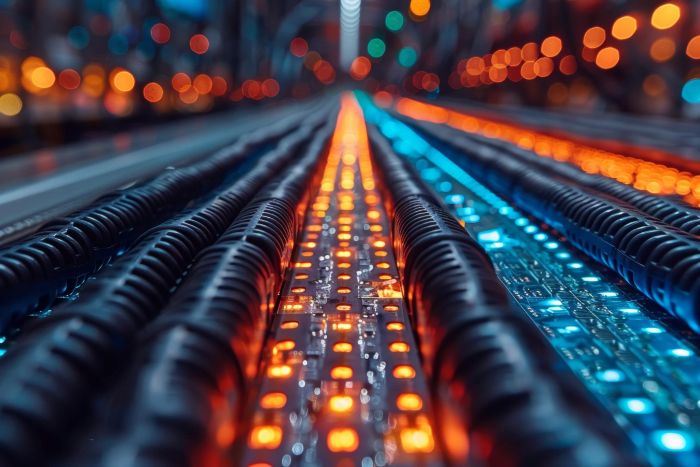
When people talk about artificial intelligence, the conversation usually revolves around algorithms, models, and cloud platforms. We hear about faster GPUs, larger language models, and smarter software stacks. Yet behind every AI system—no matter how advanced—there is a physical layer of fiber infrastructure that quietly determines whether those intelligent systems actually perform as expected.
AI runs on data. And data, in the real world, still runs on physical infrastructure.
From hyperscale data centers to distributed edge deployments, fiber optic networks remain the backbone that enables AI workloads to move massive volumes of data quickly, reliably, and with minimal latency. As AI systems grow in scale and complexity, the importance of this underlying physical layer is becoming harder to ignore.
Key Takeaways
- AI systems rely on massive data movement, and fiber optic infrastructure remains the physical foundation that enables high-speed, low-latency AI workloads.
- While AI is often discussed in terms of software and cloud platforms, physical-layer reliability plays a critical role in real-world performance and scalability.
- Human error at the infrastructure level—such as misidentifying fiber connections—can create significant operational risks in large-scale AI deployments.
- Fiber identification methods, including color coding, help manage complexity but also reveal limitations as networks grow denser and more diverse.
- AI and computer vision technologies are increasingly being applied to physical fiber infrastructure to reduce errors, improve deployment efficiency, and support smarter operations.
- Even in an AI-driven world, standardized systems and manufacturing experience remain essential for building reliable and intelligent infrastructure.
Table of contents
- Key Takeaways
- AI Runs on Data — and Data Runs on Fiber Infrastructure
- From Cloud Abstractions to Physical Fiber Infrastructure
- Where Human Error Still Exists in AI Infrastructure
- A Small Detail with Big Impact: Fiber Identification in Large-Scale AI Networks
- How AI and Computer Vision Are Reducing Physical-Layer Errors
- Why Standards Still Matter in an AI-Driven World
- From Manufacturing Experience to Intelligent Infrastructure
- Looking Ahead: AI Is More Than Software
AI Runs on Data — and Data Runs on Fiber Infrastructure
Modern AI workloads are fundamentally different from traditional enterprise applications. Training large models and operating real-time inference systems require continuous, high-speed data exchange between servers, storage systems, and distributed computing nodes.
This is why fiber optics continue to dominate AI networking environments. Compared to copper-based alternatives, fiber provides higher bandwidth, lower signal loss over distance, and better resistance to electromagnetic interference. These advantages are no longer “nice to have”—they are essential.
Inside AI data centers, fiber infrastructure supports:
- High-throughput east–west traffic between compute nodes
- Low-latency connections for distributed training
- Scalable architectures that can grow without redesigning the entire network
In short, while AI may feel abstract and software-driven, its performance is deeply rooted in physical connectivity.
From Cloud Abstractions to Physical Fiber Infrastructure
Much of today’s AI discussion focuses on abstraction layers: cloud services, APIs, orchestration tools, and automated pipelines. These abstractions are powerful, but they can also obscure what is happening underneath.
In reality, every AI deployment still involves physical activities:
- Installing and expanding data center capacity
- Managing thousands of physical ports and connections
- Performing maintenance, upgrades, and troubleshooting
At this level, human interaction is unavoidable. Engineers plug cables, label ports, and verify connections. And it is precisely here—at the boundary between digital intelligence and physical execution—that errors tend to occur.
Where Human Error Still Exists in AI Infrastructure
Despite increasing automation, physical-layer tasks remain one of the most common sources of operational risk in large-scale AI environments. A single mistake—such as connecting the wrong cable or misidentifying a port—can lead to degraded performance, unexpected downtime, or time-consuming rework.
As AI systems scale, these risks grow exponentially:
- More fibers, more ports, more opportunities for confusion
- Faster deployment schedules with less margin for error
- Mixed environments with equipment from multiple vendors
Even experienced technicians can struggle when operating under tight timelines or suboptimal conditions. This reality has made physical-layer reliability an increasingly important topic in AI infrastructure planning.
A Small Detail with Big Impact: Fiber Identification in Large-Scale AI Networks
One often-overlooked challenge in fiber-based networks is identification. Fiber infrastructure systems rely heavily on visual cues—especially color—to distinguish between fiber types, connector interfaces, and signal paths.
Color coding is used to help technicians quickly identify:
- Single-mode versus multimode fibers
- Connector polishing types (such as UPC and APC)
- High-density multi-fiber assemblies in data center environments
However, as AI networks become denser, color-based identification also reveals its limitations. Similar hues can represent different fiber categories, color interpretations may vary between manufacturers, and environmental factors such as lighting or dust can affect visibility.
In large-scale deployments, these small ambiguities can translate into real operational risks. Misidentification at the physical layer can delay deployments or compromise network integrity—outcomes that are especially costly in AI-driven environments.
For readers interested in understanding how fiber optic color-coding works in practice, including industry standards and common pitfalls, this guide offers a clear overview of fiber optic color identification systems.
How AI and Computer Vision Are Reducing Physical-Layer Errors
Interestingly, AI itself is beginning to play a role in addressing these physical-layer challenges.
Beyond analytics and content generation, AI—particularly computer vision—is being applied to infrastructure management. In data centers and manufacturing environments, vision-based systems can assist with tasks such as:
- Verifying cable types and connector interfaces
- Detecting incorrect connections before systems go live
- Supporting guided installation and maintenance workflows
By augmenting human operators with visual recognition and automated checks, AI helps reduce reliance on memory, experience, or manual verification. The result is fewer errors, faster deployment, and more predictable infrastructure performance.
This shift reflects a broader trend: AI is no longer confined to virtual environments. It is increasingly embedded into the physical systems that support digital intelligence.
Why Standards Still Matter in an AI-Driven World
While AI can enhance physical-layer operations, it does not replace the need for clear standards. In fact, standardized systems become even more important when automation and machine recognition are involved.
Consistent definitions—whether for fiber types, connector interfaces, or color coding—provide the structured information that intelligent systems depend on. Without standardization, even the most advanced AI tools struggle to deliver reliable results.
In fiber infrastructure, color coding and interface conventions act as a shared language between humans, machines, and systems. As AI adoption accelerates, maintaining these standards becomes a foundational requirement rather than a legacy concern.
From Manufacturing Experience to Intelligent Infrastructure
The evolution of AI infrastructure is not happening in isolation. It builds upon decades of experience in manufacturing, deployment, and real-world network operation.
Organizations with long-standing expertise in fiber connectivity understand that intelligence at scale requires more than speed and bandwidth. It requires consistency, reliability, and an appreciation for how systems are actually installed and maintained.
As AI continues to reshape industries, fiber connectivity solutions developed with real-world deployment in mind will remain an essential part of the ecosystem—bridging the gap between digital intelligence and physical reality.
Looking Ahead: AI Is More Than Software
The future of AI will undoubtedly bring smarter models and more sophisticated software. But it will also demand stronger, more resilient fiber infrastructure beneath the surface.
From data centers to edge networks, intelligent systems are only as effective as the physical layers that support them. Fiber optics—down to details as simple as how cables are identified—will continue to play a critical role in ensuring that AI performs as intended.
In the end, intelligence is not just built in the cloud. It is grounded in the physical world.