The sound quality has ceased to be a luxury; by 2026, it will be the minimum requirement. Your viewers, listeners, and users of short content on social media now want your voice to sound as it does through crystal-clear speakers, no matter what your production is doing; making a YouTube video, recording a podcast, a virtual meeting, or a brief piece of social media content. The most visually captivating content would immediately lose its power when the audio is full of interruptions.
This change is precisely the reason why background noise cleanup tools powered by AI have become a necessity. No longer considered as useful extensions, they have become an inseparable component of the contemporary content processes.
In this guide, we are going to discuss how AI noise removal works, why it is more important than ever, and which tools are actually the most successful in 2026.
Table of contents
Why Clean Audio Is More Important Than Ever
The quality of audio has a direct impact on how it is viewed. It becomes stressful when your listener cannot hear you because of the wind, traffic, and echo. The result of that friction is decreased engagement, watch time and trust.
However, the effect extends beyond user experience.
Currently, AI technologies are used by numerous creators to do transcription and subtitles as well as repurposing of content. Bad audio greatly reduces transcription accuracy, which in turn affects summaries, captions, and even SEO performance. That is, bad audio is not only unprofessional but also kills your entire content pipeline.
That is why background noise removal is no longer optional. It’s a foundational step.
How AI Noise Removal Has Changed the Game
The conventional audio editing was somewhat technical. It was necessary to recognize noise patterns by hand, regulate frequencies, and balance sound changes. It was a time-consuming and frustrating process among non-professionals.
This experience has been entirely changed with AI.
In present-day AI applications, it is possible to automatically identify and isolate human speech and filter out any unwanted sounds, such as wind, keyboards, or even people chattering in the background. Rather than wasting hours in the settings, you can now achieve clean, professional sound in a few seconds.
The most effective thing about AI is that it learns and gets better. These systems are also trained with massive data thus enabling them to differentiate between voice and noise with astounding precision- even on difficult recordings.
The Best AI Tools for Background Noise Removal in 2026
When choosing the right tool, it really depends on your workflow and goals. Some tools focus on simplicity and speed, while others offer deeper editing capabilities.
DeVoice: Best for Fast, One-Click Noise Removal
DeVoice has emerged as one of the most efficient solutions for creators who want results without complexity. Its biggest strength lies in its simplicity. You don’t need any audio editing knowledge—just upload your file, and the AI handles everything.
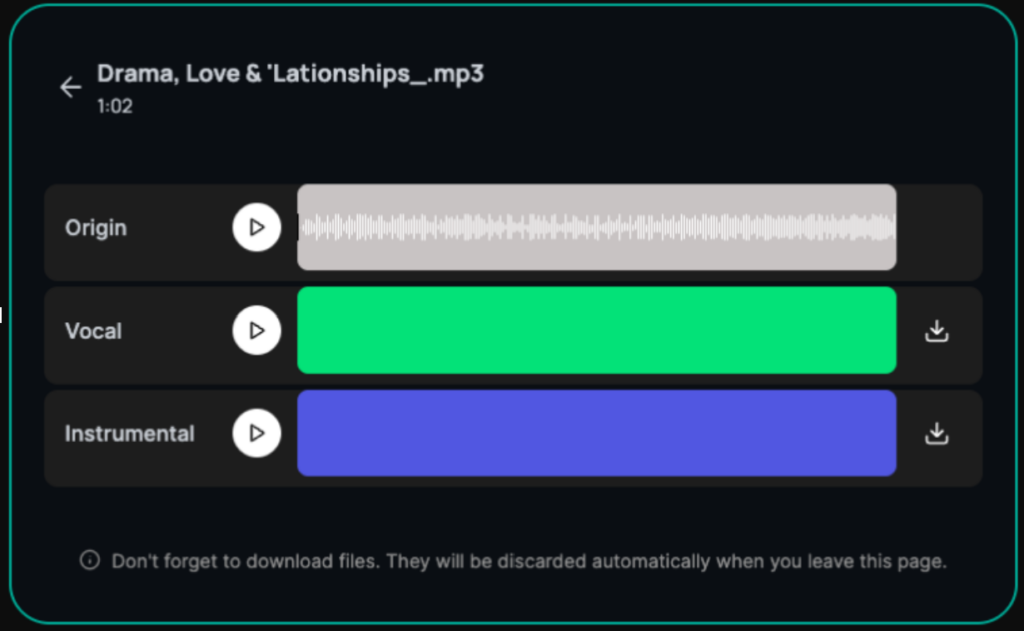
What makes it stand out is how well it balances speed and quality. The tool is particularly useful for creators who rely on transcription or summarization, as it enhances speech clarity, improving downstream AI processes.
If your priority is saving time while still getting clean, professional audio, DeVoice is a strong choice.
Adobe Podcast: Studio Sound Without the Studio
Adobe Podcast goes a little bit differently. It does not focus on removing noise but it overemphasizes the improvement of voice quality to make the records sound as though they were recorded in an official studio.
This is particularly useful in the case of podcasters, interviewers and voiceover artists who require a clean polished broadcast quality of the product.
Nonetheless, its performance is good, but the output quality cannot be the best when it needs to be used for large workflows or large-scale processing.
Krisp: Real-Time Noise Cancellation for Professionals
Krisp is designed for a completely different use case: real-time communication. Instead of cleaning audio after recording, it removes background noise during live calls.
This is particularly useful for remote teams, customer support agents, and freelancers who spend a lot of time on Zoom or Google Meet.
Its ability to clean both incoming and outgoing audio makes conversations clearer and more professional, even in noisy environments.
VEED.IO: For Creators Who Work With Video
VEED.IO combines video editing with AI-powered audio cleanup, making it ideal for social media creators and marketers.
What makes it appealing is the all-in-one workflow. AI Noise Remover: edit your video, add subtitles, and export everything from a single platform. This eliminates the need to switch between multiple tools.
While it may not offer the deepest audio processing capabilities, its convenience makes it a popular choice for content creators.
Descript: A Complete Content Creation Ecosystem
Descript does not just stop at noise removal, but is a complete set of content creation tools. It has one of the most distinctive features: editing audio through editing text. This renders it very intuitive, particularly to novices.
In addition to cleaning background noise, it lets you delete filler words, edit recordings, and create transcripts, all in the same interface.
It is especially helpful when the teams are dealing with long-form content such as podcasts, webinars, or interviews.
Choosing the Right Tool for Your Workflow
The most useful tool is not the one with the most features; it is the one that fits your workflow.
If you want to work quickly and easily, you can use a tool like DeVoice to save hours of time. If you want to focus on the quality of high-end audio, Adobe Podcast may be the superior choice. Krisp will be the best in live communication, but VEED.IO and Descript will suit creators who need all editing and sound cleaning in a single location.
It is important to know what you need. Do you handle high volumes of content? Is real-time performance required? Or do you want studio level production? The choice will depend on your answers.
A Smarter Workflow for Clean Audio
AI noise removal is most effective when integrated into a proper workflow to extract the maximum.
Begin by cleaning your audio as soon as you have recorded. This ensures that whatever is constructed on it, such as transcriptions, captions, summaries, etc., is more accurate.
After making the audio clear, the next step is in transcription and content re-purposing. This methodological approach is not only effective in enhancing quality but also a long-term time-saving methodology.
The Future of AI Audio Technology
There is a fast development of AI audio processing. Today we are already witnessing the tools that can separate several speakers, remove distortion and echo at the same time, and fix incredibly low-quality recordings.
These tools will be further integrated in the near future. Noise removal, transcription, and summarization will occur as a single conjunctive workflow as opposed to different steps.
This will also minimize manual work and enable creators to focus more on content than on technical work.
Final Thoughts
The final decision on which AI software to use to remove background noise will always be a matter of need, but one thing is clear: clean sound is the basis of great content.
Due to the ever-increasing competition, audio quality will make creators shine. Not only due to the better sounding of their content, but due to its better performance, in terms of engagement, retention, and better AI processing.
In the digital world, a sound quality is no longer a choice. It’s a competitive advantage.