For years, software leaders have been obsessed with tools, frameworks, and architectures. Then AI arrived and quietly shifted the real battleground.
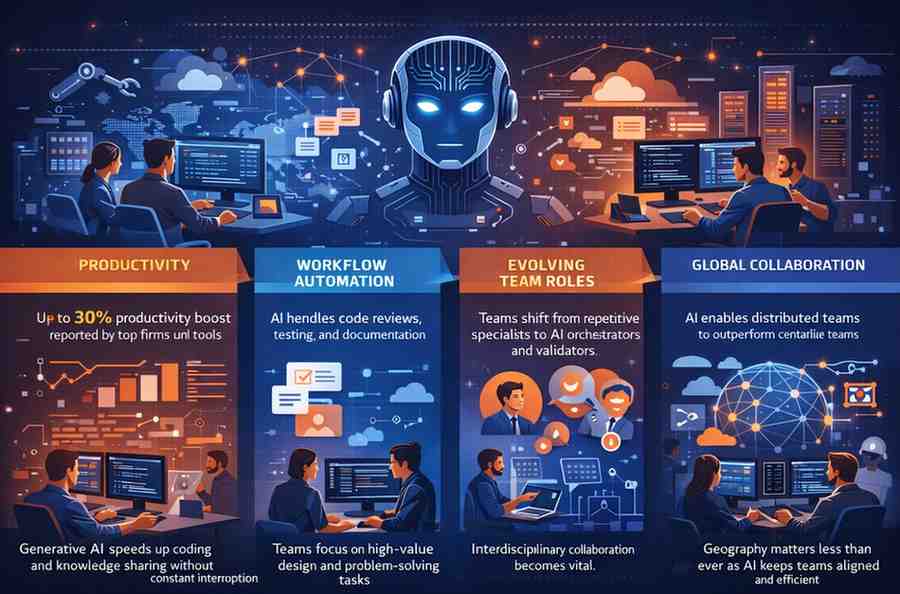
The biggest change wasn’t how code is written. It was how teams are formed, coordinated, and scaled. AI doesn’t just make developers faster; it changes the very dynamics of software teams. Routine tasks like code reviews, testing, and even refactoring can now be partially automated, allowing teams to focus on higher-value work like system design, architecture decisions, and problem-solving. Leading software organizations report that shifting team roles, collaborative processes, and ways of working often enabled by AI can drive 16%–30% improvements in productivity, time‑to‑market, and software quality.
It also alters team composition. Organizations may need fewer specialists performing repetitive tasks, but more people who can orchestrate AI outputs, validate model results, and integrate AI into broader systems. Cross-functional collaboration becomes essential, as AI introduces dependencies between development, data science, and operations that were previously less pronounced.
AI also has implications for geography and labour flexibility. With AI, remote/distributed teams can work processes in sync and closely together, thus less physical co-location is necessary. And when that hits you, a lot of long-standing presumptions about the kinds of software teams that are this size, structure, and even skills start to look out of date.
Table of contents
- From Individual Productivity to Team-Level Leverage
- AI-Assisted Development Is Redefining Engineering Roles
- Why Distributed Teams Are Becoming Easier to Manage
- Offshore Engineering Teams in an AI-Augmented World
- When Location Stops Being the Bottleneck
- Scaling Faster Without Overloading Core Teams
- Governance, Quality, and the New Risks AI Introduces
- What Leaders Get Wrong About AI and Team Scaling
- AI Changes the Math, Not the Responsibility
From Individual Productivity to Team-Level Leverage
In its early days, the conversation about AI centered on personal productivity. Faster coding. Better autocomplete. Fewer Stack Overflow tabs. Helpful, yes, but not wide-ranging.
Even more interesting is what happens at the team level. It now supports documentation, test generation (I should have written them up), refactoring, onboarding, and what we’re thinking of as architectural reasoning. Less time lost to handovers, fewer misunderstandings, and less reliance on tribal knowledge.
The true leverage comes when AI smooths cooperation, not just execution. Software Teams no longer depend on a handful of overburdened experts. Knowledge spreads faster. Delivery becomes less fragile. Coordination improves as AI can surface dependencies, flag potential bottlenecks, and even recommend priorities at the team level.
Suddenly, a value system matters more than individual heroics. It is about team resilience, adaptability, and scaling, not just the coolest developer per capita. AI essentially moves us away from individual output toward organizational intelligence, enabling the team to accomplish more together.
AI-Assisted Development Is Redefining Engineering Roles
If AI writes boilerplate, generates tests and catches common mistakes, what does the developer do? The answer is judgment. The best have their senior engineers spend less time typing and more time reviewing, designing, and guiding. Young engineers ramp up more quickly, but only if the company promotes learning rather than relying on tools to do their thinking for them.
This change is friendly to teams that value process over “stuff.” AI does not eliminate the need for experience. It makes the lack of it stand out.
Why Distributed Teams Are Becoming Easier to Manage
Distributed teams used to struggle with context loss. Async communication created gaps. Onboarding took forever. Documentation lagged reality. Coordination often relied on repetitive meetings and redundant explanations.
AI quietly fixes many of those issues. Codebases explain themselves more clearly. Decisions are summarized automatically. New engineers get context without interrupting five people on Slack. Pull requests, design choices, and architectural updates are surfaced proactively, reducing the need for constant check-ins. Async work stops feeling like second-class work.
As a result, distributed teams no longer feel inherently slower. In some cases, they outperform centralized teams, particularly on projects that require deep focus, uninterrupted flow, and thoughtful collaboration. AI effectively acts as a “team memory,” bridging gaps, accelerating onboarding, and making distributed collaboration smoother, more transparent, and more resilient than ever.
Offshore Engineering Teams in an AI-Augmented World
This is where AI changes the offshore conversation entirely. The old argument against offshore teams was friction: communication gaps, onboarding delays, uneven quality. AI reduces each of those if the team is structured correctly.
Modern companies increasingly choose to hire offshore developers as long-term contributors, embedding them directly into existing workflows rather than treating them as external execution units.
With shared tooling, AI-assisted documentation, and stable ownership, geography becomes far less relevant than process maturity. What matters isn’t where engineers sit, but whether they’re part of the same system.
When Location Stops Being the Bottleneck
If everyone uses the same repositories, pipelines, review standards, and AI tools, location becomes a logistical detail rather than a risk factor.
Teams aligned on quality expectations, delivery cadence, and ownership models outperform teams held together solely by proximity. This is why some globally distributed organizations ship more reliably than companies with everyone in one office. AI doesn’t remove the need for alignment. It amplifies it.
Scaling Faster Without Overloading Core Teams
One of the quiet dangers of AI is demand inflation. When output increases, expectations follow. Suddenly, the same team is expected to deliver more features, more experiments, more integrations. Without structural changes, burnout follows.
Smart organizations protect their core teams by deliberately scaling capacity. They expand delivery while preserving internal architectural ownership. AI helps, but it doesn’t replace the need for stable, dedicated contributors who understand the product long term. Scaling safely is about absorption, not acceleration.
Governance, Quality, and the New Risks AI Introduces
AI doesn’t eliminate risk. It redistributes it. Over-reliance on generated code, unclear IP boundaries, and inconsistent review standards – these issues compound faster in distributed environments. The solution isn’t a restriction. It’s governance.
Clear policies. Mandatory reviews. Defined ownership. Teams that treat AI as an assistant, not an authority, avoid most problems before they reach production. Process maturity matters more than tooling sophistication.
What Leaders Get Wrong About AI and Team Scaling
Two myths appear repeatedly.
- First: AI will replace developers. It won’t. It replaces friction, not responsibility.
- Second: AI makes team structure irrelevant. It doesn’t. Poor structure simply fails faster.
Leaders who succeed with AI understand that technology amplifies systems. If the system is unclear, AI magnifies the chaos. If it sounds, AI accelerates progress.
AI Changes the Math, Not the Responsibility
AI changes how much teams can do. It doesn’t change who is accountable. Organizations that scale well in the AI era invest in structure, ownership, and team collaboration. They use AI to reduce friction, not replace thinking. And they design teams around how work actually flows, not how org charts look. The future of software delivery isn’t centralized or distributed. It’s intentional.