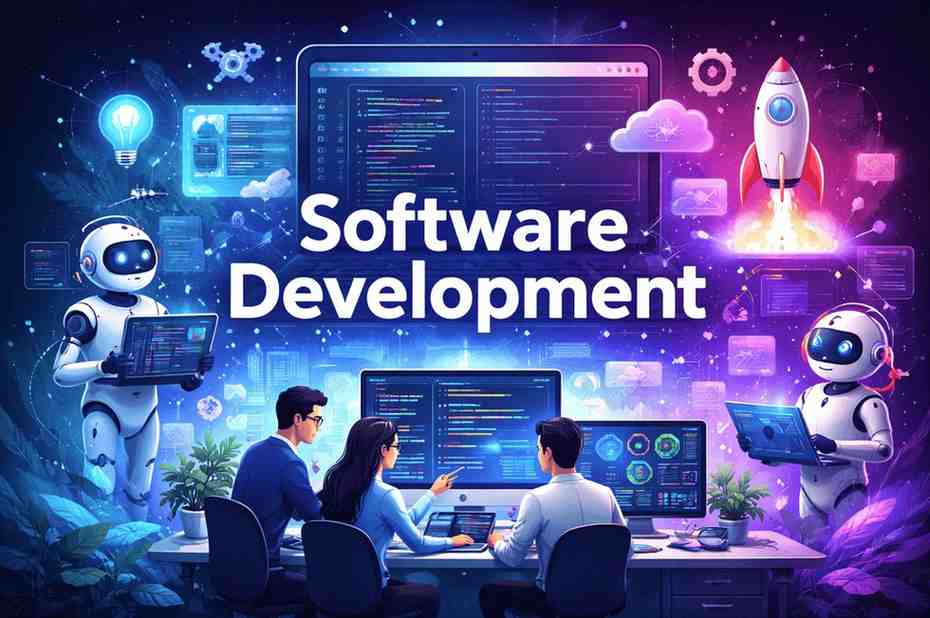
Artificial intelligence, along with its features and applications, is infusing a new level of creativity, intelligence, and automation into the Software Development Life Cycle (Design, Development, Testing, and Maintenance) and, on a broader scale, transforming entire industries. Enhancements with AI are offering advanced decision-making and predictive capabilities in the SDLC, allowing developers to pivot from low- to high-level problem-solving. This newly automated SDLC process enables organizations to offer improved code, which is more ‘bug-free,’ and deliver more resilient software in less time. According to Gartner, by 2028, 90% of enterprise software engineers will be using AI coding assistants, a huge leap from less than 14% in early 2024, showing how deeply AI is weaving into SDLC processes. It is a game-changer in the industry.
Table of contents
AI in Requirement Analysis and Planning
The most critical phase of any software project is the requirements phase. Clear and detailed requirements are a prerequisite. A large part of the requirements phase is undertaking stakeholder interviews. Historically, this has been a time-consuming and arduous process, but with AI, it can be performed much more accurately and in less time. The latest AI technology, Natural Language Processing (AI Using Human Language), can analyze large volumes of unstructured data to detect feature requests (user feedback, support tickets, market research docs, etc.). The advantages of AI tools include the ability to recognize patterns, determine sentiment, and identify priorities based on the analysis of customer reviews, which may not be conducted by human analysts. In addition, AI tools can check requirements against criteria such as consistency, ambiguity, and conflict, thereby starting the project on a solid, coherent basis. This explanation of how AI tools function provides a solid justification for outlining the benefits of a data-driven approach. These approaches help minimize the guesswork that may lead to increased development goals, aligning with the user’s needs and the business’s goals.
AI-Based Coding and Development Software
AI has been integrated into many aspects, including the coding phase. Most developers simply can’t work without AI-based coding tools fully integrated into development environments, such as GitHub Copilot. These AI tools can observe patterns and document the code developers write, providing real-time code suggestions, completing entire functions, and assisting with troubleshooting and debugging. These AI tools are built on extensive libraries of computer code across a variety of programming languages and can provide developers with relevant, syntactically sound code suggestions.
This kind of aid makes the development process faster and less expensive for junior developers. AI tools can do more than just generate code. They can measure code intelligibility and study breaches in security and defense measures to identify bugs. AI tools can also identify code simplifications that offer opportunities to improve algorithmic efficiency. As the field of artificial intelligence development advances, these tools will become even more sophisticated, acting as true partners in the creative process of software engineering.
AI in Software Testing and Quality Assurance
The area of quality assurance (QA) is also very promising for AI technologies, and innovation can be expected here as well. AI tools are enhancing software testing, making it less tedious and less prone to human error. From testing system interfaces to generating test scenarios that include human testing omissions, these tools immediately improve testing throughput.
Through machine learning, AI can evaluate app user interfaces to detect visual bugs and layout issues across devices and screen sizes. AI can also perform “smart” regression testing by anticipating which parts of the code are most affected by recent changes and directing testing efforts to those areas. These AI models are designed to study historical patterns of bugs and code modifications, and therefore to more accurately catch defects before the software is released to production, and to do so more reliably and confidently.
AI for Predictive Maintenance and Monitoring
Using predictive maintenance, operations teams can mitigate potential issues before they occur, reducing downtime and preserving an uninterrupted experience for users. For instance, an artificial intelligence (AI) system can detect an increase in memory usage, which, without intervention, can result in a system failure. Thus, the system can give developers a heads-up so users can remain unaffected. This proactive approach, rather than waiting for issues to arise, is fundamental to the more resilient software architecture today.
AI-Driven DevOps and Automation
With respect to the pillars of DevOps, which are collaboration, automation, and continuous integration/continuous delivery (CI/CD), artificial intelligence can take these concepts to the next level. AI is becoming part of DevOps pipelines to enable smarter, more automated workflows. This concept, frequently referred to as AIOps, applies machine learning to automate and optimize IT operations.
Within a CI/CD pipeline, AI can optimize build and deployment scheduling, automatically roll back failed deployments, and manage infrastructure resources. For example, an AIOps platform can utilize historical data to anticipate peak load times and adjust resource allocation (scaling) to optimize costs and performance. Through automated, advanced decision-making, AI enables DevOps teams to manage more intricate systems more effectively and efficiently, thereby perpetuating a culture of continuous improvement.
Governance and Ethical Impact of AI in Development
Incorporating AI into every facet of the Software Development Life Cycle (SDLC) warrants addressing the corresponding ethics and governance risks. One of the risks is the training data the AI uses, which can be biased. Take, for example, an AI tool for requirement analysis: if the training data is biased, it will filter out feedback from minority user groups.
Additionally, the need for explainable, transparent AI models is significant. Stakeholders and developers should be able to know what led the AI to develop a suggestion. It is the requirement for the ethical commitment to be in the development of the AI tool to ensure bias is not propagated, and to do this, there needs to be governance policies in place to oversee AI usage, as well as audits to check for bias and to ensure the involvement of humans in the AI development process.
Conclusion
Artificial intelligence integration is not simply an addition to the software development lifecycle; it is a paradigm shift. The AI-powered features development process is faster, smarter, and more secure. From clarifying initial requirements to predicting production failures, these features aid the process. By automating tedious tasks and providing intelligent insights, AI empowers developers to create software of a higher quality than previously possible. As these technologies mature, they will increasingly become the core of contemporary software engineering. Praising the technology will enable development teams to go beyond previous restrictions, promote renewed thinking, and provide extraordinary service in a quickly changing digital marketplace.