Once you begin using an AI research assistant, what stands out the most is the shift in how you think about obtaining information. Rather than having open windows with multiple tabs and a plethora of articles that you have marked to read later, with AI research synthesis you have a support system that provides some of the strength to help you move toward your goal of understanding. Your AI research assistant will not hurry you through your research process. It will not inundate you with copious amounts of unfiltered data but rather provide you with information that will assist you in reaching your desired level of understanding.
In an environment where the speed of information exceeds our ability to retain attention, the AI research assistant moves from just being a tool to having the ability to assist and enable you to see relationships with items in their database of information before you physically search for them. This shift toward AI research synthesis changes how knowledge is gathered and understood.
This change will affect website editors, content strategists, and internet researchers alike. The AI researcher assistant changes the way we seek out research but not how we think about the insights we uncover through research. Rather than just treating research as a list of to-dos or tasks to complete, here the AI researcher assistant thinks of research as a story to be told. This is the small, yet powerful change that transforms the creation of a strategic insight — insight happens through connection, relevance and timing, not through a volume of research data.
Key Takeaways
- AI research synthesis changes how we gather and understand information by filtering out noise and providing relevant context.
- An AI research assistant helps streamline the research process, offering structured clarity and actionable insights.
- Tools like TeraBox’s AI research assistant integrate into workflows, improving user access to research without extra uploading or friction.
- AI research assistants evolve with use, learning individual preferences and enhancing overall research efficiency.
- These tools democratize access to strategic insights, fostering collaboration and allowing more people to engage meaningfully with research.
Table of contents
From Information Overload to Meaningful Context
The ability of an AI research assistant to take your information overload and turn it into context is one of the greatest advantages. The feeling of confusion, countless people over and over with opinions, and the idea that you will not get any more clarity if you keep reading are things anyone who has used traditional research methods has felt. By using an ai research assist, the dynamics of how you have experienced these feelings or perceptions are changed. Your smart assistant will filter the information out before it gets to you by eliminating the noise so that you will receive only relevant and accurate information. This is where AI research synthesis becomes most visible, transforming scattered data into structured clarity.
Rather than throwing loads of references at you, an AI research assistant locates themes repeatedly expressed. It shows you same ideas again and again as well as shows you the same data points are discussed every time with an authoritative writer in support of those articles. When reading each paragraph, they will feel like intended to be there. Therefore, editors will spend less time asking themselves if a source is significant or how to determine its significance but rather than concentrating on the basis of its significance. The AI research assistant serves as a lens that focuses the blurry margins of raw material and produces useful materials.
Using AI as a tool to gather and organize research information enables you to have a much greater degree of mental clarity than if you were attempting to do so manually. The research assistant can compile your resource materials together and provide concise summaries for your review, allowing you to spend more time interpreting the results of your work rather than collecting it all from PDF files or spreadsheets. This new method of using AI as part of your research process allows you to work at a higher level than you have been previously able to do, facilitating the emergence of new ideas and new ways of thinking about the types of research you are doing and how best to accomplish it.
The Role of AI Research Assistant in Content Strategy
Today the content strategy has changed from only being based on keywords or calendars, it is now more focused around understanding your target audience’s intent, how the industry is changing, and what our long-term goals should be. An AI research assistant will help to provide you with information about more than just one article.
An AI research assistant can identify areas of opportunity based on trends from various source data. It will help identify where your competition is focused, the type of questions your audience asks and where there are opportunities to differentiate your offering. For an editor, this information turns the concept of planning from guesswork to informed strategy.
The Evolution of Research Help Bots as Strategic Navigators: Research help bots will not dictate what you Should think instead will indicate places where to Check and help with larger goals of development, consistency and effectiveness through content decision spaces creating alignment with all of your content throughout your network.
TeraBox and the Practical Advantages of Built-In Intelligence
When talking about the application of AI, TeraBox’s AI research assistant is an excellent example of a product designed for practical use. Instead of being designed as an isolated (and complicated) system, TeraBox’s AI research assistant has been built directly into a normal user’s working environment. This will increase the ease of learning how to use the assistant and provide everyday users with access to advanced research.
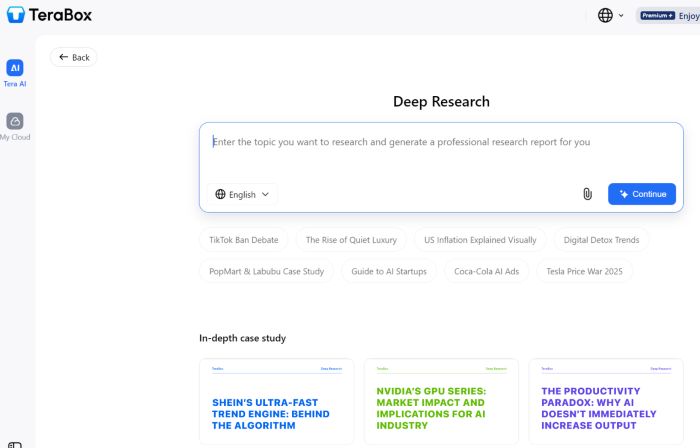
Among the benefits is streamlined access to previously stored documents. The TeraBox Research AI assistant can evaluate files that have been previously stored within TeraBox, providing you with the ability to gain insight without needing to upload the content somewhere else. The seamlessness of this process will save you time as well as reduce the amount of friction associated with researching, making it much easier for you to incorporate your research into your existing workflow. Through AI research synthesis, those stored documents are not just retrieved but meaningfully connected.
A further asset is the AI research assistants’ balance. AI research assistants give adequate synthesis of material without overwhelming the user. For a project editor working on several projects at the same time, this clarity is essential. In addition to that, the user gets actionable information versus theoretical information, therefore, they can make decisions quicker and with increased confidence.
A Tool That Learns with You
AI research assistants have another, more subtle benefit, which is their ability to evolve with time. The more often you use your AI research assistant, the better that assistant becomes at mirroring how you as an individual scholar think. It learns the kinds of sources you value, the level of thoroughness or detail in analyses that meet your needs, and your preferred way to illustrate shared knowledge.
The way we’ve built these behaviors into our products helps provide a feeling of stability. There is an underlying sense that each new content creation is becoming more in line with what you need. For the editors of web pages, maintaining this same voice and style in their writings helps to save both time and break down potential barriers to writing. In systems like TeraBox, this learning process becomes a daily task within the platform by way of their AI Research Assistant. As the assistant becomes part of your everyday routine, you are more likely to use it in different ways, leading to greater use of the system over time.
Making Strategic Insight Accessible to More People
Previously, conducting extensive research required particular knowledge and many hours to accomplish, however, the tools developed by AI to assist researchers have reduced these barriers for identifying strategic insights by providing access to strategic insight to individuals who do not have extensive training as researchers (i.e., editors, marketers, educators, etc.). The availability of insights to a larger group of people allows for a new way of working together when there is more meaningful engagement with research from more people. The result will likely result in conversations that are based on a greater collective knowledge rather than only on individual expertise.
An AI research assistant acts as a common reference point for teams, fostering alignment and collaboration through a synthesis of knowledge. Having this shared basis of information promotes quicker alignment of teams as well as more clearly communicated objectives, particularly when working remotely or in geographically diverse locations.
Looking Ahead at the Role of AI Research Assistant
With the continual evolution of information, so arises the increase in importance of an Artificial Intelligence Research Assistant. Simply gathering data is no longer sufficient, we need tools that allow for thought process collaboration with the data. The AI Research Assistant exemplifies this new direction of thought, such being able to help us think based on data instead of merely providing us with a retrieval of data.
The evolution of the TeraBox platform provides tangible benefits to users, with AI research assistants being an integrated, functioning component of that platform, AI Research Assistants assist users in doing things such as meeting editing deadlines, developing creator ideas, and providing strategists with a clearer plan for moving forward.
The AI research assistant’s value is therefore determined by how much larger a role we let it play in increasing our productivity, without sacrificing our ability to be creative or express ourselves creatively. Through AI research synthesis, the AI research assistant allows us to return our attention and focus on the three things that we as human beings do best where human beings excel: making decisions (using their own judgment), being creative, and communicating meaningfully with others.