There has always been rewriting in writing. Bloggers revise old posts, marketers freshen landing pages, and website owners update content to remain relevant. Rewriting has become much faster and easier with the advent of tools such as ChatGPT in recent years. But speed also raises an important question: Is a ChatGPT rewriter useful at all, or does it simply replace words without improving quality?
The growing integration of AI into professional environments makes this question more relevant than ever. Gartner predicts that by 2026, more than 80% of enterprises will have used generative AI APIs or models in production environments, up from less than 5% in 2023. This signals that AI writing assistance is not just a casual productivity hack; it is becoming embedded in enterprise systems, marketing workflows, and large-scale content operations.
In this article, I will explain what an AI Paraphraser is, how it works, where it excels, where it falls short, and how to use it so that it improves readability and trust rather than completely destroying it.
Table of contents
- What Is a ChatGPT Rewriter?
- How a ChatGPT Rewriter Works Behind the Scenes
- Why People Use ChatGPT as a Rewriter
- Where a AI Paraphraser Is Actually Useful
- Where a ChatGPT Rewriter Falls Short
- ChatGPT Rewriter vs Traditional Rewriting Tools
- How to Use an AI Rewriter the Right Way
- Three Best Practices for Better Rewrites
- Is an AI Rewriter Good for SEO?
- Can ChatGPT Rewrite Content to Sound Human?
- Common Mistakes People Make
- How to Decide If an AI Paraphraser Is Worth Using
- Final Verdict: Is a ChatGPT Rewriter Actually Useful?
What Is a ChatGPT Rewriter?
A ChatGPT rewriter is a tool that uses ChatGPT to rewrite text while preserving its original meaning. Rather than writing entirely new content, the tool ingests an input and spits out a version that uses different wording, sentence structure or tone — essentially similar to the way one might try to spin something on social media nowadays.
It’s not a primitive spinning tool that simply replaces words with synonyms; ChatGPT understands context. It can also reword full sentences, reorder ideas, and adjust tone as directed. So it’s easier for it to be more flexible than other article spinners.
But it is important to note one thing, too: ChatGPT does not “comprehend” content in the way humans do. It concerns predicting which text to predict based on patterns. Which is significant when evaluating its utility.
How a ChatGPT Rewriter Works Behind the Scenes
ChatGPT does this by analyzing linguistic patterns. If you feed it a passage of text to paraphrase, it observes how ideas are expressed and produces output that sounds less forced.
It’s not a rip-off of anything. It jumbled the words it was trained on; put it through another round, and we started to find sentences that programs like this one were never fed. It’s generating new sentences based on its perceived likelihood. That’s why rewrites sometimes seem to be in perfect English, but also flat or not quite right.
The quality of the rewrite depends heavily on:
- The original text’s clarity
- The prompt you give
- How much human editing follows
A fuzzy prompt produces fuzzy output. Certainly, good prompts lead to better results, and a prompt can introduce additional structure into the training data in various ways.
Why People Use ChatGPT as a Rewriter
Practical concerns drive most people to use ChatGPT for rewriting. There also isn’t much time, and it would be tedious to rewrite by hand.
An AI Paraphraser is often used to:
- Refresh outdated blog posts
- Simplify complex content
- Tone it down for a new crowd
Used judiciously, it can be lifesaving. Inattentiveness can lead to superficial or false content.
Where a AI Paraphraser Is Actually Useful
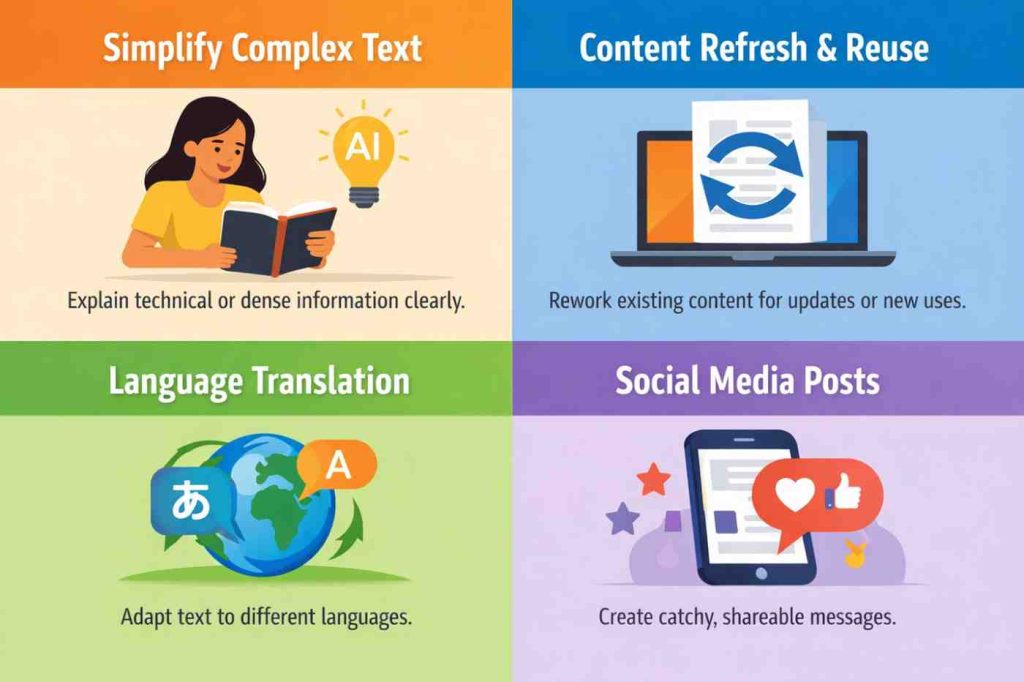
ChatGPT works well when the rewriting tasks are direct and very clear. It’s useful for clarity. If the content is overly formal, overly lengthy, or poorly structured, ChatGPT can help streamline it. It is also great for rewriting content for reuse across multiple places, taking something from your blog and turning it into lighter website copy, for example.
To point you to three places, in fact, where it adds real value:
- hRewriting content for better readability
- Changing tone without changing meaning
- Creating alternative versions for testing
In these cases, ChatGPT acts as a fast assistant rather than a replacement for a writer.
Where a ChatGPT Rewriter Falls Short
It often removes nuance. Minor concepts, opinions, or experiences may be described in general terms. This becomes particularly dangerous in expert content or competitive niches where precision and subtle distinctions matter.
Another issue is over-polishing. Rewritten text may sound refined and technically correct, yet it can lose originality or personality. Readers may not immediately identify the flaw, but they often sense that something authentic is missing.
There is also the risk of subtle meaning shifts. When rephrasing, ChatGPT can slightly alter context, tone, or emphasis. These small changes may introduce minor factual distortions or reshape the intended message. In fact, BBC testing of major AI chatbots found that around 20% of responses contained factual errors, and 13% of quoted material was altered or fabricated when compared with trusted sources. This demonstrates how easily AI-generated text can appear authoritative while quietly distorting meaning.
And this is why human review is not a luxury. It is a safeguard.
ChatGPT Rewriter vs Traditional Rewriting Tools
Conventional paraphrasing systems simply substitute words. They are changing words, not sentence structure. This results in even more clunky or disjointed sentences.
ChatGPT is more advanced. It can reconstruct sentences and reorder ideas. That’s an improvement, but also more dangerous. There’s more room for it, so it requires greater attention.
Think of traditional tools as mechanical and ChatGPT as creative but erratic. Both will require human piloting, but with ChatGPT, you need a bit more judgment.
How to Use an AI Rewriter the Right Way
Using AI Paraphraser well begins with how you prompt it. Don’t say “rewrite this,” provide explicit guidance. Explain to it the purpose, tone, and audience.
Do not post right away after receiving the rewrite. Review it line by line. Check meaning, accuracy, and flow. It’s also important to ask yourself whether the content still sounds like it belongs to your brand.
Most importantly, add your own insight. AI output should be a base, not a final product.
Three Best Practices for Better Rewrites
- Always compare it to the original and ensure the usual AI-powered writing patterns are absent.
- Edit for meaning first, style second
- Add at least some original human input
These practices help maintain quality and trust.
Is an AI Rewriter Good for SEO?
An AI rewriter can support SEO, but it cannot replace strategy.
Search engines reward helpful, original content. Rewriting alone does not guarantee value. If rewritten content adds clarity, better structure, or improved relevance, it can perform well.
However, mass rewriting for the sake of “new content” often fails. Search engines can recognize low-value pages based on user behavior, not just text patterns.
Humanized content and purposeful rewriting support SEO. Blind rewriting does not.
Can ChatGPT Rewrite Content to Sound Human?
Yes, but only with guidance.
ChatGPT can mimic conversational tone, but it does not feel emotion. If you want content to sound human, you must shape it. That means simplifying language, adding context, and removing unnecessary polish.
Human tone comes from intent, not just phrasing. That intent must come from you.
Common Mistakes People Make
One common mistake is trusting the first output. AI rarely gets it perfect on the first try. The initial response is often generic and lacks context, depth, or alignment with your exact goal. Without refining prompts and reviewing carefully, the result may sound fine but miss important details.
Another mistake is using ChatGPT to avoid thinking. AI should support thinking, not replace it. When people stop analyzing, questioning, and structuring ideas themselves, content quickly becomes shallow. AI can generate sentences, but it cannot replace critical judgment, audience understanding, or strategic intent.
A third mistake is ignoring context. AI does not automatically understand your brand voice, competitive landscape, or long-term content strategy. Without guidance, it may produce technically correct text that is strategically misaligned.
The biggest mistake is assuming rewritten content is automatically unique or valuable. Rewording alone does not create originality. Real uniqueness comes from insight, perspective, experience, and interpretation, not just different wording.
AI is a powerful drafting tool. But value, nuance, and authority still come from human review.
How to Decide If an AI Paraphraser Is Worth Using
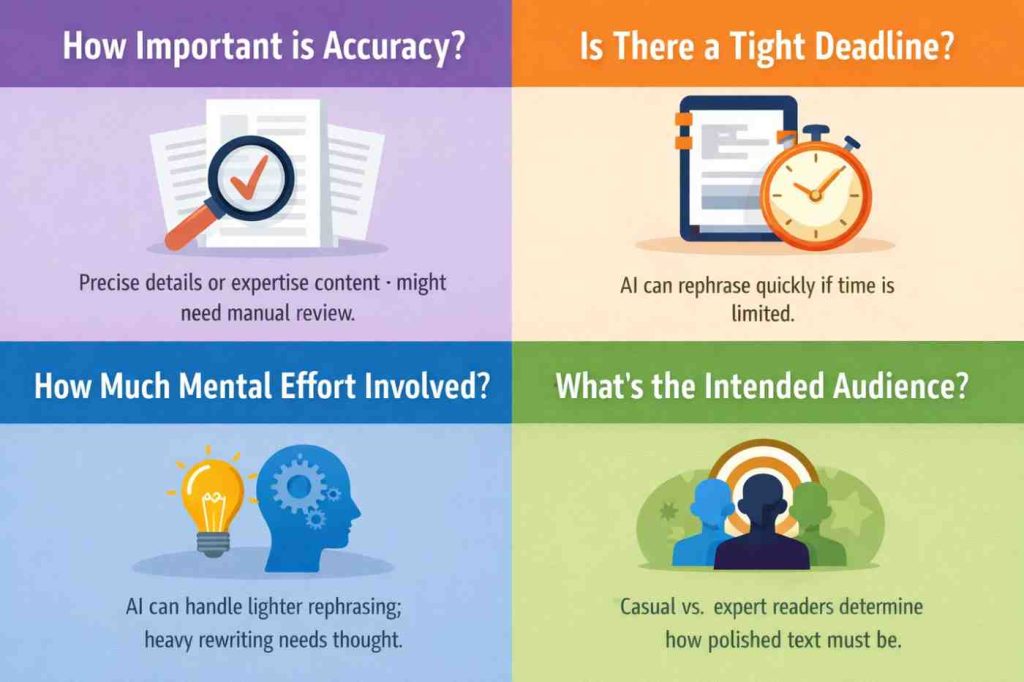
Ask yourself one simple question: Is the reader better off after this content rewrite? years ago. Is that so? Well, who needs it then! It’s not worth it if it just saves you time while sacrificing quality. A great AI rewriter workflow increases clarity, saves time, and preserves human control. Anything less is a shortcut that tends to backfire.
Final Verdict: Is a ChatGPT Rewriter Actually Useful?
A ChatGPT rewriter makes a great assistant, not a substitute. It accelerates the process of rewriting words for readability and testing new phrasing.
But usefulness lies in how you use it. There lies mediocrity in what it generates on its own, no human editing! When used in human judgment, it can help produce strong reader-focused writing.
When it comes down to it, ChatGPT does not replace writers. It benefits writers who know how to lead it.