
We tend to think about change in straight lines. You add one unit of effort and get one unit of progress. But some technologies don’t work that way. They double. Then double again. And again. By the time most people notice them, they’ve already rewritten the rules.
That’s the essential idea behind exponential technologies, and it’s why leaders who understand them have a significant edge over those who don’t.
Here’s what you need to know.
Table of contents
- 1. Exponential Technologies Follow a Different Kind of Growth Curve.
- 2. The Technologies Reshaping the World Right Now Are Converging.
- 3. Most Organizations Are Not Built to Respond at Exponential Speed.
- 4. The Risks Are Just as Exponential as the Opportunities.
- 5. Understanding Exponential Technologies Is Now a Leadership Skill.
- Frequently Asked Questions
1. Exponential Technologies Follow a Different Kind of Growth Curve.
The term “exponential” gets thrown around a lot, but it has a specific meaning in this context. So what are exponential technologies? They are those that follow a pattern of rapid, compounding improvement, typically doubling in power while dropping in cost on a predictable cycle.
Exponential technology doubles in capability or performance over a short period of time. The evolution of transportation is a good example of this. Humans could only travel at the speed of a horse for many millennia, approximately 35 mph. Then humans developed mechanized travel (trains, cars, airplanes, etc.) that could travel much faster, and now spacecraft can reach up to 17,500 mph, thanks to advanced rocket propulsion systems.
2. The Technologies Reshaping the World Right Now Are Converging.
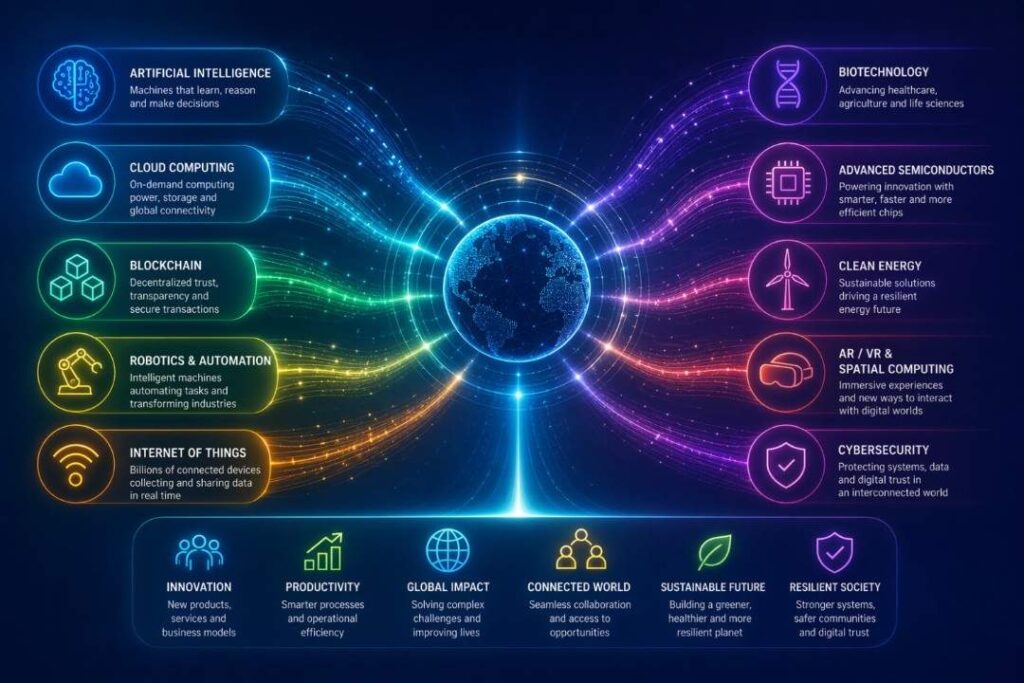
It’s tempting to think about AI as one story and biotech as another. But one of the defining features of this moment is that exponential technologies are converging, each one accelerating the others.
AI is making drug discovery faster. Quantum computing is poised to crack problems in materials science that classical computers can’t touch. Synthetic biology is merging with digital manufacturing to enable products that weren’t physically possible a decade ago.
According to the World Economic Forum, this convergence of emerging technologies is one of the most significant forces reshaping the global economy, and the pace is only accelerating.
For business leaders, the implication is that you can’t just track one technology in isolation. The disruption—and the opportunity—often live at the intersection.
3. Most Organizations Are Not Built to Respond at Exponential Speed.
Here’s the uncomfortable truth: human institutions evolved for linear change. Annual planning cycles, hierarchical decision-making, and risk-averse culture are reasonable adaptations to a slower world. But linear tools become liabilities in an exponential one.
This is a core insight that drives the work at Singularity University. The organization was founded specifically to help leaders understand and respond to technologies that are advancing faster than traditional strategy cycles can accommodate. Through its executive programs and learning experiences, Singularity gives entrepreneurs and business leaders the frameworks not just to understand exponential change, but to build organizations capable of moving with it.
The challenge isn’t access to information. Most executives can read the same trend reports. The challenge is developing the mindset and organizational muscle to act on what those reports tell you, before your competitors do.
4. The Risks Are Just as Exponential as the Opportunities.
Exponential growth cuts both ways. The same dynamics that can lift a startup from garage to global in five years can also collapse an industry, displace a workforce, or amplify the reach of a bad actor at unprecedented scale.
Biotech advances that accelerate vaccine development also lower the barrier to engineering pathogens. AI tools that supercharge productivity also enable sophisticated disinformation at scale. This isn’t an argument against these technologies; it’s an argument for taking them seriously.
Leaders who engage deeply with exponential technologies tend to become more thoughtful about governance. Understanding the upside clearly also means understanding what’s at stake if development outpaces oversight.
5. Understanding Exponential Technologies Is Now a Leadership Skill.
A few years ago, you could make a reasonable argument that exponential technologies were the domain of technologists and futurists. Today, CEOs are making AI strategy decisions. CFOs are evaluating quantum-readiness timelines. HR leaders are redesigning organizations around automation. Boards are asking hard questions about biosecurity and synthetic media.
Research from McKinsey shows that companies led by executives with strong technology fluency outperform their peers during periods of disruption. Fluency doesn’t mean coding. It means understanding how these technologies scale, where they’re headed, and what effect they have on your business model.
Frequently Asked Questions
What are exponential technologies? Exponential technologies follow a pattern of rapid, compounding improvement, doubling in capability while falling in cost over time. Examples include artificial intelligence, quantum computing, biotechnology, robotics and renewable energy. Unlike linear technologies, their growth curves can seem slow at first and then suddenly overwhelming.
Why do exponential technologies matter? They matter because they don’t just improve existing products and services; they make entirely new things possible and render existing business models obsolete. Leaders who understand how these technologies scale are better positioned to anticipate disruption and act before it arrives.
Which industries are most affected? Almost every major sector is being affected, including healthcare, finance, energy, manufacturing, education, and media. The convergence of multiple exponential technologies means that disruption rarely stays contained within a single industry.
How can leaders prepare? The most effective preparation combines technology fluency with strategic thinking. Programs like those offered by Singularity University are specifically designed to help executives and entrepreneurs build both, connecting emerging technology trends to real business decisions and long-term strategy.