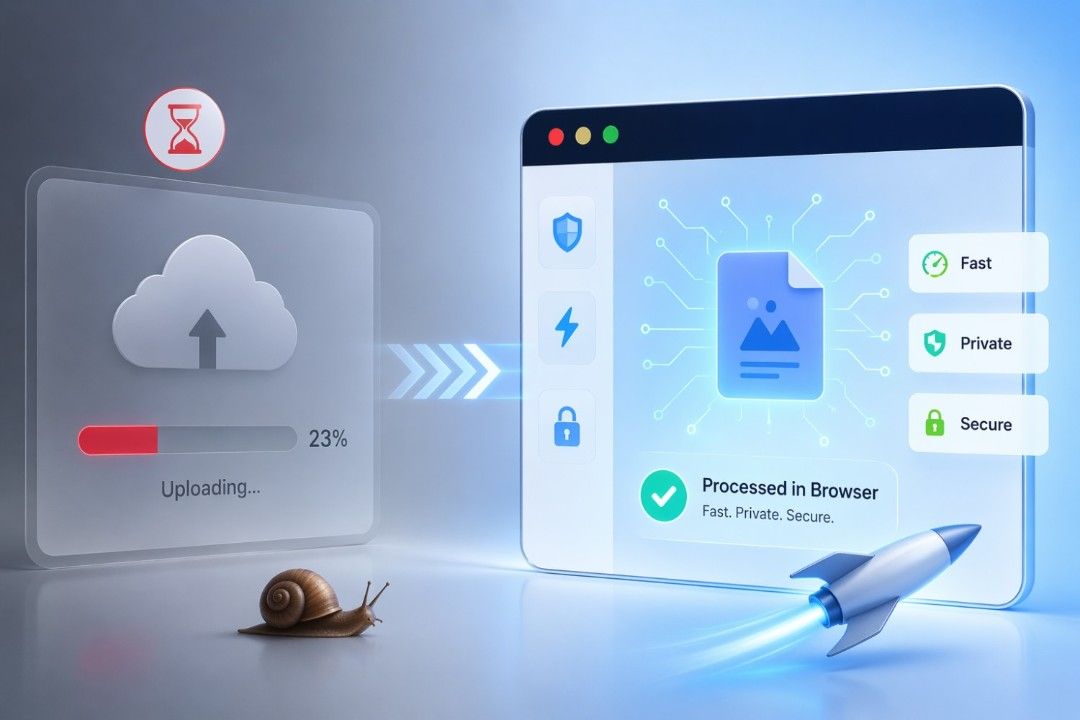
Executive Summary: As global content volume hits record highs in 2026, the traditional “Cloud-SaaS” model for media processing has hit a wall. Organizations are now shifting toward Browser-Native Processing, leveraging WebAssembly (WASM) to execute complex media tasks locally. This shift eliminates the “Upload Tax,” ensures 100% data sovereignty, and redefines the return on investment (ROI) for digital content stacks.
Table of contents
- The 2026 Efficiency Crisis: Beyond the Cloud
- The Rise of the Browser-as-a-Workstation
- Data Sovereignty: The Security Imperative
- Case Study: High-Fidelity Infrastructure via AudioCut.io
- The ROI of the “App-Free” Enterprise
- 2026 Strategy: Implementing the Browser-Native Standard
- Conclusion: Reclaiming the Creative Perimeter
The 2026 Efficiency Crisis: Beyond the Cloud
For the better part of a decade, the “Cloud” was the answer to every enterprise problem. However, in 2026, we are witnessing a massive efficiency gap. While fiber and satellite internet have increased bandwidth, video file sizes are now standardizing at 8K and high-bitrate ProRes, outpacing network growth.
For a modern content operations team, every media task requires a “Cloud Loop”: uploading a multi-gigabyte file, waiting for server-side processing, and downloading the result. This cycle isn’t just a nuisance; it is a systemic drain on productivity. When a team processes 50 videos a week, the cumulative “Upload Tax” can account for over 40 hours of idle time per month. In the high-stakes world of digital marketing and news cycles, this latency is a competitive disadvantage.
The Rise of the Browser-as-a-Workstation
The solution is a fundamental re-architecture of how we think about web software. The emergence of WebAssembly (WASM) has allowed the browser to move past its role as a mere document viewer. Today, the browser acts as a high-performance execution environment that can tap directly into the user’s local hardware.
Browser-Native Processing allows media applications to run near-native code within a sandboxed browser tab. By moving the computing load from a remote data center to the user’s local CPU and RAM, organizations can effectively bypass the network entirely. The result is a “Zero-Latency” workflow that feels instantaneous, regardless of file size.
Data Sovereignty: The Security Imperative
Beyond speed, the primary driver for browser-native adoption is Data Sovereignty. In 2026, the regulatory landscape regarding data privacy (GDPR 2.0 and the AI Ethics Act) has become significantly more stringent.
Traditional cloud converters are a compliance nightmare. To process a file, you must transmit it. The moment a sensitive internal meeting recording or a proprietary product demo leaves the local network, its security perimeter is compromised. “Encryption-at-rest” and “auto-delete” policies are no longer sufficient for high-security environments in the legal, financial, and healthcare sectors.
By contrast, the “Zero-Server Footprint” model ensures that data never leaves the device. The file is loaded into the browser’s local memory, processed via WASM, and saved back to the disk. There is no transit, no middleman, and no residual data on a third-party server. In 2026, the only 100% secure file is the one you never upload.
Case Study: High-Fidelity Infrastructure via AudioCut.io
To understand how this looks in practice, we can look at AudioCut.io, a platform that has become a benchmark for browser-native media processing tool. AudioCut does not function as a middleman; it functions as a modular, browser-based engine that replaces several legacy desktop applications.

1. AI-Powered Stem Separation (The Audio Splitter)
One of the most technically demanding tasks in 2026 is “Stem Separation,” splitting a combined audio track into isolated layers of vocals, drums, and instruments. While this used to require professional workstations or heavy cloud processing credits, AudioCut performs this via browser-local AI. For content teams, this means the ability to remix and repurpose assets without any per-file processing costs or upload delays.
2. Surgical Extraction and Bitrate Integrity
Legacy web converters often compress audio to save on server egress costs, leading to “generation loss.” Because AudioCut utilizes local resources, it can maintain the highest audio standards, such as 320kbps MP3 and lossless WAV extraction. This ensures that extracted sound bites are “AI-Ready,” possessing the clarity required for high-end voice cloning or professional broadcasting.
3. The Modular Toolkit: Cutting, Speed, and Compression
The platform integrates a suite of essential tools, MP3 Cutting, Audio Compression, and Speed Changing into a single, unified export workflow. This “Modular” approach allows creators to move from extraction to trimming to compression in seconds, all within a single tab.
The ROI of the “App-Free” Enterprise
For a CTO or Creative Director, the shift to browser-native tools like AudioCut provides a clear financial incentive. The return on investment can be categorized into three pillars:
Pillar 1: Infrastructure and Storage
Native media applications are notoriously “heavy,” often requiring 500MB to 1GB of disk space per user. Across a 100-person team, this is a significant storage overhead. Browser-native tools require zero disk footprint, freeing up hardware resources and reducing the strain on managed devices.
Pillar 2: IT Maintenance and Patching
Software distribution is an ongoing operational cost. Native apps require version control, security patches, and OS compatibility audits. A WASM-based tool is “evergreen,” it is always updated to the latest security standard the moment the user opens the URL, drastically reducing IT overhead.
Pillar 3: Human Capital Efficiency
The most valuable asset in any organization is the creator’s time. By eliminating the upload bar, browser-native processing provides a “Productivity Dividend.” If an employee saves 10 minutes a day by not waiting for a cloud converter, that totals over 40 hours of regained productivity annually per person. In a large content house, that equals thousands of reclaimed hours for high-value creative work.
2026 Strategy: Implementing the Browser-Native Standard
As we look toward the end of 2026, the organizations that will lead the content race are those that eliminate friction. The transition from “Cloud-Heavy” to “Browser-Native” is not just a technological upgrade; it is a strategic repositioning.
A Strategic Capability Matrix for 2026:
| Priority | Technical Requirement | Proposed Outcome |
| Data Compliance | Local Sandboxing | 100% Data Sovereignty |
| Workflow Speed | WASM Execution | Zero Upload Latency |
| Output Quality | 320kbps Extraction | Professional-Grade Assets |
| Cost Control | Serverless Architecture | Scalable ROI / Low IT Overhead |
Conclusion: Reclaiming the Creative Perimeter
The era of the “Upload Bar” was a necessary but frustrating bridge in the evolution of the internet. We are now moving into an era where the browser is the ultimate workstation.
For the modern enterprise, the goal is simple: Reclaim the creative perimeter. By utilizing tools like AudioCut.io, companies can finally give their teams the power of professional software with the privacy of an offline device and the speed of a fiber-optic link. The future of content operations is decentralized, local, and incredibly fast. It’s time to stop uploading and start processing.
About the Author: The author focuses on the intersection of WebAssembly (WASM), browser-native technologies, and enterprise content workflows, with a particular interest in performance, privacy, and scalable media infrastructure.