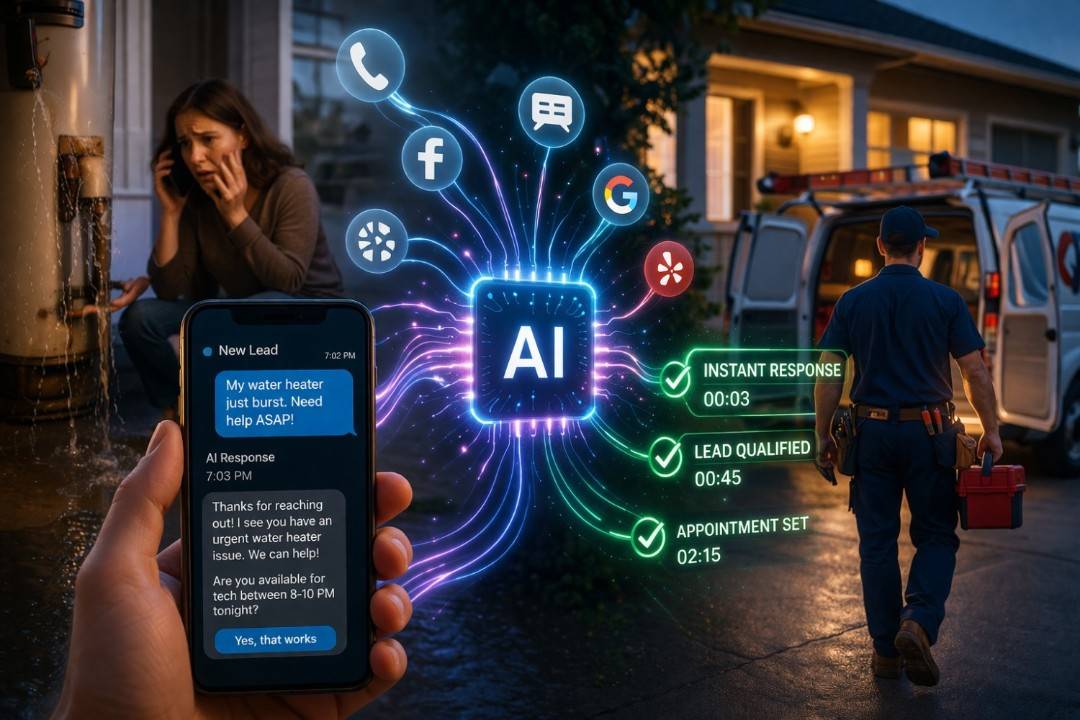
A homeowner’s water heater bursts at 7 pm on a Saturday. They pull out their phone and send quote requests to five local plumbing companies. One plumber has AI automation that responds within 3 minutes with available time slots. The other four reply the next morning with manual messages.
Who gets the emergency call?
This scenario plays out thousands of times daily across every home service trade. Plumbing, HVAC, roofing, electrical, pest control. The contractor who replies first almost always wins the job. And artificial intelligence is now the tool that enables fast responses at scale.
That advantage has a name: speed to lead. And AI is changing how contractors achieve it.
Table of contents
What Speed to Lead Actually Means
Speed to lead measures the time between a new inquiry hitting your system and your first reply. Not the time to a full estimate. Not the time to dispatch a crew. Just the initial response.
It sounds simple, but most contractors get it wrong. The average home service company takes over two hours to respond to a new lead. Some never respond at all.
Research from Lead Response Management shows that contacting a lead within 5 minutes makes you 21 times more likely to qualify that lead compared to waiting 30 minutes. After 5 minutes, your odds drop off sharply.
For home service businesses specifically, the numbers are even more dramatic. Data from contractor lead platforms show that 78% of jobs go to the first business to respond. Not the cheapest. Not the one with the best reviews. The first one.
Why AI Changes the Speed Game
A homeowner searching for a roofer or HVAC technician is not casually browsing. Their roof is leaking. Their AC died in August. They need someone now.
This urgency creates a first-responder advantage unique to home services. Unlike B2B sales, where buyers compare vendors over weeks, a homeowner will often book the first contractor who picks up the phone or sends a helpful text.
The problem is human limitation. Your office staff cannot monitor six different lead sources 24 hours a day. They cannot reply instantly while technicians are on jobs. They cannot be in two places at once.
AI removes these limitations. Automated systems can monitor every channel, respond instantly, and qualify leads without human intervention. The technology handles the first touch while your team focuses on closing the job.
The Three Places AI Solves Speed Problems
Slow lead response usually is not a people problem. It is a systems problem. Here are the three most common bottlenecks and how AI fixes them.
1. Leads Spread Across Too Many Channels
A typical contractor gets leads from their website, Google, Yelp, Angi, Thumbtack, missed phone calls, and Facebook. Each one has its own inbox, app, or notification system.
When you are on a job site with your hands dirty, you are not checking six different apps. Leads sit in inboxes for hours while nobody is watching.
AI-powered lead management platforms pull every source into one place. The system monitors all channels simultaneously and sends unified notifications to your team. No lead gets missed because it arrived on the wrong platform.
2. No After Hours Coverage
About 40% of home service leads come in outside of business hours. Evenings, weekends, and holidays. If your office closes at 5 pm, every after-hours lead sits untouched until morning.
By then, the homeowner had already booked someone else. They called three companies at 8 pm. One had an automated system that texted them back at 8:01 pm with availability options. Your quote request at 9 am the next day was too late.
AI chatbots and automated texting handle after-hours inquiries instantly. The system captures lead information, answers basic questions, and schedules appointments even when nobody is in the office. Your business never closes to new customers.
3. Manual First Responses
Some contractors still require a human to read every lead, write a reply, and hit send. That is fine if you have a dedicated office manager who does nothing else. Most small shops do not.
The first reply does not need to be a full estimate. It just needs to confirm that you got the message, show that you are interested, and ask a next-step question. That can be automated with AI.
Modern AI tools read the lead content and generate context-aware responses. A message about a leaking roof gets a different reply than a message about AC installation. Personalization happens automatically, without human typing.
What AI-Powered Fast Response Looks Like
Speed to lead is not about sending a generic “thanks for contacting us” auto-reply. Homeowners see through that. A good AI-powered fast response does three things:
- Acknowledges the specific request: Got your message about the AC repair feels different from Thank you for your inquiry. AI reads the inquiry and references the actual problem.
- Asks a qualifying question: Is the unit cooling at all, or completely down? AI can ask relevant questions based on the service type.
- Offers a next step: I have availability tomorrow between 8 and 10 am. Does that work? AI can pull from your calendar and offer real-time slots.
The best contractors automate step one with AI and personalize steps two and three with human follow-up. The combination delivers speed plus genuine engagement.
How AI Measures and Improves Your Speed
You cannot fix what you do not track. AI-powered systems handle measurement automatically.
- Step 1: Automatic tracking: Every lead timestamp gets recorded the moment it arrives. Every response timestamp gets logged when sent. The system calculates response time without manual work.
- Step 2: Set targets: Under 5 minutes is good. Under 2 minutes is great. AI-powered teams operate within 30 seconds. The system alerts you when you miss targets.
- Step 3: Weekly reports: Most AI platforms automatically generate response time reports. You can see which channels are slowest and which team members need support.
- Step 4: Smart routing: AI can route urgent leads to available staff first. Emergency plumbing requests jump ahead of general inquiry forms. The system prioritizes what matters most.
The AI Speed to Lead Payoff
Here is what contractors typically see after implementing AI-powered lead response:
- 30 to 50% increase in booked estimates. When you are first, more homeowners say yes to an appointment.
- Lower cost per lead. You are not paying for Angi or Thumbtack leads that go cold because nobody replied.
- Better reviews. Fast responders get more 5-star reviews because the customer experience starts with that first text.
- Less stress. A system that handles first responses automatically means you no longer have to worry about leads slipping through the cracks.
- 24-hour coverage without 24-hour staffing. AI handles nights and weekends without overtime pay.
A plumbing company in Texas cut their response time from 47 minutes to under 90 seconds using automated lead management software and saw their booking rate jump from 22% to 51% in the first month. That is the same number of leads, more than double the jobs.
Start With One AI Change
You do not need to overhaul everything at once. If you do one thing this week, set up an automated text reply for missed calls. It is the single highest impact change for most home service businesses.
That one text, sent instantly when a call goes unanswered, can recover leads that would otherwise be lost. It tells the homeowner you are on it, even when you are elbow deep in a repair.
AI-powered speed-to-lead is not science fiction. It is available now and affordable for small contractors. The companies that adopt this technology first are the ones booking more jobs from the same lead flow. The first five minutes are all that matter. Make sure AI helps you win them.