Buildings consume around 35% of the world’s total energy and generate approximately 40% of global greenhouse gas emissions. Traditional HVAC systems don’t handle these challenges very well, especially when static designs fail under fluctuating climate conditions. AI-controlled buildings are changing this reality. These systems utilize machine learning and predictive analytics to optimize heating and cooling based on occupancy patterns, weather forecasts, and immediate data. One study suggests that AI climate solutions could help reduce building energy consumption by at least 8%. In this piece, we’ll explore how AI addresses climate change challenges, the core technologies powering climate control building systems, their benefits, and real-life applications transforming modern structures.
Table of contents
What is AI-powered climate control in buildings?
AI-powered climate control operates fundamentally differently from conventional systems. Traditional HVAC setups rely on static control models that cannot respond to live conditions. They often run on fixed schedules and manual controls. This approach results in wasted energy and inconsistent comfort levels. For Australian property owners considering upgrades, a professional Brisbane air conditioning installation can serve as a strong foundation before layering in AI-driven optimization.
How AI differs from traditional HVAC systems
AI climate control buildings process data within devices themselves. This eliminates the need for constant connections to remote servers. The edge-based approach reduces response times to one to two seconds. Such immediate adjustments maintain consistent comfort, especially when minor delays could cause temperature instability.
The system also performs reliably in areas with intermittent connectivity. Localized data processing limits reliance on external networks and reduces the amount of information sent to centralized building management systems. This lowers bandwidth usage. Unlike cloud-based setups that require substantial infrastructure, edge-based AI solutions have significantly lower operational requirements and costs.
Core technologies enabling smart climate control
Several technologies work together to enable intelligent climate control building management. IoT sensors are the foundations, tracking temperature, humidity, air quality, and occupancy levels. These devices transmit live data that AI algorithms analyse to adjust settings.
Smart sensors can distinguish between different uses of space, such as a quiet office versus a high-traffic gym. They adjust airflow and temperature accordingly. Some systems integrate thermal imaging to detect heat loss through windows, walls, and doors in real time. Advanced implementations even incorporate online occupant feedback and combine it with weather data and energy market pricing.
Machine learning and predictive analytics in action
AI-based systems follow a structured five-step process. Sensors collect data on temperature, humidity, and related parameters first. Second, internal models assess current conditions and determine adjustments. The system forecasts optimal temperature changes based on environmental and zone-specific factors. Fourth, setpoints change with ongoing monitoring. The system refines its predictive models over time as more data accumulates.
Key benefits of AI climate control systems
AI climate control buildings provide measurable advantages in operational, financial, and environmental performance. These benefits go beyond simple automation and create substantial value for building owners and occupants.
Energy efficiency and cost savings
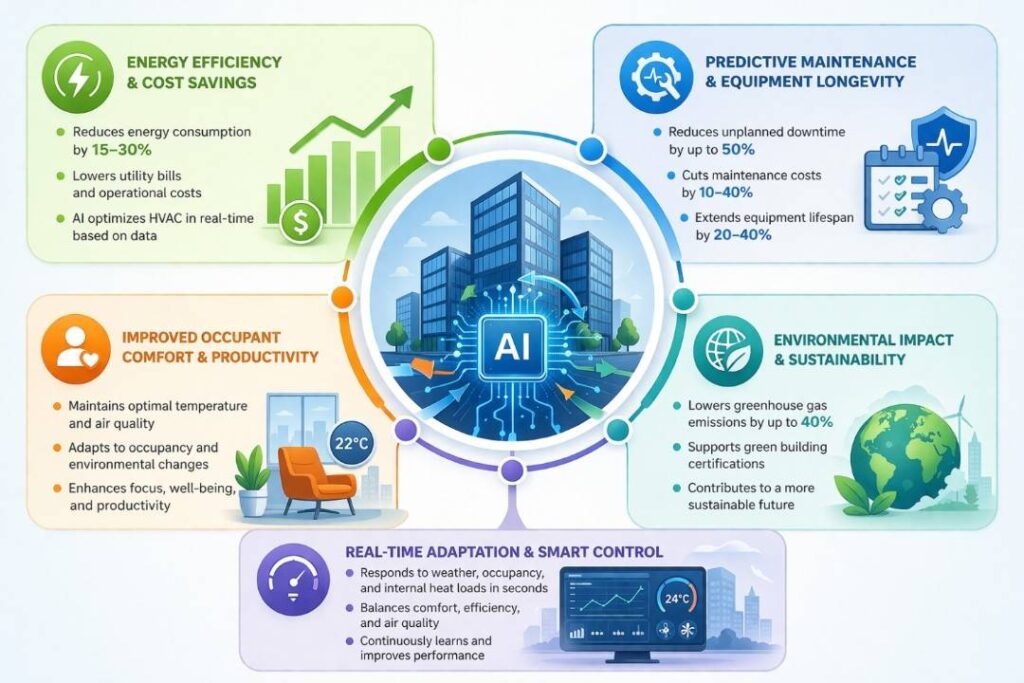
Adding AI to existing HVAC equipment can decrease energy consumption by up to 25% and reduce emissions by up to 40%. AI achieves these reductions by connecting to existing systems and sending optimized control commands that account for weather forecasts, utility data, and grid emissions factors.
In commercial settings, energy savings range from 15% to 25% compared to traditional systems. A major international airport in Southeast Asia achieved approximately USD 500,000 in annualized savings by reducing HVAC energy consumption by 10%. Healthcare facilities have documented 10% to 20% energy cost savings using AI-driven optimization.
HVAC systems can consume up to 40% of a building’s total energy. Inefficient management causes waste and premature equipment wear. AI addresses this problem by forecasting temperature variations, energy demand peaks, and maintenance needs before problems surface.
Predictive maintenance and equipment longevity
Predictive maintenance through AI can reduce unplanned downtime by up to 50%. Facilities using AI predictive maintenance have documented 72% fewer unplanned failures. This approach cuts maintenance costs by 10% to 40% compared to traditional schedules.
Equipment lifespan extends by 20% to 40% when AI detects early warning signs in critical components like compressors, fans, and refrigerant systems. AI monitors performance indicators and flags issues like dirty filters or refrigerant leaks before they cause system strain. This prevents small problems from escalating into expensive failures.
Improved occupant comfort and productivity
AI optimizes thermal comfort by analyzing real-time occupancy patterns and environmental conditions. AI-driven controls dynamically adjust comfort levels while using less energy, unlike static systems that maintain fixed temperatures.
Buildings with AI-driven climate control achieve better air-quality monitoring by tracking CO2 levels and particulate matter. The system alerts facility managers when ventilation adjustments are needed. Stable temperatures and clean air help occupants stay focused and energized.
Real-time adaptation to environmental changes
AI systems respond to occupancy changes, external climate shifts, and internal heat gains within seconds. This adaptive approach balances comfort, energy efficiency, and health outcomes by predicting and adjusting thermal conditions based on multiple data inputs.
AI technologies transforming building climate management
Several interconnected technologies power modern AI climate control buildings. They work together to create responsive and efficient systems.
IoT sensors and data collection
IoT-based monitoring forms the backbone of intelligent climate management. Sensors track temperature, humidity, CO2 levels, and occupancy patterns at one-minute intervals. This ensures high-resolution insights. These devices gather data on indoor conditions alongside external climate factors. They transmit information to cloud-based platforms for analysis.
Motion detectors identify unoccupied spaces. Systems can then adjust cooling levels and conserve energy during off-peak times. Wireless sensor networks now provide detailed coverage across multiple floors. Data gets integrated into AI platforms for precise control. This continuous monitoring enables building operators to make informed decisions based on immediate conditions rather than assumptions.
Deep learning for pattern recognition
Deep learning methods excel at capturing complex temporal dependencies in HVAC operational data. Long short-term memory networks (LSTM) and recurrent neural networks process historical performance data. They predict future consumption patterns. These algorithms identify relationships between sensor measurements, control variables, and total energy use.
Deep learning has proven especially effective for fault detection in HVAC systems. Studies show these methods correctly identify systems with faults and accurately recognize systems without issues. Machine learning models are trained on environmental parameters such as dry-bulb temperature, relative humidity, and solar radiation. System efficiency gets optimized through iterative improvements.
Automated HVAC optimization
AI platforms deploy thousands of models at once using elastic, multi-node architectures. These systems generate optimal recommendations for setpoints. Energy costs are minimized with suggestions tailored to user-defined priorities, such as reducing electricity versus natural gas expenses.
Integration with smart building ecosystems
AI climate systems integrate naturally with lighting, security, and water management technologies. This creates automated structures. Interoperability enables different building systems to share data and coordinate responses to changing conditions.
Real-world applications and implementation
Major organizations worldwide have deployed AI climate control buildings with documented results. Johnson Controls created OpenBlue, a smart building platform built on Microsoft Azure that connects climate control, lighting, fire safety, and security systems into a centralized digital infrastructure. Facilities expect a 20% to 30% reduction in operating costs, a 10% to 15% reduction in maintenance spend, and a 10% to 20% reduction in energy emissions through strategic collaborations that implement AI, virtual reality, and digital twins.
Commercial buildings using AI climate control
Hilton’s Connected Room platform adjusts temperature, lighting, and ventilation based on guest priorities and check-in data. The system achieved a 36% reduction in energy consumption per square meter over ten years. Beijing’s Galaxy SOHO complex uses Baidu’s AIoT platform to coordinate HVAC, elevators, lighting and security. This resulted in a 28% reduction in energy expenditure. Marina One in Singapore uses AI-driven systems to adjust climate control based on occupancy and CO2 levels. The building enables energy savings of up to 35% compared to standard commercial buildings.
Residential applications and smart homes
Smart thermostats like Nest and Honeywell Home learn household habits and adjust temperatures automatically. Homeowners can save up to 10% per year by adjusting thermostats 7 to 10 degrees Fahrenheit for 8 hours daily. Higher upfront costs deter adoption despite long-term savings. Data privacy concerns and compatibility issues between manufacturers create barriers.
Implementation costs and ROI timelines
A 200,000-square-foot Class A office building requires predictive maintenance platforms that cost $46,000 to $60,000 annually, against total benefits of $150,000 to $190,000. This yields ROI of 160% to 520% with payback periods of 4 to 8 months.
Challenges in deployment and scaling
Each building presents unique characteristics. This makes it difficult to transfer optimization techniques. Deployment can account for up to 50% of total project time and cost due to the heterogeneity of systems and lack of standardization.
Conclusion
AI climate control is a proven solution that reduces building energy consumption and operational costs. Studies showed that facilities achieve 15% to 40% energy savings and improve occupant comfort and equipment longevity. Deployment challenges exist, especially with system heterogeneity, but the ROI timelines speak for themselves. These systems deliver measurable environmental impact by significantly reducing emissions. We recommend starting with pilot implementations to test AI-driven optimization before scaling throughout your portfolio.