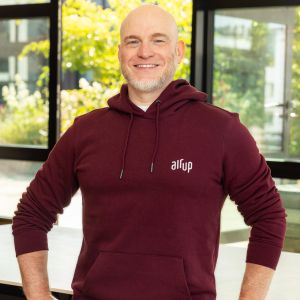
Chris Hauth Podcast Transcript
Chris Hauth joins host Brian Thomas on The Digital Executive Podcast.
Brian Thomas: Welcome to Coruzant Technologies Home of The Digital Executive Podcast.
Do you work in emerging tech, working on something innovative? Maybe an entrepreneur? Apply to be a guest at www.coruzant.com/brand.
Welcome to The Digital Executive. Today’s guest is Chris Hauth. Chris Hauth is the CEO of air up, the German consumer brand behind the world’s first refillable Scentaste drinking system, which flavors water through scent alone without sugar or additives.
Under his leadership, air up has grown from an early university born idea into one of Europe’s fastest growing consumer businesses, scaling profitable nine figure revenue, and expanding across major international markets. Air up sits at the intersection of health, sensory innovation, and behavior change, giving Chris a distinctive perspective on how breakthrough physical products are built, explained, and scaled.
Before joining air up, Chris held senior leadership roles at Freeletics, where he worked across marketing, customer experience, and e-commerce during a period of international expansion and brand development. Earlier in his career, he co-founded and led siroop, a Swiss B2C marketplace, giving him experience across entrepreneurship, digital growth, and consumer platform building.
Today he shares how to ensure innovation in physical consumer products and the challenge of building credibility and a new market category.
Well, good afternoon, Chris. Welcome to the show.
Chris Hauth: Hello, Brian. Nice to be there.
Brian Thomas: Absolutely, my friend. I appreciate it and making the time. We are traversing about six time zones, or six hours, approximately.
Chris Hauth: A couple. Yeah.
Brian Thomas: It’s, yeah. You’re in Lichtenstein. I’m in Kansas City. So, it’s always a challenge doing these international podcasts, but I really, really appreciate it. And Chris, if you don’t mind, I’m gonna jump into your first question. You helped scale air up from a university student idea into one of Europe’s fastest growing food startups.
With nine figure revenue, what were the key moments in your journey that shaped you as a CEO?
Chris Hauth: Very good question. I would say the biggest moment was at the very get go when we set together and the founders decided to bring me on. It’s a very rare moment in startups that founders have the humility and also the foresight to take a step back from their own baby and bring somebody else on to lead it.
And that is one of the key pillars of, of air ups. Say motivation leadership philosophy since then, we always say company over ego. We have super low ego company and that was one of the first big things for me and important things. It was the main pillar that I needed to start at app.
I wouldn’t have done it otherwise. After that we, I had a bit of a, an analysis section of where we want to be in five years. To be very frank, we said around 30 to 40 million would be a really good goal. Fact is five years later we are at nearly 150 million. So quite surpassed that that very early set on goal.
And the most challenging part on that journey to that 150 million for me was keep the reins. Steady during hypergrowth in a period where you could not steer as I was used to steer pre Corona, you were basically in office. You are walking to halls and you interacted with people, with live people, with real people on a daily basis.
And literally when we switched on our website at December, 2019, four months later, Corona hit. Yeah. So the birth of air up was happening under, the cloud of Corona. And for me that was one of the most decisive learnings in my whole career. That you actually don’t need to be in an office. Yeah. That you don’t need to cramp everybody and force everybody to travel an hour or two hours a day to the office that it actually works.
Building a company without doing that most decisive learning probably ever in my personal history. And after that, of course we had another one that was super decisive for us as a company that grew up in Corona D two C first, and then suddenly Corona ends and all the predictions that all the smart guys from Google, Shopify, and whatnot made during Corona that it would change the world forever, just did not come true.
It just, within a matter of six, 12 months completely went back to the old reality. Yeah, people bought offline. People went away from D to C. We were pure D to C, so we had to evolve in light year speed. And that was the second biggest learning in the history of being the CEO ever. Don’t believe predictions.
Brian Thomas: That’s amazing. Thank you so much. There’s just so, and I love these. Usually the first question here is, is talking about, how’d you get to where you are today? And you talked about the inception air up the challenges the goals. You set 20, 30 million in revenue and you surpassed that by at least four times.
That’s just awesome. And then of course you learned, you, you shared about keeping those rain steady during hypergrowth, but the pandemic was a challenge for many people. Probably everybody, including your company as well. You leveraged that and it taught you that, companies can be successful being remote and there is a lot of time savings if you take out a lot of the old brick and mortar business model.
So, I really appreciate everything you shared and that’s just really exciting for us here. And Chris, air up introduced the Scentaste System, flavoring Water through Scent Alone. What inspired this breakthrough concept and how did you validate that consumers would embrace it?
Chris Hauth: To very honest that was not my doing.
There was a doing of two of my co-founders on the team Lena and Tim, they started it in a bachelor thesis very, very early on. They were studying product design and the title of the thesis was given by the university, and it was supposed to be neuroscience meets product design. Very generic, very broad.
By accident, Lena stumbled over, I think it was Canadian University’s a tick article over Rachel Nasal Scent Perception. So instead of smelling through the front of your nose, basically perceiving scent through the back of your mouth reaching the retronasal cavities. And that got her thinking if there might not be something behind it.
And at the same time, they were looking at consumer problems to solve or actually humankind problems to solve. The easiest way to start they figured out is probably looking at what are the main root causes, why we die as humans. And the majority of humans die because of cardiovascular diseases.
And cardiovascular diseases are a civilization problem. Why are they occurring? Well, the root cause or the majority of the root causes lies in fat and sugar consumption. Being far too high compared to what it is supposed to be for an animal that grew up in the steps. So here we go. They looked into that.
What is the main source for that? Poisoning through fat and sugars. Turns out it’s not our food, it’s our drinks, because in drinks we rarely expected. So. The sugar contained in any liquid form when drinking is one of the main problems that causes cardiovascular diseases, which is the main cause why humans actually die.
And that triggered the thinking for air up and send taste. They thought if you can actually include, send and thus taste to a degree in something that’s not liquid and in something that’s not fixed, stuff like food. What would happen then if you can decouple, send and taste from the stuff that it’s usually contained in.
That’s the whole idea behind Scentaste. Basically what it does is it’s encapsulating natural aromas in little air bubbles. They explode in the back of your mouth, go to through your a nasal cavities. Your brain thinks you are tasting orange chocolate, which I’m drinking right now. And, in reality, your body just ingests water and your nose breathes out the natural rumors.
That’s all it is.
Brian Thomas: That’s awesome, and I appreciate that. You talked about the genesis of your co-founders. The, there was this bachelor thesis they were working on and they figured out that this perceiving the scent through the back of your mouth obviously worked and put that prototype to test.
Of course. But you did highlight the issue that we as humans have is this cardiovascular disease. It’s a big issue here in the US as fat and sugars, right? And what you talked about here is a lot of the sugars that we. Really just don’t understand is coming through our drinks, not through our food necessarily.
And you’ve basically taken that science, decoupled the scent from the taste and made something that not only is healthy and pure water, but also going to help the world be a better place. And disease free is the goal. So thank you. And Chris air up has expanded across 16 European markets and in the US.
What have been the biggest challenges and lessons in scaling internationally?
Chris Hauth: It’s probably different for our air up than for other companies because we experienced very early on that our product caught on in literally every market in Europe that we entered. And usually if you look at other startups in Europe, they are strong, super strong in one market and then you know, meek or weak in all others.
And there’s one core market, well, one home market that’s overpowering least strong. That’s not the case for app. So in Germany or birthplace we are. At around 25% of our revenue around 20% comes from France, another 15 to 20 comes from UK and so on and so forth. We basically are, if you look at purchasing power, very much equal to that in the distribution of our revenue, and that’s very much unique.
However, it does not excuse us from the typical challenges on internationalization. And there you Americans have a huge advantage. You have a consolidated 360 million English speaking, or at least mostly English speaking market. If we are talking about Europe, we are talking about 12 markets. Then we are talking about 12 cultures, 12 languages.
Yeah. That is the biggest challenge for any European company scaling in Europe or any international company coming to Europe, underestimating that cultural and that language and that that inherent complexity of basically crossing a border into a completely different civilization. While we are called Europeans we are extremely different.
And when it comes to go to markets, that needs to be taken into account. It’s not just language, it’s purchasing behaviors. It’s the buildup of how people search for products, how people learn about products, very different despite meta, despite Google, despite TikTok very different per country.
And it’s also about generational differences in the individual countries that are, I would say it’s like entering a new universe every single time, and that puts a lot of strain on a small company with limited resources. Who can’t just, reinvent communication for every single market.
So you need to accept that you’re probably gonna be average in your communication. If you wanna internationalize in Europe across the markets, you cannot be perfect in Germany, perfect in France, perfect. In UK it’s just literally impossible unless you have unlimited money, which we don’t.
Brian Thomas: Wow. That’s I didn’t look at it that way, but it totally makes sense.
Your product did catch on early in the European market, but you talked about the complexities obviously being in that market in Europe, you mentioned there’s 12 different markets, 12 different languages, cultures and you need to take that into account when you’re going to market. And I really do appreciate those insights and so does the audience here.
Chris, the last question of the day, as we look ahead to the future, how do you see the future of consumer products evolving, particularly in health and experiential innovation, and where does air up fit into that future?
Chris Hauth: I do firmly believe that the future is. More on the functional side, and it’s much more on the science side when it comes to food and food innovation, or generally innovation than it used to be in the past.
People are no longer believing any BS that they hear and that they see, they’re much more critical. They are much more reflective on what they actually ingest and want to ingest. And it starts low key, but it, or started low key, but it became mass market already a couple of years ago.
And that trend is going to continue. So the food industry has to change, has to become more transparent. Not just because it’s gonna be forced by regulation and government but especially because the consumers are no longer buying everything that they are being told and they watch out what they eat.
For app, that means our biggest challenge will be to move from a product that costs 40 to 50 US dollar per pop for the bottle and around six to 12 US dollar for the pots, the flavor pots, into a product that is much more accessible to more people at a significantly lower price point. And there stay tuned.
There’s going to be a big innovation starting in UK from us in 2027. We have managed to super shrink our product into ready to drink. Can, if you like which we can sell for the price of a dollar 80 or $2. Easily and thus finally make cent taste and the cent taste technology available to the masses.
Right now. It is definitely a product that is not an occasional buy right now. It’s a product that needs a lot of reflection before you buy it because it is quite an invest. The future will be very much different. We will make health accessible to the mass market, and I think that is the trend in the market per se.
The mass market is getting healthier.
Brian Thomas: Thank you. I think that’s important. You talked about we’re looking to the future here, but functional and science side of things is much more looked at than it has ever been in the past. People are more aware of what products they buy, they can consume.
They want to be healthier no matter what’s on the commercials that say, Hey, drink these different unhealthy soft drinks. Your goal with air up is to bring your product down to a better price point for everybody, thereby bringing health to the masses. And I think that’s just amazing.
I really appreciate that. And Chris, it was such a pleasure having you on today and I look forward to speaking with you real soon.
Chris Hauth: Same here, Brian. It was a pleasure. Thanks for having me.
Brian Thomas: Bye for now.
Chris Hauth Podcast Transcript. Listen to the audio on the guest’s Podcast Page.