Anshuman Podcast Transcript
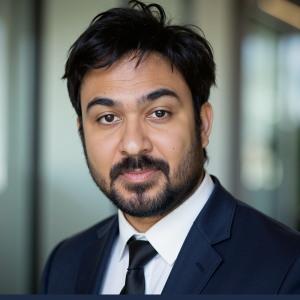
Anshuman Yadav joins host Brian Thomas on The Digital Executive Podcast.
Brian Thomas: Welcome to Coruzant Technologies, Home of The Digital Executive Podcast.
Do you work in emerging tech, working on something innovative? Maybe an entrepreneur? Apply to be a guest at www.coruzant.com/brand.
Brian Thomas: Welcome to The Digital Executive. Today’s guest is Anshuman Yadav. Anshuman Yadav is a two times entrepreneur and strategic finance, financial planning and analysis, and capital allocation leader with over 12 years of global experience across Fortune Global 500 financial institutions, publicly traded technology companies, and high growth startups.
He has worked across the United States, India, and Canada, advising executives on enterprise forecasting, FP&A transformation, M&A evaluation, and scalable operating models designed to perform under uncertainty. He’s the founder and CEO of NeuraCraft and architect of StratiqAI an AI native CFO system designed to help founders deploy capital with clarity, structure and discipline.
Through this work, Anshuman has built resilient financial infrastructure at the intersection of finance and AI transforming finance from reactive reporting into proactive decision architecture. He has also served emerging ventures as a fractional CFO, helping founders refine strategic planning, fundraising narratives, and capital efficiency frameworks.
Well, good afternoon Anshuman. Welcome to the show.
Anshuman Yadav: Good afternoon, Brian. Excited to be here.
Brian Thomas: Absolutely my friend. I appreciate it making time today to get on a podcast. I know we’re in the same time zone in Chicago. I’m in Kansas City, so thank you so much. I really appreciate that. Anshuman, if you don’t mind, I’m gonna jump right into your first question.
You’ve built a career across Fortune 500 institutions, public tech companies and startups. Before founding NeuraCraft, what key experiences shaped your journey to becoming a founder and an AI focused finance leader?
Anshuman Yadav: So, there was a founder I was working with Sharp, well-funded good instincts, and yet he could not tell me with confidence what his company’s burn rate actually was.
Not because he was not paying attention, but because his banking data, his payroll system, his accounting software, they were all saying something slightly different. And that was not unusual. I have seen versions of that everywhere, in large enterprises where the treasury team and the CFO would have different views on available cash.
Not because anyone made an error, but because the timing of how systems updated created a permanently moving target. And then even in startups where decisions moved fast, but the financial picture was fragmented and the models broke, the moment, assumptions changed. So in both these environments, the pattern was the same.
Finance was explaining decisions after they had already been made instead of shaping them in real time. What made that frustrating was that the people were not the problem. These were capable, experienced teams, but they were spending the majority of their time reconciling data instead of generating insight, validating numbers, instead of acting on them.
So the system was not built to help them lead. It was built to help them report. So that gap is what led me to build NeuraCraft and StratiqAI platform. Because what founders and leadership teams who are missing wasn’t ambition or intelligence. It was a system that could unify their data, hold institutional memory, and help them make forward looking decisions with confidence.
And completely, that means three things. It means integrating DA data across every system in real time. So there’s one version of the truth, not three. It means building institutional memory into the platform itself. So the context behind every number doesn’t walk out the door when A CFO moves on. It means simulating decisions before they are made.
No running scenarios. Stress testing assumptions so leadership can act with clarity instead of just reacting to what already happened. That’s what we built an AI native CFO system designed to move finance from reactive reporting to proactive decision making.
Brian Thomas: That’s awesome. I really appreciate that.
You’re absolutely right. You can, there’s examples in every industry, but finance especially, and I’m glad you’re focusing on it, but taking that reactive and turning it into more of a proactive, forward thinking, strategic tool versus just always trying to figure out where you’re at. And I, I really love that, but your backstory, you learn from another founder, and a lot of CFOs go through this too.
They just can’t provide the data that you need that is up to date. They can’t provide you that burn rate. They’re always focusing on validating the data rather than, Hey, we have the data, now let’s start looking at it proactively. And I just love when founders like yourself, see a gap or a need in the market and go ahead and try to build a solution.
So, thank you. Anshuman, you’ve advised organizations across the US, India, Canada, how do global perspective influence capital allocation strategies and financial decision making?
Anshuman Yadav: One of the biggest lessons from working across the US Cap India, Canada is that capital allocation is not universal. It’s shaped by both culture and constraints.
In the us, especially in venture backed environments, there’s a strong bias towards growth. The capital is deployed aggressively to capture market share, sometimes even ahead of proven unit economics. I have seen companies scale sales teams very quickly, only to realize later that retention or margins were not strong enough to support that growth.
In markets like India. Capital tends to be more constrained, which forces a much sharper focus on efficiency and return on every dollar invested. So in one case, I worked with a team that delayed hiring and focused on improving product monetization first, which extended their runway significantly without having them to raise any additional capital.
So you end up with two very different instincts. One, optimize for speed and the other for discipline. What I’ve found is that the best operators, they actually combine both. They pursue growth, but with a very deliberate and disciplined approach to capital allocation. And that means understanding not just where to invest, but when, and equally importantly, when not to invest.
Brian Thomas: Thank you. That’s awesome. And I’m glad that you shared that. ’cause I know every region in the world is different. You talked about that capital allocation in the US obviously focused on growth and speed and what you found in India, they were more focused they were more disciplined of course, but they were more focused on that conservative spend.
But again, knowing what you have, where your markets are, you can adapt and adjust to those markets. So I appreciate that. Anshuman, you described StratiqAI as an AI native CFO system. What was broken in traditional FP&A and financial leadership that inspired you to build this platform?
Anshuman Yadav: When people hear AI native CFO system, they assume the story starts with AI.
It does not. It starts with a much more basic problem that AI alone cannot fix. Here’s a diagnosis I’d push back on that. Finance teams in most cases are slow because their tools are bad. Better software, better dashboards, better automation. That’s where most of the conversation goes. But I’ve seen companies with best in class software still spend the first few days of every planning cycle, just reconciling numbers.
The tools were not the problem. The problem ran deeper. It’s a combination of three things, fragmentation process, and something that doesn’t get talked about enough. The absence of system level memory on fragmentation. Financial data today lives across multiple disconnected systems. There’s banking, revenue platforms, payroll, accounting, each with its own logic.
None of them build to agree with each other. You get multiple versions of the truth, and by the time you have reconciled them, you’re exhausted, you’re behind, and the actual decision making gets compressed into whatever time is left. Sales may have one number as an example. Operations could have another number.
Finance could have a third number depending on how they are defining and measuring that metric and nobody’s lying, they’re just pulling data from systems that were never designed to connect. The deeper issue is memory, and the cost of missing it is higher than most people realize. When institution memory isn’t embedded in the system, you don’t just lose efficiency, you lose pattern recognition.
You repeat the same forecasting mistakes because nobody remembers why the last one missed. You revisit assumptions that were already stress tested and discarded six months ago. So I’ve sat in rooms where someone proposes an approach and a senior person sees, oh, we tried that in 2021 and here’s why it didn’t work.
That one comment saves weeks of work. That knowledge is enormously valuable, but it lives in one person’s head and it’s really documented and it does not definitely scale as the organization grows. So every planning cycle partially starts from scratch, and as a result, finance ends up reactive spending.
Its energy explaining decisions after they have already been made instead of shaping them in real time. What I wanted to build with StratiqAI was fundamentally different. Not another dashboard, but a system that integrates data in real time, builds institutional memory over time, and helps you simulate a decision before you commit to it.
Something that acts like a CFO with an embedded team behind it. Because if you just layer AI on top of broken processes, you don’t fix anything. You’re just scaling the kiosk. So that founder, I mentioned, the one who couldn’t tell me his burn date, that’s exactly who we built strategy for. And there are a lot more of him out there than people think.
Brian Thomas: Absolutely. And in my tech career I’ve seen the same. So, I appreciate you highlighting it and a few things. You did say, obviously AI alone cannot fix this, right? You talked about where everybody’s like, well we’ve gotta do this software and this analytics and you’ve seen where people have spent a lot of money in that area and it still doesn’t fix anything.
You talked about process and fragmentation, but what you’re building really builds real time data. It documents that institutional knowledge and provides that decision making, which is phenomenal. So thank you, Anshuman. The last question of the day, as we look to the future, how do you see AI reshaping the role of finance leaders and capital allocation over the next decade, and what will separate companies that thrive from those that struggle?
Anshuman Yadav: I think AI is going to do something that makes a lot of finance leaders uncomfortable. It’s going to make it very obvious who’s actually operating strategically and who’s been sheltering behind the complexity of the reporting function. So right now, a significant portion of what finance does, reconciling data or building variance reports on maintaining financial models.
They’re all genuinely hard and time consuming. But AI is going to compress that dramatically, and when it does, the question becomes what are you actually doing with the capacity that frees up? So the leaders who thrive will use it to increase decision velocity, and I mean that in a very specific way, not just moving faster, but being able to test scenarios quickly, stress test assumptions against real time signals and allocate capital more dynamically.
So instead of locking into a static annual plan and revisiting it quarterly, they will be running continuous capital allocation. Revisiting and optimizing investment decisions across hiring product marketing on an ongoing basis as conditions change rather than committing upfront and reacting only when things drift.
And that’s a fundamentally different operating model. And the ones who struggle will be running the old cycle, backward looking reports, reactive adjustments. Acting after the window to act has already closed. The compounding of that is pretty significant. It’s not just that they’re slower. It’s that the gap widens every quarter.
The leaders running continuous allocation, they’re learning from real time signals and they’re adjusting. The ones on the old cycle are working from data that’s already three months still. By the time it reaches a decision, so over two or three years. That’s not a small difference in outcomes. It’s a structural disadvantage that becomes very hard to close.
So what actually separates them? It’s not whether they adopt AI because almost everyone will. It’s how deeply it gets integrated into how decisions actually get made into the operating cadence, not just the reporting layer, but here’s the part I think gets underappreciated. The shift isn’t technological, it’s conceptual.
Finance has to stop seeing itself as the function that explains what happened and start seeing itself as what I would call a decision architecture function. The system through which the entire organization makes better choices. The future CFO is since someone who presents numbers to the board, they are the person who designs how decisions get made across the company.
And that’s a very different job. And not everyone currently in that sheet is going to make that transition. I think about that founder who made a capital allocation called six months too late because his financial picture was always lagging reality. The window had closed by the time he saw it.
That’s the cost of the old cycle, and that cost is only going to get higher.
Brian Thomas: That’s amazing. I appreciate you breaking that apart for us too. You’re absolutely right and we’re seeing this today. AI is disrupting, it’s challenging, as you said, the status quo. Especially, you know those people, those experts that may be comfortable in their analytical tools or maybe even be hiding behind them.
AI is definitely going to be challenging. And you talked about forward thinkers will be well ahead of those that are still not looking at investing in AI or future technologies. They’re still looking at data that’s 30, 60, 90 days old. And that’s not a recipe for sustainability. It’s a recipe for disaster for the business.
And I, last thing is finance needs to move from what happened into that more strategic architectures of strategy for the organization. And I, I really like that. Anshuman, it was such a pleasure having you on today and I look forward to speaking with you real soon.
Anshuman Yadav: Thank you so much for having me on the show, Brian.
Brian Thomas: Bye for now.
Anshuman Yadav Podcast Transcript. Listen to the audio on the guest’s Podcast Page.