
Node.js shows up in a lot of modern healthcare platforms for good reasons. It handles high-concurrency APIs well, supports real-time communication, and also fits naturally into microservice architectures for healthcare startups. Telehealth apps, patient portals, and remote monitoring systems often rely on Node.js on the backend.
But the moment a product touches patient data, the rules change. Building regulated software is fundamentally different from launching a typical SaaS product. Security requirements, infrastructure constraints, and auditability shape almost every technical decision, which is why Node.js healthcare application development ends up looking very different from standard backend work.
This gap becomes obvious when startups hire a Node.js development team without checking whether the team has experience building compliant healthcare systems. Strong JavaScript skills alone don’t guarantee the product will pass security reviews or partner integrations.
Below, we gathered the most typical mistakes that show up again and again in early-stage healthtech products.
Key Takeaways
- Node.js is popular in healthcare for its ability to handle high-concurrency and real-time communication, but building compliant software requires a different approach.
- Startups often treat healthcare software like standard SaaS, neglecting important compliance aspects like logging, traceability, and audit trails.
- Technical skills are insufficient; teams must understand healthcare standards like FHIR, and compliance extends to infrastructure, not just application code.
- Relying on external tools can create compliance risks if they aren’t built for healthcare, as they might mishandle patient data.
- It’s crucial to prioritize security from the start, including continuous testing and expert knowledge in healthcare regulations, to avoid costly revisions later.
Table of contents
- Treating Healthcare Software like Another SaaS Dashboard
- Assuming Node.js Itself Solves Security
- Hiring Good JavaScript Engineers Who Know Nothing About Healthcare Startups
- Forgetting that Compliance Includes Infrastructure
- Patient Data Moves Through more Systems than Healthcare Startups Expect
- Compliance Documentation is not Optional Paperwork
- Third-party Tools can Quietly Break Compliance
- Monolithic Backends make Security Harder
- Security Testing Arrives Too Late
- Speed is Useful. Security Debt is Expensive.
Treating Healthcare Software like Another SaaS Dashboard
Founders of healthcare startups often assume the same architecture used for a marketing platform or analytics tool will work for healthcare.
It usually doesn’t.
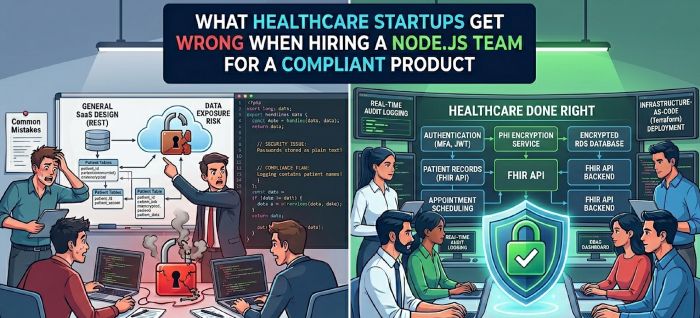
Healthcare systems handle protected health information (PHI). That affects things developers rarely worry about in consumer apps: logging policies, infrastructure isolation, encryption policies, as well as audit trails.
Take logging. A typical Node.js stack might use Winston or Pino for structured logs. In a healthcare environment, those logs must never contain patient identifiers, appointment data, or clinical notes. Yet many teams log request payloads during development and forget to disable them in production.
Another overlooked requirement: traceability. Healthcare systems must record who accessed patient records, when they accessed them, and also what they changed. These audit trails must survive system restarts and infrastructure changes.
If the architecture doesn’t support that from the beginning, teams end up rebuilding core components months later.
Assuming Node.js Itself Solves Security
Node.js is a runtime, not a compliance layer.
Some founders of healthcare startups believe choosing a modern stack automatically produces a secure system. In reality, security failures almost always happen in surrounding services: authentication logic, storage configuration, API access rules, or third-party integrations.
Secure healthcare systems require deliberate design decisions, and this is where most teams underestimate the scope of HIPAA compliant Node.js development:
- encryption for data in transit and at rest
- short-lived access tokens and secure refresh flows
- strong role-based access control (RBAC)
- audit logging across services
- secrets management for credentials and keys
Authentication is a good example. Many Node.js apps rely on JWT tokens with libraries like jsonwebtoken or Auth0 SDKs. But default settings often allow long-lived tokens and weak refresh logic.
Healthcare systems typically require stricter session management and often multi-factor authentication.
The runtime won’t enforce that for you.
Hiring Good JavaScript Engineers Who Know Nothing About Healthcare Startups
This one happens constantly.
A startup hires experienced backend engineers. The developers are great with Express, NestJS, PostgreSQL, as well as Docker. The system works well technically.
Then the product needs to integrate with a hospital.
Suddenly, the team discovers standards like FHIR (Fast Healthcare Interoperability Resources) or HL7. These define how medical data moves between systems such as Epic, Cerner, or Allscripts electronic health record platforms.
Without prior exposure, developers spend months learning the domain.
Experienced Node.js developers for healthcare startups already know these patterns. They understand that clinical systems require structured patient identifiers, strict data validation, in addition to specific authentication models.
That knowledge shortens integration timelines dramatically.
Forgetting that Compliance Includes Infrastructure
Startups often focus on application code and forget the infrastructure layer entirely.
But compliance requirements extend to cloud configuration, logging pipelines, as well as access policies.
For example, healthcare workloads running on AWS typically rely on services configured with strict controls:
- Amazon RDS with encryption enabled
- S3 buckets with restricted public access
- AWS KMS for key management
- CloudTrail for audit logging
Misconfigured storage buckets are still one of the most common data exposure issues across industries. In healthcare, that kind of mistake can trigger regulatory investigations.
A mature healthcare software development team treats infrastructure as part of the security model. They define it through infrastructure-as-code tools like Terraform or AWS CloudFormation so environments remain consistent.
Manual configuration is where most mistakes happen.
Patient Data Moves Through more Systems than Healthcare Startups Expect
Developers often think about security in terms of databases.
In reality, patient data flows through many layers:
- API gateways
- Microservices
- message queues
- Caches
- analytics pipelines
- monitoring tools
Every step creates a potential exposure point.
For example, teams frequently send user activity data to analytics platforms like Mixpanel or Amplitude. If patient identifiers slip into those events, the data ends up stored in systems not designed for regulated healthcare workloads.
Strong Node.js data security healthcare practices focus on controlling these data flows.
That means:
- sanitizing logs and analytics events
- encrypting service-to-service traffic
- isolating PHI from non-regulated tools
- minimizing stored patient identifiers
Reducing the amount of stored PHI is one of the simplest ways to lower breach impact.
Compliance Documentation is not Optional Paperwork
Technical controls alone do not prove compliance.
Healthcare platforms must document how security policies are implemented and enforced.
Startups often delay documentation until they approach partnerships with hospitals or insurers. At that point, they suddenly need:
- security architecture diagrams
- data protection policies
- incident response procedures
- vendor risk assessments
- employee access controls
Without these documents, due diligence reviews stall.
Security documentation also forces teams to clarify how systems actually work. If a policy states that backups are encrypted, the infrastructure must prove it.
Many teams discover gaps only when they try to document their processes.
Third-party Tools can Quietly Break Compliance
Startups depend heavily on external services. Email platforms, analytics tools, monitoring systems, and customer support software rely on dozens of them.
The problem: many services were built for consumer apps, not regulated healthcare systems.
Common risk areas include:
- support platforms like Zendesk storing patient messages
- analytics tools collecting identifiers
- messaging platforms storing appointment details
- error monitoring systems capturing request payloads
Before integrating a service, teams must verify whether it supports regulated healthcare data handling.
Some vendors provide contractual protections for healthcare workloads. Others simply cannot be used with PHI.
Ignoring that distinction creates serious compliance problems later.
Monolithic Backends make Security Harder
Early-stage startups often build a single Node.js service handling everything: authentication, messaging, scheduling, and patient records.
That speeds up initial development. It also creates long-term security headaches.
When everything lives in one application, vulnerabilities in one feature can expose the entire system. It also becomes harder to apply strict access controls.
Modern healthcare platforms often split responsibilities into smaller services:
- authentication and identity
- patient records
- messaging
- scheduling
- analytics
Node.js works well for these architectures. Lightweight services built with frameworks like NestJS or Fastify can run independently while communicating through APIs.
This isolation limits the blast radius of security problems.
Security Testing Arrives Too Late
Startups frequently delay security validation until the product approaches launch.
That’s risky.
At that stage, fundamental design flaws are difficult to fix—things like weak tenant isolation or flawed access control models.
Security validation should include several layers:
- dependency vulnerability scanning
- automated security checks in CI pipelines
- regular penetration testing
Tools like Snyk, Dependabot, or npm audit help monitor vulnerabilities in Node.js dependencies. Considering how large the npm ecosystem is, monitoring is essential.
Security testing works best when it’s continuous, not a one-time review before release.
Speed is Useful. Security Debt is Expensive.
Startups are built around speed. Investors expect rapid product iterations and quick market validation.
Healthcare software forces a different balance.
Cutting corners on security or compliance early in healthcare startups often leads to major refactoring later. Systems handling sensitive patient data cannot rely on patchwork fixes.
That’s why experience matters when teams hire a Node.js development team for healthcare platforms. Developers who have already built compliant systems know where the traps are long before regulators or hospital partners find them.
Getting those foundations right early saves months of rework later.