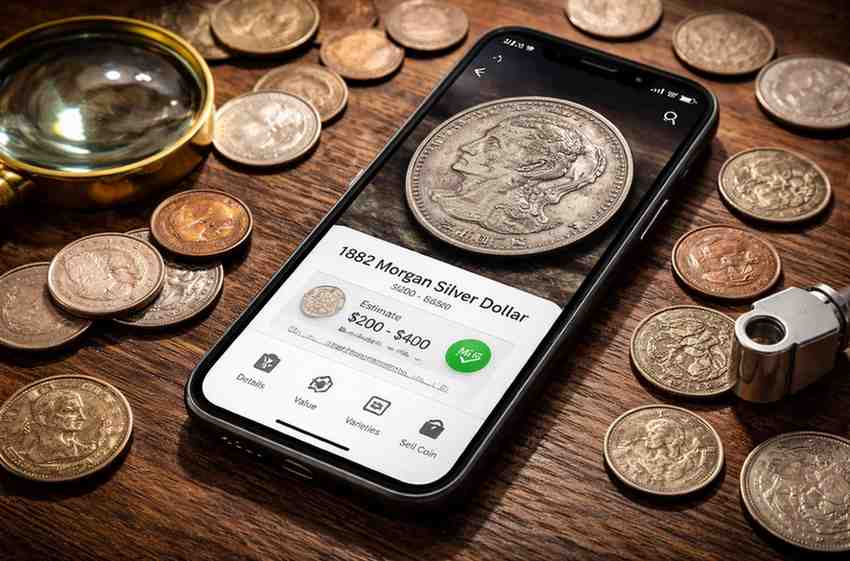
Artificial intelligence is increasingly being applied to niche domains, including collectible identification. Coin identification apps now use computer vision and data aggregation to help users recognize and evaluate coins more efficiently. This article examines how one such app performs in practice, focusing on accuracy, system behavior, and limitations rather than promotional claims.
Table of contents
The App in Context
CoinKnow is an AI-powered mobile application that identifies U.S. coins. It uses image recognition to analyze uploaded photos and match them against a structured dataset of known coin types. In addition to identification, the app provides estimated grading ranges and market-based value approximations.
Its primary focus is on U.S. coinage, allowing the system to concentrate on depth within a defined dataset rather than attempting broad global coverage.
Testing Methodology
To evaluate performance, a small group of coins was tested under controlled conditions. These included a mix of common coins, proof coins, and known error varieties, along with one coin outside the app’s supported scope.
All images were captured using consistent lighting, macro mode, and neutral backgrounds. This ensured that the results reflected typical usage conditions rather than edge-case scenarios.
Observed Identification Performance
In testing, the app generally accurately identified standard U.S. coins when images were clear. Coins with distinct visual characteristics, such as steel cents or proof finishes, were recognized without noticeable issues.
For coins with known variations, such as doubled die examples, the system occasionally highlighted irregularities during analysis. However, detection consistency can vary depending on image clarity and the visibility of the variation.
When presented with a coin outside its dataset, such as an ancient piece, the app did not return a confident identification. This indicates that the system avoids unsupported classifications rather than producing uncertain matches.
Grading and Valuation Outputs
The app provides grading estimates based on the Sheldon scale, typically presented as a range rather than a fixed grade. This reflects the inherent limitations of visual-only grading through images.
It is important to interpret these results carefully:
- AI-based grading is approximate and not equivalent to professional certification
- Minor differences in grade can significantly affect market value
- Output accuracy depends on lighting, wear visibility, and image quality
For valuation, the app aggregates pricing data from multiple sources, such as auctions and resale platforms. These estimates provide general market guidance but should not be treated as exact or guaranteed values.
Feature Analysis from a Software Perspective
From a technical standpoint, the app demonstrates several notable capabilities.
Its computer vision system is optimized for recognizing patterns specific to U.S. coinage. Performance appears strongest when identifying commonly traded coins with well-documented features.
The error-detection functionality attempts to automatically flag irregularities. While useful as an assistive feature, these detections should be verified independently, as subtle variations can be difficult to classify reliably.
The valuation system relies on aggregating external data. The usefulness of these estimates depends on how frequently the data is updated and how effectively the system filters inconsistent entries.
The built-in collection management feature allows users to store and organize their coins digitally. This reflects a broader trend of combining identification tools with lightweight data management systems.
Limitations and Constraints
Despite its capabilities, the app has several practical limitations. Its scope is restricted to U.S. coins, meaning international and ancient coins are not supported. This limitation is common among specialized datasets but reduces overall coverage.
Image quality plays a critical role in performance. Low-resolution or poorly lit images can lead to inconsistent identification and grading outputs. Additionally, some advanced features may be restricted behind paid access, which is typical for apps offering extended data or higher usage limits.
Position Within the Broader Ecosystem
Coin identification tools vary in their approach. Some prioritize speed and ease of use, while others function as detailed reference databases. Independent comparisons, such as Free Coin Identifier Apps Reviews, highlight how different platforms balance usability, data depth, and identification accuracy.
However, no mobile application fully replaces expert evaluation, particularly for rare or high-value coins. These tools are best understood as assistive technologies that help streamline initial identification and research.
Conclusion
Coin identification apps demonstrate how AI can be applied to specialized classification problems. When used under appropriate conditions, they can provide useful insights into coin identification, grading estimates, and general market trends.
However, their outputs remain dependent on data quality, image clarity, and system limitations. For high-value decisions, professional verification remains essential.
As computer vision models and data integration continue to improve, these tools are likely to become more reliable. For now, they offer a practical example of how AI can support, rather than replace, expert-driven fields.