A Clinical and Engineering Perspective on the Next Generation of Support Surfaces
Pressure injuries remain one of the most persistent and costly challenges in modern healthcare. Despite decades of clinical advancement, hospitals and long-term care facilities continue to face high incidence rates, particularly among aging, immobile, and medically complex populations. In the United States alone, hospital-acquired pressure injuries (HAPIs) contribute up to $26.8 billion annually in extended care costs, readmissions, and preventable complications.
At the same time, expectations are evolving. Clinicians are no longer looking for passive support surfaces; they are demanding adaptive, responsive systems that align with the realities of modern care delivery.
Below are five of the most significant technology shifts shaping the future of support surfaces.
Table of contents
- A Clinical and Engineering Perspective on the Next Generation of Support Surfaces
- 1. Patient Customized Therapy: A Paradigm Shift
- 2. Advanced Alternating Pressure with Fowler Compensation
- 3. Integrated Microclimate Management Systems
- 4. AI-Driven Risk Monitoring and Predictive Surfaces
- 5. Bariatric-Specific Pressure Redistribution Systems
- From Passive Support to Intelligent Systems
1. Patient Customized Therapy: A Paradigm Shift
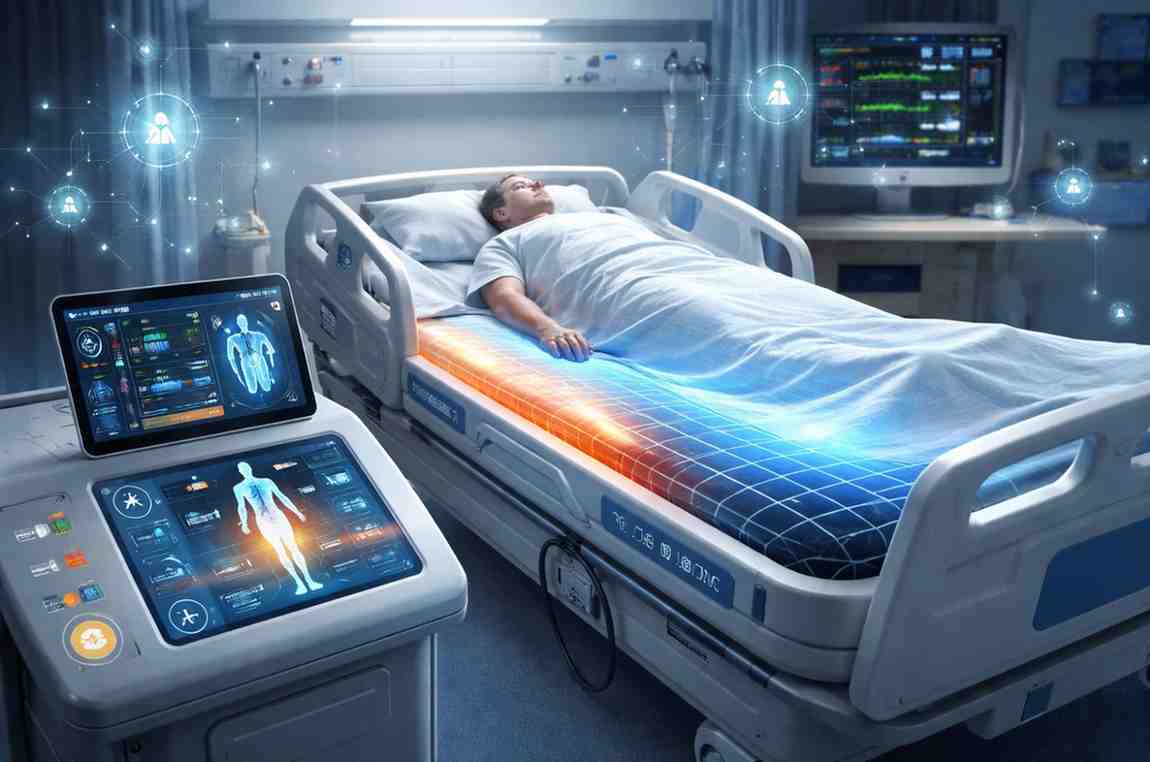
One of the most important advancements is the emergence of advanced pressure injury treatment systems that provide immersion, envelopment, flotation, and pressure control in localized areas of the body in real time, dynamically adjusting to the patient. These systems can provide customized treatment for each patient.
Advanced alternating pressure systems or air-fluidized systems do not offer this level of targeting or control. In contrast, these newer technologies introduce continuous feedback loops, allowing the surface to respond to:
- Individual patient, weight, body shape, wound severity, or location.
- Patient movement (or lack thereof)
- Wound location
- High-risk pressure zones
- Bony prominences
- Changes in positioning, including Fowler’s position
An example of this is a new class of mattresses that addresses this evolution, incorporating hundreds of individual surface sensors that measure and continuously control clinician-set pressures. These systems are a major advancement in providing individualized therapy tailored to each patient, and they can more closely align with the underlying pathophysiology of pressure injuries.
2. Advanced Alternating Pressure with Fowler Compensation
Alternating pressure therapy remains a cornerstone of modern wound care. However, one of its longstanding limitations has been its reduced effectiveness when patients are positioned with the head of the bed elevated.
In these scenarios, shear forces and sacral loading increase significantly, often offsetting the benefits of pressure redistribution. Newer systems introduced at NPIAP 2026 are addressing this challenge through Fowler compensation technologies, which:
- Adjust air cell behavior based on bed articulation
- Redistribute pressure away from the sacrum during elevation
- Maintain immersion and envelopment even in seated positions
This represents a critical advancement, particularly in acute care environments where elevated positioning is unavoidable.
3. Integrated Microclimate Management Systems
Pressure redistribution alone is no longer sufficient. Increasingly, clinicians are recognizing the role of microclimates, specifically heat and moisture at the skin interface, in the development of tissue damage.
Emerging support surfaces now integrate more effective microclimate management directly into the system architecture, using:
- Advanced low air loss delivery systems
- Continuous airflow channels
- Moisture vapor transmission materials
These features help:
- Reduce maceration risk
- Maintain skin integrity
- Improve patient comfort over extended periods
This is particularly relevant for high-risk populations, including diabetic and bariatric patients, where tissue tolerance is already compromised.
4. AI-Driven Risk Monitoring and Predictive Surfaces
Beyond the surface itself, another emerging layer is the integration of predictive analytics and AI-driven monitoring.
Rather than reacting to pressure injuries after they develop, these systems aim to:
- Identify high-risk patients earlier
- Track subtle changes in movement and loading
- Alert clinicians before tissue breakdown occurs
While still evolving, these platforms represent a shift toward proactive, data-informed care models in which support surfaces become part of a broader digital health ecosystem.
5. Bariatric-Specific Pressure Redistribution Systems
Bariatric patients have long been underserved by traditional support surface designs. Standard systems often fail to provide adequate immersion, leading to elevated interface pressures and increased risk of tissue breakdown.
Recent innovations focus on:
- Reinforced air cell structures
- Higher weight capacity engineering
- More supportive materials
These systems are not simply scaled-up versions of standard mattresses; they are purpose-built solutions designed to address the unique biomechanical challenges of bariatric care.
From Passive Support to Intelligent Systems
The overarching trend emerging from NPIAP 2026 is clear: support surfaces are evolving from passive devices into intelligent clinical systems. This shift reflects a broader transformation in healthcare, one where technology is expected to:
- Adapt in real time
- Integrate with clinical workflows
- Align with evidence-based standards of care
For clinicians, this transition means shifting away from static technology/product selection toward the strategic deployment of technology solutions that actively improve patient outcomes.
For manufacturers and innovators, it sets a new benchmark: success will not only be measured by an improved pressure redistribution performance outcome but also by the responsiveness, integration of data, and alignment to clinical practice.
As these technologies continue to evolve, the future of pressure injury prevention will likely be dominated by one principle: The best support surface is no longer one that only redistributes pressure but one that comprehends it.
About the Author
Jeff Adise has dedicated over 30 years to advancing wound care solutions. He is a product specialist and subject-matter expert in the prevention and treatment of Stage I–IV pressure injuries across hospital beds, home care environments, wheelchairs, and specialty seating systems. His work focuses on aligning clinical evidence with real-world product design to improve patient outcomes and caregiver efficiency.