Building a generative AI application in 2026 is an exercise in managing chaos, often driven by growing API sprawl. Just a few years ago, integrating AI meant plugging into a single Large Language Model (LLM) and calling it a day. Today, the landscape has exploded into a multi-modal ecosystem of highly specialized tools. If you are building a modern, competitive application—say, an automated video marketing suite—you can no longer rely on a single vendor.
You might need Black Forest Labs’ FLUX for generating base images, Alibaba’s Wan 2.6 or Kuaishou’s Kling for animating those images into video, ElevenLabs for high-fidelity voiceovers, and a Sync Labs model for lip-syncing the avatar.
On paper, this sounds like an incredibly powerful tech stack. In practice, at the engineering level, it is a nightmare known as “API Sprawl.”
Key Takeaways
- Building generative AI applications in 2026 involves managing API sprawl, requiring integration with multiple vendors.
- API sprawl creates challenges like varied JSON schemas, management of numerous API keys, and increased risk of failure.
- A unified API gateway, like WaveSpeed, centralizes connections to various AI models, simplifying integration and improving reliability.
- This approach offers benefits such as access to over 700 models, built-in fallback routing, and consolidated billing.
- Transitioning to a unified gateway allows teams to focus on their core product instead of writing and maintaining API wrappers.
Table of contents
The True Cost of API Sprawl
When a development team decides to integrate multiple AI models directly from their respective creators, they aren’t just writing a few HTTP requests. They are taking on a massive, compounding pile of technical debt. Here is what API sprawl actually looks like under the hood:
1. The Integration Headache Every AI vendor believes their JSON schema is the industry standard. Vendor A requires parameters nested under a config object; Vendor B requires a flat structure. Vendor C uses WebSockets for video generation, while Vendor D relies on asynchronous REST endpoints with polling. Your engineering team is forced to write, test, and maintain a dozen different API wrappers just to get these models to talk to your backend.
2. The Billing and Credential Labyrinth Managing one API key is easy. Managing fifteen is a security risk. Your DevOps team has to securely store and rotate keys for OpenAI, Google, Anthropic, Midjourney, Runway, Luma, and more. Furthermore, your finance team has to track prepaid credits and monthly invoices across multiple dashboards, making it nearly impossible to calculate the true Unit Economic cost of a single user action in your app.
3. The “Single Point of Failure” Multiplier AI models go down. Servers get overloaded, especially when a new version drops. If your application’s core feature relies on a direct, hardcoded API link to a specific video model, your app breaks the second that vendor experiences an outage. You have no fallback mechanism without pushing a new code deployment.
The Paradigm Shift: Enter the Unified API Gateway
The industry has realized that maintaining direct connections to every individual AI lab is unsustainable. This architectural bottleneck is exactly why the engineering community is pivoting toward unified API gateways.
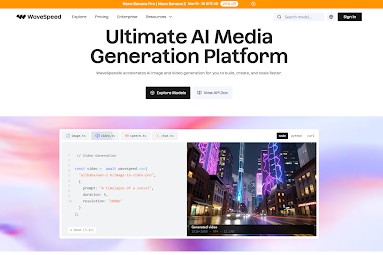
Rather than juggling a dozen different vendor SDKs, developers can route all their generative tasks through a centralized infrastructure layer. By integrating with the WaveSpeedAI platform, engineering teams unlock immediate access to an entire ecosystem of generative tools through one standardized RESTful interface.
This approach fundamentally changes how AI applications are built. Instead of spending weeks reading varying API documentations and standardizing input/output formats, developers integrate once.
“Integrate Once, Call Anywhere”: How It Works at the Code Level
A unified gateway acts as a universal translator. When you use an infrastructure provider like WaveSpeed, the complexity of the underlying model is abstracted away.
Whether you are generating a text response, an image, a 3D asset, or a high-definition video, the structure of your API request remains consistent. The platform normalizes the authentication headers, the webhook delivery systems, and the payload structures.
For a developer, switching from an older video model to a brand-new, state-of-the-art model (like swapping from an early Stable Video Diffusion model to the newly released Wan 2.6 or Sora 2) no longer requires a database migration or a backend rewrite. It becomes as simple as changing a single string parameter in your code:
Changing “model”: “legacy-video-model-v1” to “model”: “wan-2.6-image-to-video”.
That is the power of a unified gateway. It decouples your application logic from the specific AI models it relies on, making your software incredibly future-proof.
The Strategic Advantages of a Consolidated Gateway
Transitioning from a fragmented API architecture to a unified gateway like WaveSpeed provides several immediate, tangible benefits for both the engineering and product teams:
1. Accessing a 700+ Model Arsenal
The pace of AI development is too fast for any single company to keep up with. A unified gateway aggregates the best open-source and proprietary models globally. You instantly gain access to a massive library—over 700 models encompassing everything from Google’s Veo and ByteDance’s Seedance for video, to Minimax for audio, and specialized LoRA models for precise image editing. You always have the right tool for the specific job at your fingertips, without waiting for procurement to sign a new vendor contract.
2. Built-in Fallback Routing and Reliability
When your API requests run through a unified gateway, you gain the ability to build dynamic routing. If a user requests a video and your primary model choice is experiencing high latency, your backend logic can instantly reroute that request to a secondary model (e.g., failing over from Kling to Hailuo) with zero interruption to the end-user. The gateway handles the translation, ensuring your app stays online even when individual AI labs stumble.
3. Unified Asynchronous Webhooks for Heavy Media
Generating a 10-second high-fidelity video takes time—often minutes. You cannot keep an HTTP connection open that long. Managing asynchronous webhooks across different vendors is notoriously difficult. A unified platform standardizes this. You send the generation request, the gateway instantly returns a Job ID, and once the heavy GPU processing is finished, the gateway pings your single, standardized webhook endpoint with the final media URL. It cleans up the messiest part of media generation.
4. Consolidated Billing and Analytics
Instead of tracking credits across ten different platforms, your usage is aggregated into a single dashboard. You pay one vendor, manage one API key, and can finally see exactly how much it costs to generate a piece of content, down to the fraction of a cent.
Conclusion: Stop Building Plumbing
Your engineering team’s time is your most valuable asset. Every hour they spend writing another API wrapper, debugging a vendor’s undocumented error code, or rotating an exposed key is an hour they aren’t spending improving your core product.
The era of API sprawl is ending because it has to. By adopting a unified API gateway, you stop building the plumbing and start building the house. You gain the agility to swap out models on the fly, the security of a single integration point, and the power of the entire global AI ecosystem through a single line of code.
In the fast-moving world of generative AI, the companies that win won’t be the ones with the most API keys. They will be the ones who can deploy new models the fastest.