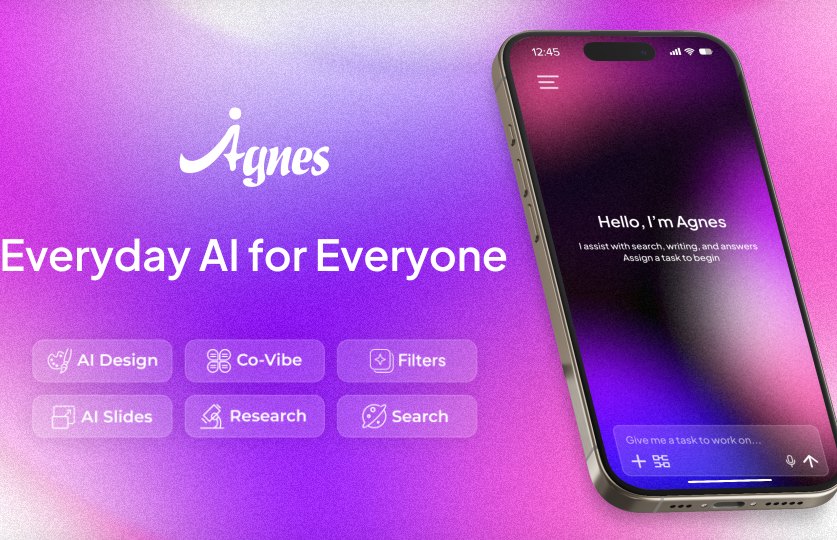
Most AI stories start with models. Agnes AI starts with people — specifically, millions of mobile‑first users in Southeast Asia who have never paid for an AI subscription and may never do so. In less than a year since its July 2025 launch, the Singapore‑based app has grown to more than 6 million registered users and roughly 200,000 daily active users, largely by reframing what an everyday AI app can be: not a narrow productivity tool, but an all‑in‑one environment for working, talking, and playing — a vision founder Bruce Yang recently discussed on the Tech Lead Journal podcast.
Bruce Yang, the company’s founder and CEO, is blunt about the opportunity. Only around 500–700 million people worldwide regularly use generative AI tools today, a fraction of the roughly 6 billion internet users. Of those, perhaps 5% pay for subscriptions, heavily skewed toward high‑income countries. That means fewer than 0.5% of all netizens currently pay for AI. Agnes’s mission is to serve the other 99.5%.
Key Takeaways
- Agnes AI focuses on serving millions of mobile-first users in Southeast Asia who have yet to pay for AI subscriptions.
- The app offers an all-in-one environment for work, socializing, and gaming, emphasizing seamless collaboration and engagement.
- It prioritizes local languages and informal speech, allowing for better understanding and interaction with users in the region.
- Agnes adopts a cost-effective model, offering free tiers and optional credits, making everyday AI accessible to emerging markets.
- The company aims to become the go-to AI platform for communication and creativity, targeting daily active users as its primary metric.
Table of contents
One App for Research, Slides, Design — and Group Chats
On desktop, Agnes looks like a power‑user’s assistant. Users can run deep research on a topic, then turn that same context into a full slide deck, complete with generated images and videos, and even push data into Excel‑style tables and charts. Agnes parses thousands of rows in seconds and outputs graphs, helping users avoid hours of manual formatting. Agentic memory tracks where each project left off so that when a user returns the next day, Agnes “remembers” prior work and can resume seamlessly. Context can be shared with colleagues through group spaces, allowing AI to explain how a deck or analysis was produced instead of dropping opaque files into email threads.
On mobile, however, the product feels more like a social network than a spreadsheet tool. Yang’s insight is that if everyday AI wants to be truly mainstream, it has to live where people already spend their time: messaging apps and content feeds. Agnes supports group chats where AI is a full participant, not just a bot summoned on demand. In these rooms, Agnes keeps shared memory, summarizes missed discussion, clarifies misunderstandings, and can even act as a conversational moderator when personalities clash or quieter members struggle to express themselves.
The company sees this as the next evolution of chat. Snapchat is reportedly investing heavily to integrate AI search in conversations, and ChatGPT recently launched its own group chat feature. Agnes goes a step further by treating group chats as the primary surface for both work and play, rather than an add‑on.

When Everyday AI Becomes a Game Master
One of the most distinctive ideas to emerge from Agnes’s product roadmap is AI‑driven social games that unfold entirely inside group chats. Instead of tapping buttons or following fixed rules, friends simply talk, and Agnes uses large language models to interpret their messages, adjust the narrative, and enforce consequences. Yang cites social deduction formats: in one experience, players vie to convince AI to spare them while persuading it to eliminate others; in another, participants must guess who in the group is human and who is the AI.
The underlying bet is that modern LLMs are now good enough at modeling human dialogue that they can act as live game masters, creating tension, pacing events, and handing out virtual rewards like credits. Agnes’s CoVibe Plots & Characters formalizes this: shared story worlds where AI acts as both narrator and referee, and where the core mechanic is not clicking, but conversation. It is a natural extension of the company’s belief that AI should not be limited to solitary productivity tasks when most of our screen time is social.
Local First: Languages and Culture
Agnes’s user base is heavily concentrated in Southeast Asia, with around 60% of users coming from countries such as Indonesia, Malaysia, Thailand, and the Philippines. That informs how the company trains its models. While global giants train on web‑scale corpora dominated by English and a few major languages, Agnes deliberately gives more weight to minority languages and informal speech.
Every day, users send millions of prompts and chat messages to the platform. Anonymized and aggregated, these become post‑training data for Agnes’s models, teaching them how people actually speak in Bahasa, Thai, Malay, or Tagalog — complete with slang, code‑switching, and local references that rarely appear in formal literature. Yang points out that serving casual, everyday communication equally well across every region is inherently difficult for any single model. Agnes’s focused approach to multilingual training lets it specialize where it matters most to its users.
Faster, Cheaper, Narrower — by Design
Under the hood, Agnes does not try to beat ChatGPT or Gemini at every task. Instead, it decomposes user needs into more specific jobs — research, slide writing, design prompting, group facilitation — and trains smaller models specialized for each. A routing layer predicts intent and sends each request to an appropriate model rather than defaulting to a giant mixture‑of‑experts every time.
That design choice has two consequences. First, latency drops; for narrowly defined tasks, a lean model can return results faster. Second, costs drop significantly, which is what makes the company comfortable offering generous free tiers and affordable one‑off credits. For users in emerging markets who are wary of recurring payments, being able to complete a specific task for a low one‑time fee — or nothing at all within free quotas — can be the difference between using everyday AI meaningfully and not using it at all.
Guardrails Through Multi‑Agent Systems
To keep quality high, Agnes combines newer open‑source base models with its own multi‑agent workflows. On complex tasks, one model generates a draft response, a second evaluates it for factual consistency, and a third suggests corrections, forming a loop of generation, critique, and repair. Research‑style answers are accompanied by citations so that users can inspect sources themselves rather than blindly trusting outputs. Yang credits improvements in recent open‑source base models for reducing hallucinations but argues that layered safeguards are still essential for user trust.
Freemium, but Not as You Know It
Agnes’s monetization approach reflects its dual focus on emerging and developed markets. In wealthier regions, the company plans to offer competitively priced subscriptions with a full‑featured experience. In Southeast Asia and similar markets, subscriptions are optional. Users can access deep research, slide generation, image and video tools, and group‑chat features with generous free allowances. When they need more, they can either purchase small credit packs or earn extra usage by inviting friends and forming active groups — a growth strategy borrowed more from social apps than from enterprise SaaS.
Behind that generosity is a conviction that, over time, traffic itself is the real asset. If Agnes can become the default AI layer for communication and creativity in emerging markets, Yang believes monetization options will naturally follow as the platform matures.
For now, the company’s internal mantra is simple: focus on one metric at a time. That metric is daily active users — not just the 6 million people who have tried Agnes once, but the hundreds of thousands who return every day to work, talk, and play with an everyday AI that increasingly feels local.
If the Tech Lead Journal conversation is any indication, Agnes AI is no longer just a “local model” from Singapore. It is an experiment in what happens when you design AI not for the richest 0.5%, but for everyone else — and Yang’s full interview on Tech Lead Journal offers an inside look at how the team plans to turn that experiment into a global consumer AI contender.