Artificial intelligence has reshaped how companies build products, run marketing, and manage operations. Pricing is now catching up. What used to sit in spreadsheets and quarterly review meetings has moved into real-time systems powered by automation and data analysis.
Industry experts note that AI-driven dynamic pricing systems allow businesses to adjust prices instantly by analyzing demand, customer behavior, and competitor data in real time. Forbes analysis of AI‑driven dynamic pricing explains how companies increasingly rely on artificial intelligence to continuously optimize price points and profitability.
An intelligent pricing tool is no longer a nice extra for ecommerce teams. It is becoming core technology infrastructure. For tech-driven companies operating in fast-moving markets, the ability to react instantly to competitor changes and demand shifts directly affects revenue, margins, and growth.
This is not about flashy algorithms for the sake of it. It is about using AI and automation to make better commercial decisions, faster and with fewer blind spots.
Table of contents
Why manual pricing no longer works
Ten years ago, reviewing competitor prices once a week felt reasonable. Today, it is outdated. Digital markets move in hours, sometimes minutes. Large retailers adjust thousands of SKUs daily. Marketplaces introduce new sellers constantly. Promotions appear and disappear without warning.
Relying on manual checks or static rules creates three problems.
- First, the reaction time is too slow. By the time a team notices a competitor’s price drop, the market has already shifted. Lost conversions are rarely recovered.
- Second, the scale becomes unmanageable. Tracking hundreds or thousands of products across multiple competitors is not realistic without automation.
- Third, decision-making becomes inconsistent. Different team members interpret data differently, which leads to pricing that feels reactive rather than strategic.
This is where a modern pricing tool steps in. It replaces manual monitoring with continuous data collection and structured decision rules.
What makes a pricing tool intelligent
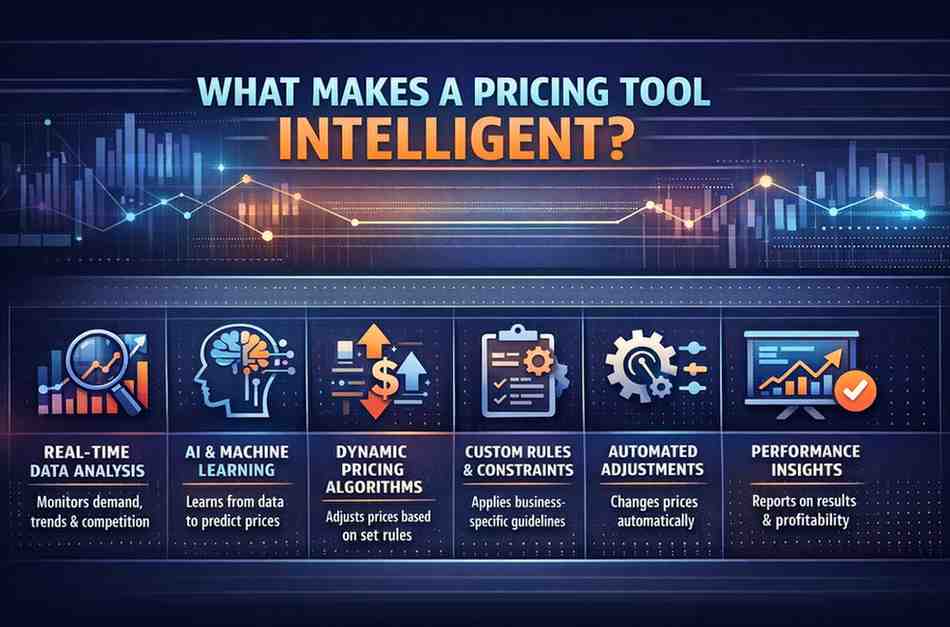
Not all pricing software is equal. Basic price monitoring tools simply collect competitor pricing data. An intelligent pricing tool goes further. It connects data, logic, and execution.
Real-time competitor pricing data
The foundation would be current and precise competitor pricing data. This comprises product matching, availability, and, in certain cases, stock status. Automation without sound data is dangerous.
This layer improves product matching and anomaly detection using AI. For instance, it can identify when a competitor’s bundled products are displayed differently on the page or when a product title is changed, so that tracking would otherwise be compromised. The outcome is a neater market insight. Teams can see not just the lowest price but also where and why it makes sense.
Rule-based automation with strategic guardrails
Automation isn’t a handover of control. The best systems integrate AI with business rules set by commercial teams.
Alternatively, organisations will define minimum margin thresholds, restrictions on specific brands/brand positioning, and agreed indices price vs competitors. The pricing tool then manages prices within those parameters. This not only removes repetitive manual work but keeps strategic intent intact. The system executes the plan. Humans design the plan.
When implemented effectively, this combination of automation and human strategy can produce measurable results. Some AI pricing systems have delivered up to 20–22% revenue improvement by optimizing prices in real time, demonstrating how data-driven pricing decisions can significantly increase commercial performance.
Learning from patterns
More sophisticated pricing tools are machine learning-powered and detect patterns in demand, seasonality, and competitor behaviour. Over time, the system can analyze past changes and current trends to recommend adjustments.
For example, if the data indicates that a certain product was maintaining conversion despite a small price premium, the tool may recommend holding a higher price point than matching every drop your competition makes.
This is where AI becomes proactive instead of reactive. Rather than chasing the market, companies start to shape their position in it.
The strategic impact of intelligent pricing
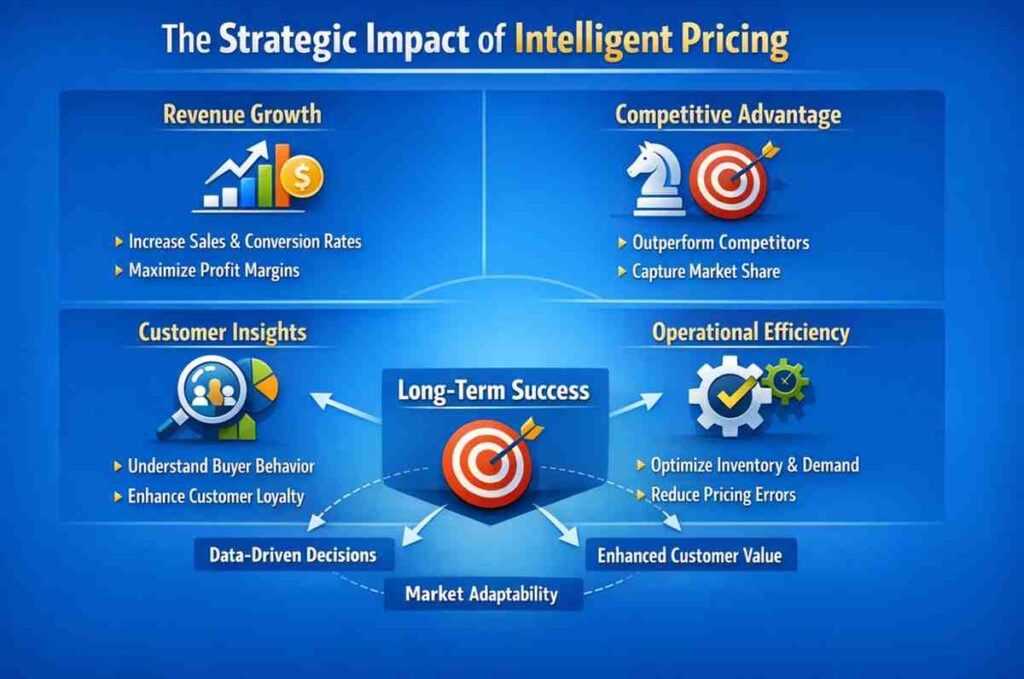
Pricing sits at the intersection of marketing, product, and finance. Even small adjustments have a measurable effect on profit. According to widely cited research, a 1% price improvement can drive a significantly larger increase in operating profit than similar gains in volume.
When AI and automation enter the picture, three strategic advantages stand out.
Faster response to market volatility
Digital markets are volatile. Demand spikes during campaigns. Competitors experiment aggressively. External factors such as supply constraints or currency shifts add further pressure.
An intelligent pricing tool processes these signals continuously. Instead of waiting for a weekly review, teams respond instantly. This agility protects margin and captures demand while it is still present.
Scalable international expansion
For tech companies expanding into new regions, pricing complexity multiplies. Different competitors, currencies, tax rules, and consumer expectations must be considered.
Automation makes this manageable. A central pricing logic can be adapted per market, while AI ensures local competitor pricing data feeds into decisions accurately. This reduces the risk of underpricing in premium markets or overpricing in price-sensitive ones.
Clearer collaboration between teams
When pricing decisions are system-driven rather than ad hoc, internal alignment improves. Marketing understands which products can be discounted. Finance trusts that margin floors are respected. Product teams see how positioning translates into price levels.
An intelligent pricing tool creates transparency. Decisions are traceable. Rules are documented. Adjustments are logged. That visibility reduces internal friction.
Balancing automation with human judgement
A perennial concern is that AI pricing becomes a black box. That risk is real if businesses views automation as a shortcut, not a strategic framework.
Human oversight remains critical.
Commercial teams define objectives. They determine whether to contest aggressively in some categories or preserve premium positioning. They take into account long-term brand impact, which algorithms simply cannot understand.
The best approach is to treat AI as an execution engine and not a standalone decision maker. The system takes care of speed and scale. Humans handle direction and ethics.
Ethical considerations also matter. Destructive price wars can be set off by undercutting automated prices aggressively. Having transparent rules and guardrails is what prevents scenarios like that. Careful implementation of automation provides a fairer playing field and trims back destructive market activity.
Pricing as core tech infrastructure
Many companies invest heavily in CRM, marketing automation, and analytics. Pricing often remains fragmented. Yet price directly influences revenue more than almost any other lever.
Forward-thinking teams now view a pricing tool as part of their essential tech stack. It integrates with ecommerce platforms, ERP systems, and analytics dashboards. It turns market insight into immediate action rather than static reports.
This shift reflects a broader trend. AI is not confined to product features or chat interfaces. It is embedded in operational systems that quietly optimise performance every day.
For technology leaders, the question is no longer whether to automate pricing. It is about doing it responsibly and strategically.
Choosing the right pricing technology
When evaluating options, technical capability matters, but so does fit.
Look for reliable competitor pricing data collection, strong product matching, and flexible rule configuration. Ensure the system supports integrations with existing platforms. Transparency in logic and reporting should be non-negotiable.
It is also worth exploring established solutions such as this advanced ecommerce pricing platform at Priceshape, which illustrates how automation and structured rules can work together without sacrificing control.
The key is alignment. The pricing tool should support your commercial strategy, not override it.
The future of intelligent pricing
As AI models continue to improve, pricing tools will become even more predictive. Expect deeper integration with demand forecasting, inventory systems, and personalised offers. Real-time experimentation will become easier, allowing teams to test price sensitivity with precision.
Governance will become that much more important, too. How automation affects markets is drawing more attention from boards and regulators. Transparent design and clear accountability will set mature technology teams apart from reckless adopters.
What does not change is your price being almost the whole thing. It connotes value, frames perception, and drives profitability. In the digital economy characterized by velocity and data, a manual approach to managing price is a joke.
An intelligent pricing tool should not replace strategic consensus. It amplifies it. When technology leaders use AI, automation, and crystal-clear commercial intent to unleash these ingredients in micro- or integrated models in an iterative fashion, they are at the helm of one of the most controllable levers of the organisation.
For readers seeking innovation, this is the real story. Pricing is no longer a mere back-office calculation. It’s a discipline unto itself, with crosscutting ties to every corner of tech, data-driven, automation-powered, and ever more integral to competitive advantage.