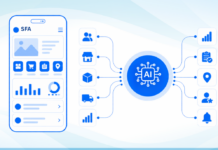
International labor mobility increasingly intersects with digital hiring infrastructure. Over the past two decades, cross-border flows of skilled labor have expanded through AI-powered application tools, global education systems, multinational firms, and distributed work arrangements. Recruitment systems have changed more slowly. Many continue to reflect assumptions shaped by domestic labor markets, even as talent supply becomes more geographically dispersed.
This divergence produces tangible effects. Qualified professionals frequently encounter barriers linked to process design instead of professional capability. These barriers are embedded in contemporary hiring systems, particularly in high-volume markets such as the United States technology sector, where efficiency and risk management shape operational priorities.
Hiring platforms now function as access mechanisms. Their structure determines how applications are processed, filtered, and advanced. As application volume grows, these design choices scale accordingly, shaping labor market outcomes that often remain invisible to applicants and insufficiently examined by employers.
Key Takeaways
- International labor mobility faces challenges due to outdated hiring systems that favor local candidates, complicating access for skilled professionals.
- Applicant tracking systems often use geographic location and indirect signals, creating barriers for international candidates seeking employment.
- Automation in job searches reduces administrative burdens, allowing candidates to apply for more opportunities while maintaining visibility.
- Hybrid application management models combine automated processes with human oversight to improve candidate experience and fit in competitive markets.
- Access and design of hiring infrastructure critically impact how global talent enters labor markets, necessitating ongoing evaluation and adaptation.
Table of contents
- Applicant Tracking Systems and Embedded Assumptions
- Administrative Intensity in Modern Job Searches
- AI-Powered Application Tools and the Redistribution of Effort
- Hybrid Models of Application Management
- Implications for Labor Market Functioning
- Design Informed by Use Cases
- A New Hiring Reality Begins with Access
Applicant Tracking Systems and Embedded Assumptions
Most large employers rely on applicant tracking systems and standardized application workflows to manage scale and control operational cost. These systems organize large applicant pools efficiently and enforce consistency across recruitment processes. Their effectiveness depends on simplifying assumptions that influence how candidates are classified and prioritized.
Geographic location is commonly treated as an indicator of availability. Work authorization may be inferred through indirect signals instead of being explicitly assessed. Employment timelines are standardized to align with internal planning cycles. Candidates who fit these parameters tend to move through the system smoothly. Others encounter obstacles even when their experience aligns closely with role requirements.
International candidates, particularly those requiring visa sponsorship or applying from outside the hiring jurisdiction, experience these effects most acutely. Reduced visibility often occurs early in the process, before recruiters review skill alignment or professional history. Exclusion at this stage reflects system constraints more than hiring intent.
This pattern contributes to a persistent contradiction. Employers report shortages in specialized skill areas, while international candidates with relevant training struggle to enter hiring pipelines. The constraint lies in system capacity to surface and retain qualified applicants with AI-powered application tools.

Administrative Intensity in Modern Job Searches
The contemporary job search is marked by administrative intensity. Applicants are expected to identify opportunities across fragmented platforms, tailor application materials repeatedly, complete extensive forms, and manage tracking independently. Much of this work is duplicative and provides limited additional insight to employers.
Administrative effort functions as a participation constraint. Candidates with greater time availability, familiarity with hiring platforms, or geographic proximity can sustain higher application volume. Others face diminishing returns as effort increases, regardless of qualification.
For international job seekers, administrative demands are compounded by uncertainty. Job postings often provide limited guidance on visa sponsorship. Automated filters may screen candidates based on location or inferred eligibility. Remote roles are frequently restricted by jurisdictional requirements with limited relevance to job performance.
Taken together, these constraints substantially limit how many applications a candidate can submit and sustain over time. In hiring environments where visibility depends on application volume and system compatibility, administrative capacity becomes a decisive factor.
AI-Powered Application Tools and the Redistribution of Effort
Artificial intelligence is often discussed in hiring through evaluation, prediction, or bias mitigation. Less attention is paid to its influence on how effort is distributed across the job search process. For candidates, AI-based tools primarily affect execution.
Automation can support job discovery, align roles with predefined criteria such as skills or visa eligibility, populate application forms, adapt résumés to system-recognized language, and centralize tracking. These functions leave candidate experience unchanged. What shifts is the cost of sustained participation.
Lower execution costs allow candidates to remain visible across a wider range of opportunities. Administrative work occupies less attention, creating space for preparation, skills development, and interview readiness. Participation becomes easier to maintain over extended periods.
Automation does not alter evaluation standards. It reduces attrition caused by procedural overload, allowing more candidates to reach stages where assessment occurs.
Hybrid Models of Application Management
Hybrid models are emerging within the broader category of application management systems, combining automated workflows with structured human oversight. In these approaches, candidates define their role preferences while standardized processes support résumé alignment, application submission, and tracking across platforms. Human review is incorporated to maintain contextual accuracy and ensure materials remain relevant to specific roles. These models reflect a growing recognition that execution at scale requires both technical efficiency and selective human judgment.
The value of this approach lies in its response to scale. In competitive markets, particularly those involving visa sponsorship, candidates often need to submit large numbers of applications to secure limited exposure. Manual execution makes this level of participation difficult to sustain without compromising quality or personal capacity.
Hybrid models distinguish between strategic decisions and procedural execution. Repetitive tasks are standardized, while candidates retain control over role selection and interview engagement. This structure reflects the growing importance of execution capacity in maintaining access.
Implications for Labor Market Functioning
From a labor market perspective, application automation shapes how supply enters consideration. Employers continue to define requirements and make hiring decisions. The change occurs in how consistently qualified candidates appear within evaluation pipelines.
In sectors such as artificial intelligence, cybersecurity, healthcare, biotechnology, and software engineering, demand for specialized skills remains strong. Employers increasingly recruit across borders, yet hiring infrastructure often filters international candidates early in the process. Application automation moderates this effect by improving alignment with applicant tracking systems and supporting sustained throughput.
Application volume alone does not ensure improved outcomes. When combined with systematic résumé alignment and centralized tracking, it lowers the likelihood that candidates are excluded due to process limitations or system incompatibility. Applicant pools become more representative of available talent as a result.
Design Informed by Use Cases
Many application automation tools are developed in response to observed inefficiencies rather than abstract models. Many application automation tools have emerged in response to recurring inefficiencies observed by international professionals navigating high-volume hiring systems. Similar patterns are widely reported across industries.
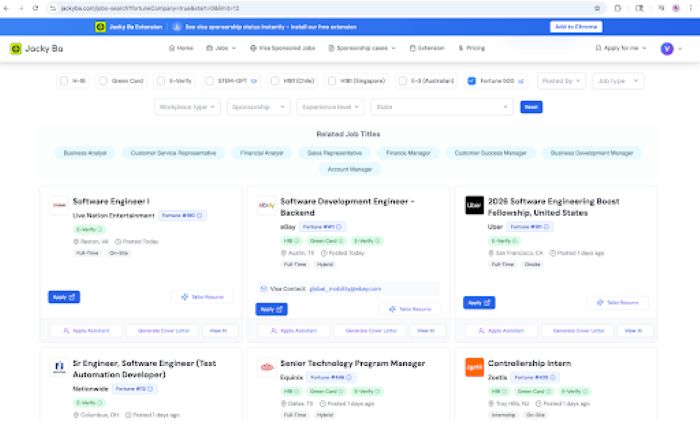
Illustration: Example of filtered job listings based on visa eligibility criteria
Candidates with advanced education, professional experience, and legal eligibility remain underrepresented in hiring pipelines due to process-related limitations. These outcomes suggest that readiness is not the primary constraint. System design is.
Hiring platforms are optimized to reduce employer-side complexity. Candidates are expected to adapt individually. Automation tools represent an attempt to rebalance this asymmetry by providing candidates with operational capacity that aligns more closely with system demands.
Incremental Shifts in Hiring Infrastructure
Hiring infrastructure tends to change incrementally. Visa considerations are increasingly addressed earlier in recruitment workflows. Remote and hybrid roles have reduced some geographic constraints. Employers facing prolonged vacancies are revisiting assumptions about talent location.
Job platforms are also evolving. Static listings are less effective in saturated markets. Execution capabilities such as application management, tracking, and follow-up are becoming integral to participation. Automation is increasingly treated as baseline infrastructure rather than a differentiating feature.
A New Hiring Reality Begins with Access
As hiring systems continue to evolve, questions of access, infrastructure design, and system compatibility are playing an increasingly important role in how global talent participates in labor markets. Digital recruitment platforms now serve as gateways through which opportunity is distributed, and their structure influences who is seen, when, and under what conditions. As these systems scale, their underlying assumptions shape labor market outcomes in ways that are often subtle but highly consequential.
Automation in job search does not alter employer evaluation standards or hiring criteria. Instead, it affects how consistently qualified candidates are able to reach the stages of the process where meaningful assessment occurs. By reducing procedural barriers and administrative friction, structured execution tools help ensure that participation is not limited solely by time, geography, or familiarity with platform mechanics. In this sense, automation influences access to consideration rather than the substance of evaluation itself.
Understanding these dynamics is becoming central to broader discussions about the future of cross-border employment and digitally mediated hiring systems. As labor markets grow more interconnected with AI-powered application tools, the ability of recruitment infrastructure to fairly and efficiently surface global talent will remain a defining challenge. Ongoing examination of how technology shapes visibility, participation, and opportunity will be essential to building hiring systems that function effectively at scale while maintaining equitable access.