Choosing the right business vertical classification categories can make or break a startup’s trajectory. These categories organize companies into industry segments based on shared characteristics, target customers, products, regulatory environments, and operational models. For founders and analysts, understanding these classifications isn’t academic; it’s the difference between building a focused brand that attracts investors and getting lost in a crowded market.
The shift from broad horizontal markets to specialized vertical niches has accelerated over the past decade. Investors now evaluate startups against vertical-specific benchmarks. Customers assess trust based on how well you understand their industry.
Here, we will break down the strategic importance of vertical classification, explore core categories across major sectors, and provide data-driven insights to help you position your business for growth.
Key Takeaways
- Choosing the right business vertical classification categories is crucial for startup success, as they impact brand positioning and investment attraction.
- Vertical classification helps sharpen market positioning, clarify investment decisions, streamline regulatory compliance, and improve marketing efficiency.
- Major classification systems include NAICS, SIC, and GICS, each with unique features relevant to different sectors.
- As markets evolve, businesses face challenges in traditional classification, including industry convergence and global variation.
- The future of business vertical classification categories will rely on AI-driven categorization, dynamic re-classification, and recognition of micro-niches.
Why Business Vertical Classification Categories Matter for Strategic Growth
Proper vertical classification categories deliver measurable advantages across multiple business functions:
Market positioning becomes sharper. A payments platform serving hospitals operates in a different vertical than one serving online retailers, even though they share identical underlying technology. This specificity helps customers immediately assess relevance and trust.
Investment decisions gain clarity. Venture capitalists compare growth rates and margins within specific verticals. A SaaS company in education gets evaluated differently than one in enterprise finance, even with similar revenue numbers.
Regulatory compliance gets streamlined. Each vertical carries distinct compliance requirements. Healthcare companies face HIPAA regulations, while financial services navigate SEC oversight. Understanding your vertical helps you budget appropriately for compliance costs.
Marketing efficiency improves. Vertical-specific messaging converts better than generic approaches. A logistics audience responds to efficiency metrics, while an education audience values impact and accessibility.

Core Classification Systems: NAICS, SIC, and GICS
Three major frameworks dominate global business vertical classification categories:
North American Industry Classification System (NAICS)
NAICS was developed under the Office of Management and Budget (OMB) and adopted in 1997 to replace the Standard Industrial Classification (SIC) system. It’s maintained jointly by the U.S. Economic Classification Policy Committee (ECPC), Statistics Canada, and Mexico’s Instituto Nacional de Estadística y Geografía.
Key features:
- Updated every five years (in years ending in ‘2’ or ‘7’)
- Most recent update: 2022
- Provides high-level similarity across North American countries
- Used by federal statistical agencies for data collection and analysis
Standard Industrial Classification (SIC)
The SIC system started in the 1930s and served as the primary classification method until NAICS replaced it. Many databases and legacy systems still reference SIC codes.
Current relevance:
- Still used in some financial and regulatory contexts
- Less granular than NAICS
- Primarily a historical reference point
Global Industry Classification Standard (GICS)
GICS was developed in 1999 by S&P Dow Jones Indices and MSCI to support global investment research and asset management.
Structure:
- 11 Sectors (broadest level)
- 25 Industry Groups
- 74 Industries
- 163 Sub-Industries (most granular)
The GICS structure is:
- Universal: Applies globally to all public companies
- Reliable: Reflects current market realities
- Flexible: Offers four levels of analytical depth
- Evolving: Updated annually based on market feedback
Understanding the Classification Hierarchy
Business vertical classification categories follow a cascading structure from broad to specific:
Sector → Industry Group → Industry → Sub-Industry
Example from Healthcare:
- Sector: Health Care
- Industry Group: Health Care Equipment & Services
- Industry: Health Care Technology
- Sub-Industry: Health Care Technology
This hierarchy lets analysts zoom in or out as needed. Portfolio managers might track sector-level trends, while competitive analysts focus on sub-industry details.
Technology Business Vertical Classification Categories
The technology vertical encompasses companies that design, develop, and distribute digital solutions.
Major sub-categories:
- Software as a Service (SaaS) platforms
- Cloud infrastructure providers
- Cybersecurity solutions
- Artificial intelligence and machine learning
- Enterprise resource planning (ERP) systems
- Consumer applications and platforms
Market context:
Investments in India in AI are projected to reach more than $400 billions upto 2035, demonstrating rapid capital flows into specialized technology business verticals.
Cybersecurity Business Vertical Classification Categories
Cybersecurity has evolved into its own distinct vertical within technology.
Market size: The global cybersecurity market was valued at $271.88 billion in 2025 and is projected to reach $663.24 billion by 2033, growing at a CAGR of 11.9%.
Key segments:
- Network security solutions
- Cloud security platforms
- Identity and access management
- Threat intelligence services
- Security operations centers (SOCs)
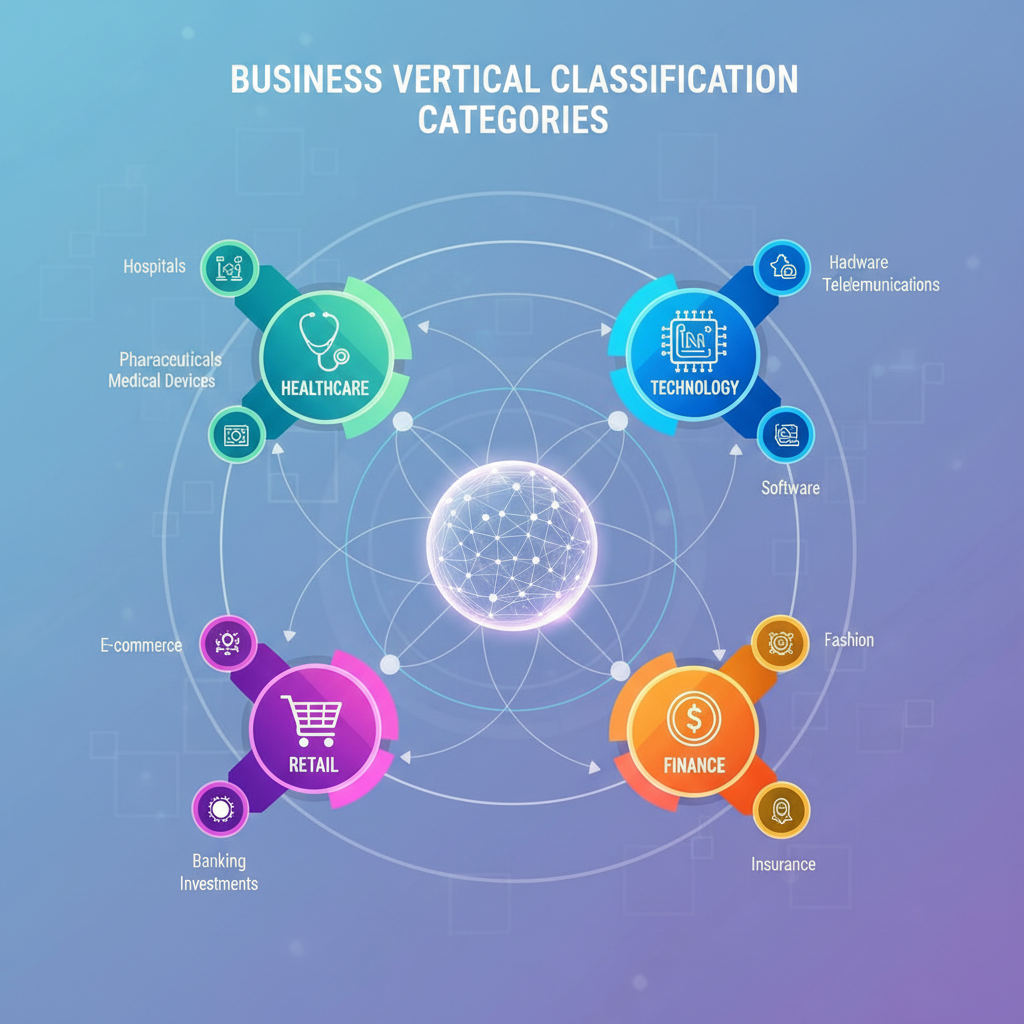
Financial Services Business Vertical Classification Categories
Financial services encompass institutions managing money, risk, and transactions.
Core classifications:
- Banking and credit institutions
- Insurance providers (covered separately below)
- Investment management firms
- Payment processing companies
- Digital wallets and mobile banking
- Blockchain and decentralized finance
The global FinTech market was valued at $228 billion in 2024 and is expected to reach $813.5 billion by 2029, growing at a CAGR of 32.5%.
Insurance Business Vertical Classification Categories
Insurance is a specialized segment within the financial services business vertical.
Primary divisions:
- Life Insurance: Individual and group life policies
- Health Insurance: Medical, dental, vision coverage
- Property & Casualty (P&C): Auto, home, commercial property
- Specialty Insurance: Cyber liability, directors & officers (D&O), professional liability
Strategic considerations: Each insurance sub-vertical faces distinct regulatory frameworks, actuarial requirements, and customer acquisition costs.
Healthcare Business Vertical Classification Categories
Healthcare focuses on services, products, and technologies helping human health and medical outcomes.
Key segments:
- Hospitals and clinical providers
- Pharmaceutical manufacturers
- Medical device companies
- Biotechnology firms
- Health information systems
- Telemedicine platforms
Regulatory complexity: Healthcare companies face stringent compliance requirements, including HIPAA (U.S.), GDPR (EU), and FDA oversight for medical devices and products.
Retail Business Vertical Classification Categories
Retail connects products with consumers through physical and digital channels.
Sub-categories:
- E-commerce marketplaces
- Direct-to-consumer (DTC) brands
- Brick-and-mortar retailers
- Wholesale distributors
- Private label manufacturers
- Subscription commerce models
Market evolution: The shift to e-commerce has created distinct e-commerce business verticals with different economics, customer acquisition costs, and margin structures than traditional retail.
Restaurant Business Vertical Classification Categories
Restaurants represent a specialized vertical within the hospitality and food services industry.
Classification by service model:
- Quick Service (QSR): Fast food with minimal table service
- Fast Casual: Higher quality than QSR, counter service with some customization
- Casual Dining: Full table service, moderate prices
- Fine Dining: Premium ingredients, extensive service, higher prices
Strategic differences: Fast-casual restaurants typically achieve 3-15% higher average checks than QSRs while maintaining faster table turnover than casual dining.
Law Firm Business Vertical Classification Categories
Legal services segment by practice area and client type.
Major practice verticals:
- Corporate law (M&A, securities, governance)
- Litigation and dispute resolution
- Intellectual property
- Real estate and construction law
- Employment and labor law
- Tax law
Business models: Solo practitioners, exclusive shop gift store, and BigLaw operate under basically different economics and client relationships within the law firm business vertical classification.
Agricultural Business Vertical Classification Categories
Agriculture spans from primary extraction to technology enabled farming.
Sector breakdown:
- Primary Agriculture: Crop and animal production
- Agricultural Technology (AgriTech): Precision farming, IoT sensors, AI-driven crop management
- Agricultural Services: Equipment rental, consulting, crop insurance
- Food Processing: Converting raw agricultural products into consumer goods
AgriTech growth: Investment in AgriTech is accelerating globally as farmers adopt data-driven approaches to optimize yields and reduce environmental impact.
Real Estate Business Vertical Classification Categories
Real estate covers property development, ownership, and infrastructure.
Core segments:
- Residential real estate
- Commercial property management
- Construction services
- Real estate investment trusts (REITs)
- Urban planning solutions
- Property technology (PropTech) platforms
PropTech market data: The global PropTech market was valued at $29.09 billion in 2022 and is projected to reach $94.20 billion by 2030, growing at a CAGR of 15.8%.
Enterprise Software Business Vertical Classification Categories
Enterprise software serves organizations with tools for operations, analytics, and productivity.
Major categories:
- Customer Relationship Management (CRM)
- Enterprise Resource Planning (ERP)
- Human Capital Management (HCM)
- Business Intelligence (BI) and analytics
- Collaboration and productivity tools
- Workflow automation
B2B characteristics: Enterprise software business verticals typically feature longer sales cycles, higher customer lifetime value, and a stronger emphasis on integration capabilities.
SaaS Business Vertical Classification Categories
SaaS has become a dominant delivery model across multiple industries.
Classification approaches:
- By function: CRM, marketing automation, accounting
- By industry: Healthcare SaaS, legal SaaS, construction SaaS
- By audience: SMB-focused vs. enterprise-grade
Key metrics: SaaS companies get evaluated on recurring revenue, churn rate, customer acquisition cost (CAC), and lifetime value (LTV, metrics that differ significantly from traditional software licensing models.
HR Tech Business Vertical Classification Categories
Human Resources technology has evolved into a substantial vertical.
Core segments:
- Applicant tracking systems (ATS)
- Payroll and benefits administration
- Client management platforms
- Learning management systems (LMS)
- Employee engagement tools
- Workforce analytics
Market dynamics: HR tech buyers prioritize integration with existing systems, compliance features, and employee experience, creating distinct evaluation criteria within HR tech business verticals.
AI Business Vertical Classification Categories
Artificial intelligence cuts across traditional verticals while forming its own classification system.
Horizontal AI platforms:
- Machine learning frameworks
- Natural language processing tools
- Computer vision systems
Vertical-specific AI:
- Healthcare AI: Diagnostic imaging, drug discovery
- Financial AI: Fraud detection, algorithmic trading
- Manufacturing AI: Predictive maintenance, quality control
Industrial Business Vertical Classification Categories
Industrial businesses transform raw materials into finished goods.
Key areas:
- Automotive manufacturing
- Industrial machinery
- Electronics production
- Aerospace and defense
- Chemical manufacturing
- Advanced materials
Strategic focus: Industrial business verticals typically emphasize operational efficiency, supply chain resilience, and capital intensity.
Business Vertical Classification Categories India
India uses the National Industrial Classification (NIC) 2008, maintained by the Ministry of Statistics and Programme Implementation (MoSPI).
NIC 2008 structure:
- Sections (21 broad categories, labeled A-U)
- Divisions
- Groups
- Classes
Example from NIC 2008:
- Section J: Information and communication
- Division 62: Computer programming, consultancy and related activities
The NIC 2008 aligns with the International Standard Industrial Classification (ISIC) for global comparability while reflecting India’s unique economic structure.
Comparing Major Business Vertical Classification Categories
| Vertical | Market Size (2024) | CAGR | Primary Challenges | Strategic Advantage |
|---|---|---|---|---|
| FinTech | $228B | 15.6% | Security, regulation | Speed, user experience |
| Digital Education | $22.2B | 26.0% | Adoption, outcomes | Accessibility, scalability |
| PropTech | $29.1B (2022) | 15.8% | Fragmentation, legacy systems | Transparency, efficiency |
| Cybersecurity | $271.9B (2025) | 11.9% | Evolving threats, talent shortage | Necessity, recurring revenue |
The Rise of Sub-Verticals and Hybrid Categories
Modern business vertical classification categories increasingly fragment into sub-verticals as markets mature.
Examples of hybrid verticals:
- HealthTech: Healthcare + Technology
- FinTech: Finance + Technology
- EdTech: Education + Technology
- PropTech: Real Estate + Technology
- AgriTech: Agriculture + Technology
These hybrid categories emerged as digital transformation reshaped traditional industries. A telemedicine platform operates differently from a hospital network, even though both fall under healthcare.
Sub-vertical benefits:
- Higher conversion rates through targeted messaging
- Premium pricing justified by specialization
- Competitive advantage in crowded markets
- Better analytics and performance tracking
Horizontal vs. Vertical Market Strategy
Understanding the distinction shapes your entire go-to-market approach.
Vertical markets:
- Focused on specific industries
- Specialized products/services
- Targeted customer base
- Example: Medical practice management software
Horizontal markets:
- Serve multiple industries
- Broad solutions
- Wide customer base
- Example: Cloud storage platforms
Strategic implications:
| Factor | Vertical Markets | Horizontal Markets |
|---|---|---|
| Customer Acquisition | Higher cost, deeper relationships | Lower cost, higher volume |
| Product Customization | Extensive industry-specific features | Standardized core functionality |
| Competitive Moat | Industry expertise and relationships | Network effects and scale |
| Risk Profile | Vulnerable to industry downturns | Diversified across sectors |
| Pricing Power | Premium pricing for specialization | Competitive pricing pressure |
Challenges in Modern Business Vertical Classification Categories
Traditional classification systems struggle with today’s dynamic markets.
Key challenges:
- Industry convergence: Tesla operates in automotive, energy, and technology. Which vertical should it occupy?
- Rapid innovation: New categories like “creator economy platforms” didn’t exist five years ago.
- Multi-vertical operations: Amazon spans retail, cloud computing, logistics, entertainment, and healthcare.
- Global variations: Classification systems vary by country, complicating international expansion and reporting.
Solution approaches:
- Identify primary revenue stream (usually determines classification)
- Track multiple secondary verticals for strategic analysis
- Reassess classification annually as the business model evolves
- Use industry-standard frameworks for investor communication
Practical Framework: Choosing Your Vertical
Follow these 5 steps to identify your optimal business vertical classification categories:
1: Analyze revenue sources
- Which products/services generate 60%+ of revenue?
- Who are your highest-value customers?
- What problems do you primarily solve?
2: Review classification systems
- Research NAICS codes relevant to your offerings
- Explore the GICS structure if targeting public markets
- Check regional systems (e.g., NIC for India, etc.).
3: Study competitor positioning
- How do similar companies classify themselves?
- What verticals do investors use to categorize your space?
- Where do industry analysts place comparable businesses?
4: Test messaging
- Do customers immediately understand your vertical?
- Does your classification resonate with target buyers?
- Can sales teams explain your vertical positioning in 30 seconds?
5: Monitor and adjust
- Set an annual review of vertical classification
- Track market evolution and emerging categories
- Update positioning as business model shifts
The Future of Business Vertical Classification Categories
Several trends will reshape classification systems:
- AI-driven categorization: Machine learning will automatically classify businesses based on real-time data, product offerings, and customer behavior rather than static definitions.
- Dynamic re-classification: Companies will shift verticals more fluidly as they pivot, requiring flexible frameworks that update quarterly rather than every five years.
- Micro-niche recognition: Classification systems will need to accommodate increasingly specialized sub-verticals as markets fragment.
- Sustainability overlays: ESG factors will create new ranking dimensions that cut across traditional industry boundaries.
Leveraging Vertical Classification for SEO and Digital Marketing
Your vertical classification directly impacts digital strategy.
Keyword targeting:
- Broad keywords (e.g., “software”) face intense competition
- Vertical-specific keywords (e.g., “dental practice management software”) convert 3-5x better
- Sub-vertical keywords (e.g., “orthodontics scheduling software”) command premium pricing
Content strategy:
- Create vertical-specific case studies
- Publish industry benchmarks and data
- Develop thought leadership in your sub-vertical
- Use vertical terminology consistently across properties
Paid advertising:
- Segment campaigns by vertical
- Create vertical-specific landing pages
- Test messaging that demonstrates vertical expertise
- Track conversion rates by industry segment
Business Vertical Classification Categories for Investor Relations
Investors evaluate companies through vertical lenses.
Why classification matters to VCs:
- Comparable analysis: VCs compare your metrics to others in the same vertical
- Market sizing: Each vertical has established TAM (Total Addressable Market) approaches
- Exit patterns: Different verticals have distinct acquisition and IPO trajectories
- Risk assessment: Each vertical carries unique regulatory, competitive, and economic risks
Best practices:
- Lead investor presentations with clear vertical positioning
- Provide vertical-specific metrics (e.g., revenue per hospital bed for healthcare)
- Reference vertical benchmarks for growth rates and margins
- Explain any multi-vertical strategy explicitly
Conclusion
Business vertical classification categories provide essential structure for modern business. They enable accurate benchmarking, streamline regulatory compliance, sharpen marketing strategies, and facilitate investment decisions.
The classification landscape is evolving. Traditional systems like NAICS and GICS provide foundational frameworks, but hybrid categories and sub-verticals increasingly define competitive positioning.
For startups: Choose your primary vertical carefully, understand its unique characteristics, and communicate that positioning consistently to customers, partners, and investors.
For analysts: Use multiple classification systems, recognize hybrid models, and stay current with emerging categories that reshape traditional industry boundaries.
Success requires balancing the structure of established business vertical classification categories with the flexibility to adapt as markets evolve and new categories emerge.
FAQs
Vertical markets focus on specific industries with specialized products and targeted customer bases (like healthcare IT or legal tech). Horizontal markets serve multiple industries with broad solutions and large customer bases (such as cloud storage or payroll software). Vertical markets typically command premium pricing through specialization, while horizontal markets scale through standardization.
Investors compare your growth rates, margins, and customer acquisition costs against benchmarks from your specific vertical. A SaaS company in education gets evaluated differently than one in enterprise finance, even with identical revenue.
NAICS is the current standard, adopted in 1997 and updated every five years. It offers more granular categories and better reflects modern industries like technology and services. SIC originated in the 1930s and hasn’t been updated since 1987, though some databases still reference it. Use NAICS for current analysis and regulatory reporting; SIC applies only to historical comparisons or legacy systems.
Yes, especially as companies scale. However, identify one primary vertical based on where 60%+ of revenue originates. Track secondary verticals for strategic analysis, but communicate a single clear vertical to investors and customers. Multi-vertical positioning works for large enterprises but confuses early-stage stakeholders.
Review your vertical classification annually or whenever major business model shifts occur (new product lines, market pivots, acquisitions). Update positioning if your primary revenue source changes or if you’re consistently explaining why your current classification doesn’t fit.