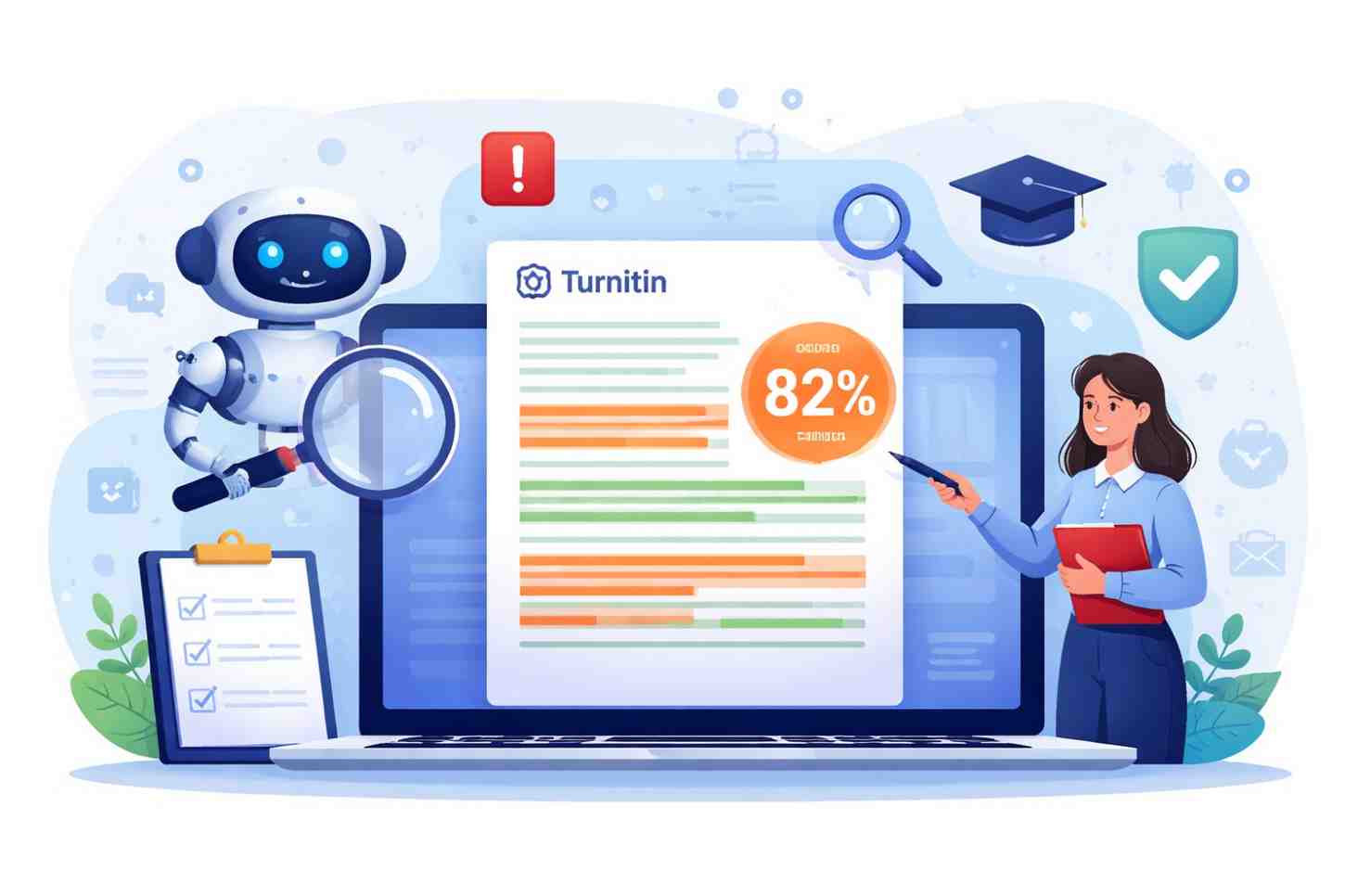
As artificial intelligence tools such as ChatGPT and GPT-4 become increasingly common in education, schools are entering new territory in protecting academic integrity. Traditional plagiarism detection is no longer enough. Institutions now need systems that can evaluate whether writing itself was generated by AI.
In response, Turnitin introduced its AI detection feature in April 2023. Turnitin’s platform serves over 16,000 institutions and 71 million students worldwide, making it one of the most widely used academic integrity tools in education. This scale has positioned the company at the center of conversations around AI and academic honesty. This guide explains what the Turnitin AI checker is, how it works, how to interpret its scores, and what both students and instructors should understand before relying on the results.
Table of contents
What Is Turnitin AI Checker?
The Turnitin AI Checker is a specialized feature within Turnitin that highlights and, presumably, detects instances of student work generated by AI. This is not an average plagiarism checker; it collects information and consolidates it into a single document. Instead, it can train on the linguistic fingerprints of AI writing tools.
Plagiarism Checker vs AI Checker. This passage is the most significant of all: The difference between the plagiarism checker tool and the AI Checker is as follows.
What did the Plagiarism Checker check my work against? It identifies text copied and pasted directly from an existing source, most likely Wikipedia. Similarity score: large values mean the text is similar to other documents.
Writing style, predictability, and linguistic features used as input to AI Checker. It doesn’t say how your text aligns with anything; it checks whether any of the words look like output from AI language models.
The Turnitin AI content detector can flag completely original AI-generated content with a 0% similarity score.
How Turnitin AI Detection Works
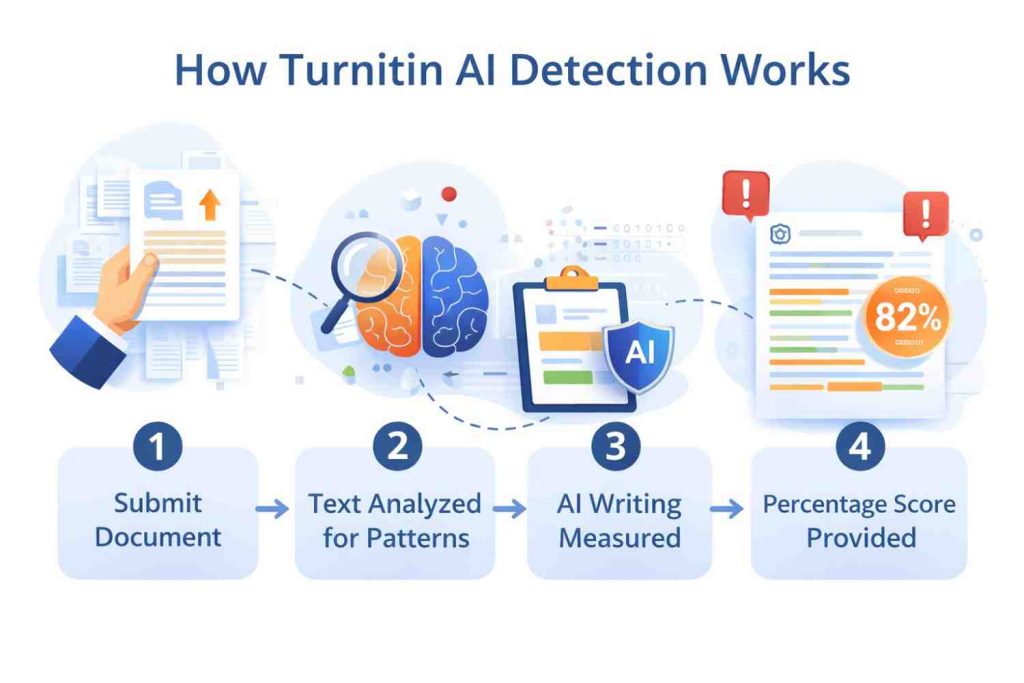
Turnitin’s AI system analyzes papers as a whole rather than analyzing a single sentence out of context. “They’re looking for patterns that are statistically frequent in AI writing,” she said.
A key sign, says one of the world’s leading linguists, is language consistency. Sentences are evenly structured, paragraph flow is regulated, and vocabulary usage is homogenously distributed . AIs’ preference for balanced paragraph structure keeps their writing clear. Human text, on the other hand, may contain small variations and inconsistencies in style and tone.
Another important measure is predictability, or burstiness. Human writers, of course, use sentences with varied lengths and complexities. One paragraph could start with a brief statement, followed by an extended analytical sentence, and end with a short punchline. AI-generated text often maintains a steady rhythm and a consistent level of complexity throughout the piece.
Turnitin also requires at least 300 words to reliably analyse using machine learning. Only a small amount of information is available in short text for precise detection.
How to Check AI Content Using Turnitin
For students, the submission process is identical to any regular Turnitin assignment. After logging into the learning management system, students upload their document in an accepted format and confirm submission. The AI detection process runs automatically in the background, generating Turnitin AI writing indicator results as part of the overall report.
In most institutions, AI detection results are visible only to instructors. Students typically do not see their AI percentage score. This policy prevents repeated revisions aimed at lowering detection scores rather than improving writing authenticity. For instructors, AI indicators appear inside Turnitin Feedback Studio alongside the similarity report. The system displays an AI percentage and highlights sections in purple that are likely AI-generated. Clicking these highlights provides additional details on why those portions were flagged.
Understanding the Turnitin AI Percentage Score
| AI Score Range | Risk Level | Interpretation | Action Needed |
| 0-20% | Low | Likely human-written | None |
| 21-50% | Moderate | Some AI patterns detected | Review flagged sections |
| 51-79% | High | Probable AI assistance | Instructor conversation |
| 80-100% | Critical | Very likely AI-generated | Formal investigation |
The AI percentage is estimated as the share of content that Turnitin reports as AI-generated. It’s not guaranteed, but it is a probability estimate.
However, these percentages should not be treated as absolute proof. AI detection tools in general, including Turnitin’s, often lack reliability; studies show detection accuracy below 80% across many detectors and report a range of false positives and negatives. For this reason, AI scores should always be interpreted alongside instructor judgment, institutional policy, and contextual evaluation rather than used as standalone evidence of misconduct.
Interpretation is always subject to the rules of an institution. Some teachers prohibit any AI use, and others permit limited use for brainstorming or outlining. Policies differ from school to school and university to university, and context is important.
What Triggers AI Detection in Turnitin?
There are some known writing behaviours that can raise suspicions, as we’ve already mentioned in the quoted block paragraphs. Too slick and even good writing can scream ‘fake’. Hence, the human authors’ very slight stylistic tinkering, changes in tone, and use of common phrases. The problem is not small, as it often occurs that the integrity of syntactic and lexical structures is well preserved in AI-generated text.
Repetitive sentence structure may also be causing detection. When sentences have essentially the same form over a paragraph or two, your work begins to sound as though it is being generated by AI. Moreover, common academic wording used in AI-generated text can enhance detection probability through overuse.
That said, strong academic writing in itself is not sufficient evidence that AI is being employed. But uniformity through lack of diversity is likely to foster suspicion.
False Positives and System Limitations
No AI detection system is perfect. Turnitin reports a false-positive rate of approximately 2-4% in internal testing. This means that a small number of entirely human-written papers may still receive elevated AI scores.
False positives are more common in highly structured academic writing, particularly in STEM disciplines where clarity and precision are prioritized. Non-native English speakers who write in an extremely formal tone may also trigger detection because their writing may resemble AI-generated patterns.
The system is also less reliable on documents under 300 words and may struggle to evaluate heavily edited AI content or collaborative human-AI writing.
Because of these limitations, AI detection results should not be treated as automatic proof of misconduct. They are indicators that require human review and contextual evaluation.
How to Reduce False AI Flags Ethically
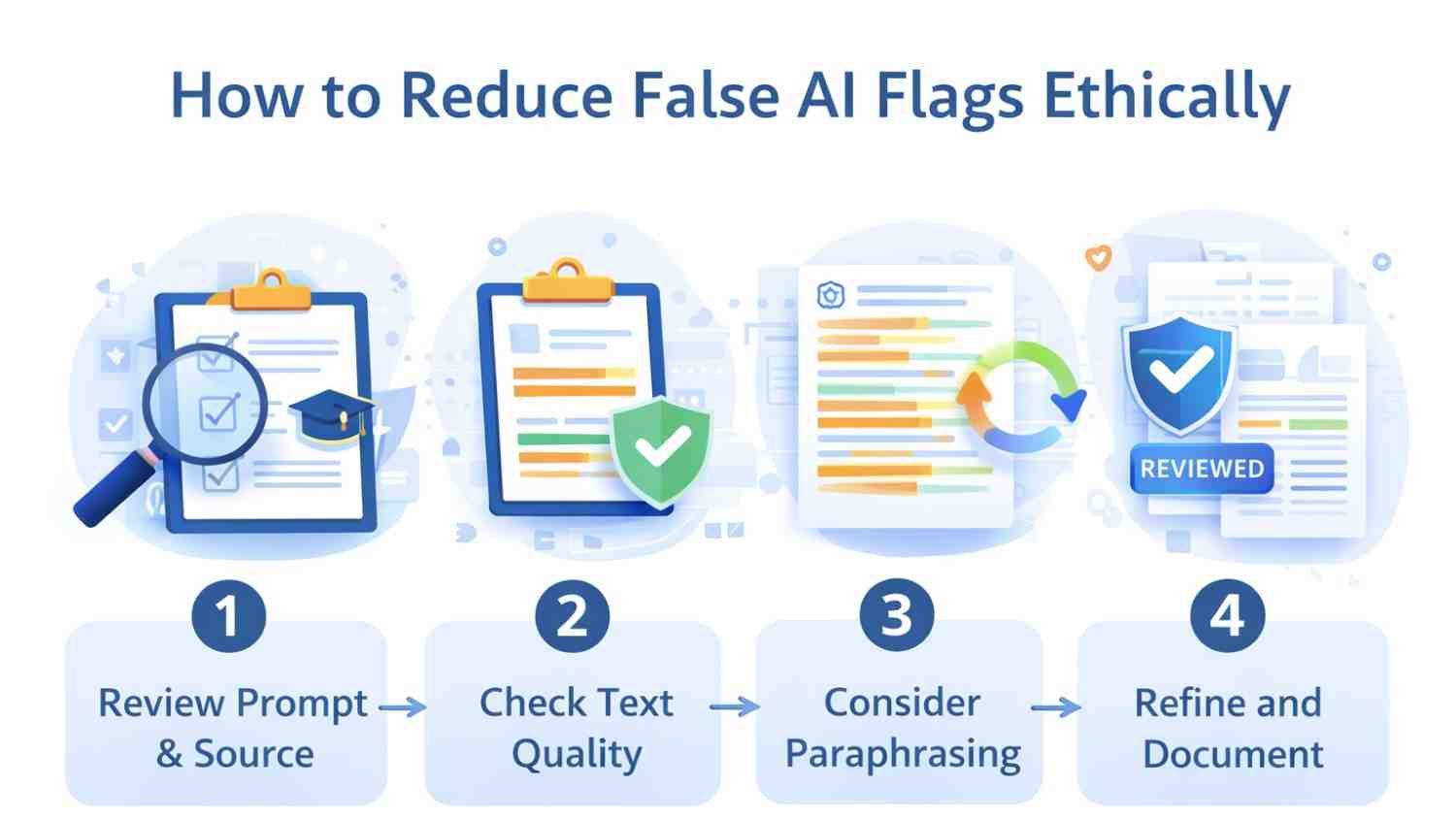
If you are creating your own content and are concerned about false positives, write in a conversational tone. Mix up your sentences–both in length and construction. Explain your logic rather than just dumping conclusions. Let your own analytical voice show through.
You might, for instance, not just say that an experiment indicates a correlation, but also explain how you went from the data to your interpretation of it. Progressions of thought and reflections that underlie them are strong evidence of human authorship.
The point is not to deceive detection mechanisms; it is to write what one really is.
Frequently Asked Questions
Turnitin can detect content generated by models such as ChatGPT, GPT-4, Claude, and similar systems because it evaluates linguistic patterns rather than searching for specific keywords. Teachers can see AI detection indicators within Feedback Studio, while students typically cannot access their own AI percentage.
Turnitin reports an overall accuracy of approximately 96-98% in controlled testing environments. However, accuracy does not equal certainty. AI detection is intended to support academic review, not replace professional judgment.
Final Thoughts
This Turnitin AI checker is a significant leap forward in academic integrity tools. Plagiarism detection shows what is copied.A detection makes clear how text must be built. Appreciating this difference allows students and instructors to interpret AI scores appropriately.
AI detection should be treated as an analytical tool rather than a final judgment. The background, policy, and academic evaluation remain very important for authorship attribution and ensuring fairness.