
A few years ago, blockchain was associated almost entirely with cryptocurrencies and speculative trading. In 2026, that narrative has changed. Blockchain technology trends 2026 show a clear shift toward real-world utility. Blockchain is evolving into a foundational digital infrastructure, quietly supporting financial settlements, digital identity systems, supply chain transparency, and automated agreements across industries.
The global blockchain market was valued at USD 31.28 billion in 2024 and is projected to reach USD 1,431.54 billion by 2030, growing at a 90.1% compound annual growth rate. That level of expansion reflects structural adoption rather than hype. Enterprises, financial institutions, and governments are integrating blockchain into core systems.
The most important question today is no longer whether blockchain will survive. It is how it will scale, connect, protect data, and integrate with intelligent systems. These five trends define the evolution
Table of contents
- Why Blockchain Innovation Matters in 2026
- 1. Real-World Asset Tokenization
- 2. Artificial Intelligence and Blockchain Integration
- 3. Layer-2 Scaling Solutions
- 4. Interoperable Blockchain Networks
- 5. Privacy Technologies and Zero-Knowledge Proofs
- The Broader Impact of These Trends
- The Future Beyond 2026
- Final Thoughts
Why Blockchain Innovation Matters in 2026
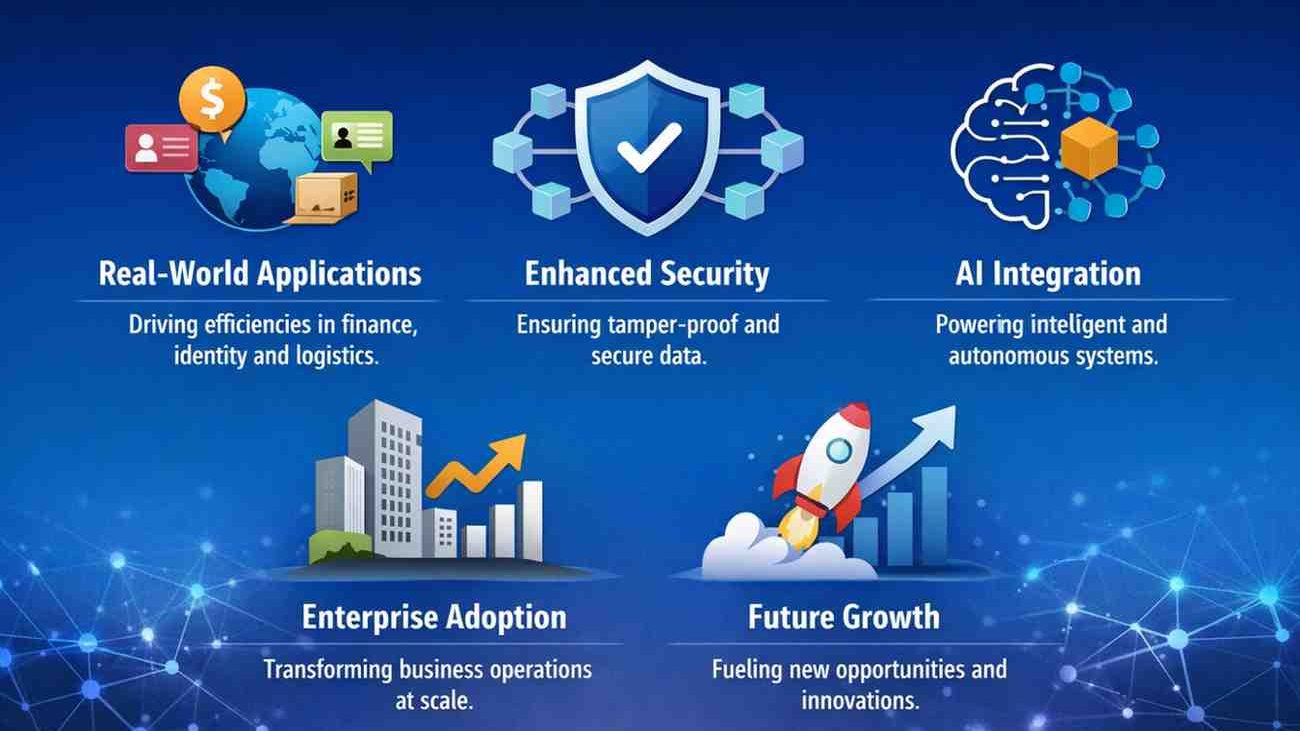
By 2026, blockchain will no longer a standalone technology experiment. It has matured into a strategic framework for managing digital trust. Organizations are using it to automate verification processes, remove intermediaries, enhance data integrity, and reduce operational friction. To implement these systems effectively, many enterprises now collaborate with a specialized blockchain development company that can design secure architectures, integrate smart contracts, and ensure scalable deployment.
Modern blockchain networks focus on high transaction throughput, privacy protection, interoperability, and real-world usability. These advancements make blockchain suitable for enterprise-grade operations rather than niche digital communities. As a result, blockchain is becoming less visible but more essential.
1. Real-World Asset Tokenization
One of the strongest developments in 2026 is the tokenization of real-world assets. In simple terms, this process converts physical or traditional financial assets into digital tokens recorded on blockchain networks. As a result, these tokens represent ownership and can be transferred, traded, or fractionalized without the delays typically associated with conventional settlement systems. Consequently, transactions become faster, more transparent, and more efficient compared to traditional financial systems.
Real estate, government bonds, company shares, commodities, and intellectual property are increasingly being represented digitally. Instead of relying on paperwork and multi-day clearing systems, ownership can be verified in near-real-time.
This shift reduces barriers to entry for investors and increases liquidity in traditionally illiquid markets. It also strengthens transparency, as ownership records become immutable and easily auditable. Tokenization is moving blockchain closer to mainstream financial infrastructure.
2. Artificial Intelligence and Blockchain Integration
Artificial intelligence depends on reliable data. Blockchain ensures that data cannot be altered retroactively. In 2026, the integration of AI and blockchain is enabling the development of intelligent, trustworthy systems.
AI models analyze patterns and automate decisions, while blockchain verifies that the underlying data remains tamper-proof. This combination is being applied in fraud detection, supply chain monitoring, healthcare record validation, and automated compliance systems.
The market growth reflects this shift. The blockchain AI market was valued at approximately USD 0.7 billion in 2025 and is projected to reach USD 1.88 billion by 2029, growing at nearly 28 percent CAGR. This rapid expansion signals strong institutional investment and accelerating enterprise adoption of AI-enhanced blockchain infrastructure.
By merging decentralized data verification with machine learning analytics, organizations can build automated processes without relying entirely on centralized authorities. The result is a smarter infrastructure supported by transparent and secure data foundations.
3. Layer-2 Scaling Solutions
Layer-2 blockchain technology focuses on improving transaction speed and network performance by offloading processing to a separate layer. These systems are essential blockchain scalability solutions that support high user demand without overwhelming the primary network.
In 2026, Layer-2 solutions will be widely used in gaming platforms, digital marketplaces, and payment systems. They enable users to complete transactions quickly and at a lower cost. Many organizations are partnering with Cubix, which offers next-gen web3 development services, to implement these solutions efficiently and build blockchain systems capable of handling high transaction volumes and cross-platform interactions.
Why It Matters:
Without Layer-2 systems, blockchain networks struggle to support large user bases. This technology makes everyday blockchain usage practical for real-world applications.
4. Interoperable Blockchain Networks
Early blockchain networks operated in isolation, each functioning as its own ecosystem. In 2026, interoperability is breaking down those barriers.
Interoperability protocols allow different blockchains to exchange data and assets seamlessly. This means users can transfer value across networks without relying on centralized exchanges, and developers can build applications that function across multiple chains.
This development reduces ecosystem fragmentation and promotes collaborative infrastructure. Instead of competing as separate digital islands, blockchains are forming connected networks. Interoperability is redefining blockchain from a collection of platforms into a coordinated digital ecosystem.
5. Privacy Technologies and Zero-Knowledge Proofs
As blockchain systems expand into finance, identity management, and governance, privacy has become essential. Public transparency is valuable, but sensitive data requires protection.
Zero-knowledge proofs enable one party to verify information without revealing the underlying data. In 2026, these cryptographic tools will be increasingly used in digital identity verification, confidential financial transactions, and regulatory compliance systems.
This innovation allows organizations to meet transparency requirements while safeguarding user data. It strengthens trust in blockchain applications by balancing openness with confidentiality. Privacy technology is shifting from an optional enhancement to a fundamental infrastructure.
The Broader Impact of These Trends
Together, these developments demonstrate that blockchain is transitioning from experimental adoption to operational maturity. Businesses gain improved transaction efficiency and stronger data governance. Developers gain a scalable and interoperable infrastructure. Users gain greater control over digital assets and personal information.
What unites these trends is a common direction: blockchain is becoming more practical, more integrated, and more enterprise-ready.
Key Benefits of These Blockchain Trends
The blockchain trends shaping 2026 are creating practical value across different user groups. These developments are not limited to technical improvements; they are changing how digital systems are designed, managed, and experienced in real environments.
- For businesses, these trends support better data control, faster digital processes, and more reliable transaction systems. As a result, organizations can reduce dependency on intermediaries, improve record accuracy, and build digital platforms that support asset ownership, automation, and cross-platform operations. Consequently, this leads to stronger digital workflows and improved decision-making.
- For developers, modern blockchain technologies offer more flexible frameworks for application development. In particular, interoperability tools, Layer-2 systems, and privacy-focused models allow developers to design platforms that scale with user demand while maintaining data integrity. Therefore, this creates opportunities to build applications across finance, gaming, identity systems, and digital services.
- For beginners, blockchain is becoming easier to understand and access. In addition, tokenized assets, user-friendly wallets, and privacy tools allow new users to interact with blockchain systems without deep technical knowledge. Ultimately, these trends make blockchain more approachable, practical, and relevant for everyday digital use.
The Future Beyond 2026
Looking beyond 2026, blockchain is expected to integrate into digital infrastructure in the same way that cloud computing has over the past decade. In other words, it will increasingly support digital identities, automated contracts, cross-border asset transfers, and decentralized data systems.
As the technology matures, the emphasis will shift from novelty to optimization. Rather than focusing on experimentation, systems will prioritize performance, regulatory alignment, and scalability. Ultimately, blockchain will function less as a visible innovation and more as the invisible trust mechanism powering modern digital systems.
Final Thoughts
Blockchain’s speculative phase has largely subsided. What remains is structural transformation. The trends shaping 2026 reflect a shift toward scalability, integration, privacy, and real-world utility.
Blockchain is no longer about potential disruption. It concerns the development of resilient digital infrastructure. Organizations that recognize this shift early will treat blockchain not as an optional upgrade, but as a foundational layer for the next generation of digital platforms.