
The Evolution of Software-Defined Cyber Defense
Cybersecurity has transitioned from hardware-centric perimeter protection to software-defined, intelligence-driven defense ecosystems. Traditional firewalls and signature-based antivirus systems are no longer sufficient against automated exploit kits, polymorphic malware, AI-generated phishing payloads, and multi-stage intrusion campaigns.
The urgency of this shift is reinforced by financial impact. The global average cost of a data breach in 2025 was USD 4.44 million, reflecting the substantial economic exposure organizations face. While this figure represents a slight decline compared to previous years, the improvement is largely attributed to faster breach containment enabled by automation and AI-driven security operations.
Alaska’s vast expanse of wilderness intersects with roadways, and encounters with large animals such as moose and caribou occur more frequently than in other states. These critters can appear suddenly, and because of their size, hitting one can result in significant vehicle damage and human injury even at moderate speeds.
Understanding the role of wildlife in these collisions helps insurers orient their estimates and assess liability, as a crash with an animal may present distinct types of evidence and risks compared with vehicle-to-vehicle crashes.
Table of contents
- The Evolution of Software-Defined Cyber Defense
- AI-Integrated Security Architecture
- Modernizing Security Operations Centers (SOCs)
- Securing Distributed Infrastructure and Cloud Environments
- Countering AI-Driven Adversarial Techniques
- Automation, Orchestration, and Intelligent Response
- Governance, Observability, and Responsible AI Implementation
- Building Adaptive and Scalable Security Ecosystems
AI-Integrated Security Architecture

Modern cybersecurity stacks increasingly combine SIEM, SOAR, EDR, and XDR platforms enhanced by machine learning models. However, this consolidation effort often begins from a fragmented baseline. A Gartner survey found that organizations use an average of 45 cybersecurity tools, underscoring the operational complexity and integration challenges within modern defense ecosystems.
Machine learning algorithms identify anomalies by detecting deviations from expected user, device, or system behavior. Predictive models dynamically assess risk scores, enabling adaptive policy enforcement in real time.
Developing next-generation threat defense capabilities requires deep technical familiarity with:
- Model training and tuning
- Data pipeline optimization
- Alert correlation logic
- API-based security integrations
- Cloud-native monitoring architectures
Without proper configuration and contextual understanding, AI-driven platforms may produce excessive noise or misclassify threats. Software-level expertise ensures accuracy and operational efficiency.
Modernizing Security Operations Centers (SOCs)
The traditional SOC model centered around manual log analysis and reactive ticket handling. Today’s SOC is software-defined and automation-centric.
By leveraging the synergy between AI and cybersecurity, organizations can significantly reduce Mean Time to Detect (MTTD) and Mean Time to Respond (MTTR). AI-powered platforms correlate events across distributed systems and trigger automated containment actions such as endpoint isolation, credential revocation, or traffic blocking within seconds.
But automation itself is only as good as the rule engine, playbooks and integration among webhook-enabled microservices areas. Security engineers need to know how AI engines rate the importance of alerts, how detection standards can be adjusted to fine-tune sensitivity and what happens when automated containment policies touch live production systems.
This is the technical depth that turns the SOC from a reactive alert-processing machine into an intelligence-predictive technician.
Securing Distributed Infrastructure and Cloud Environments
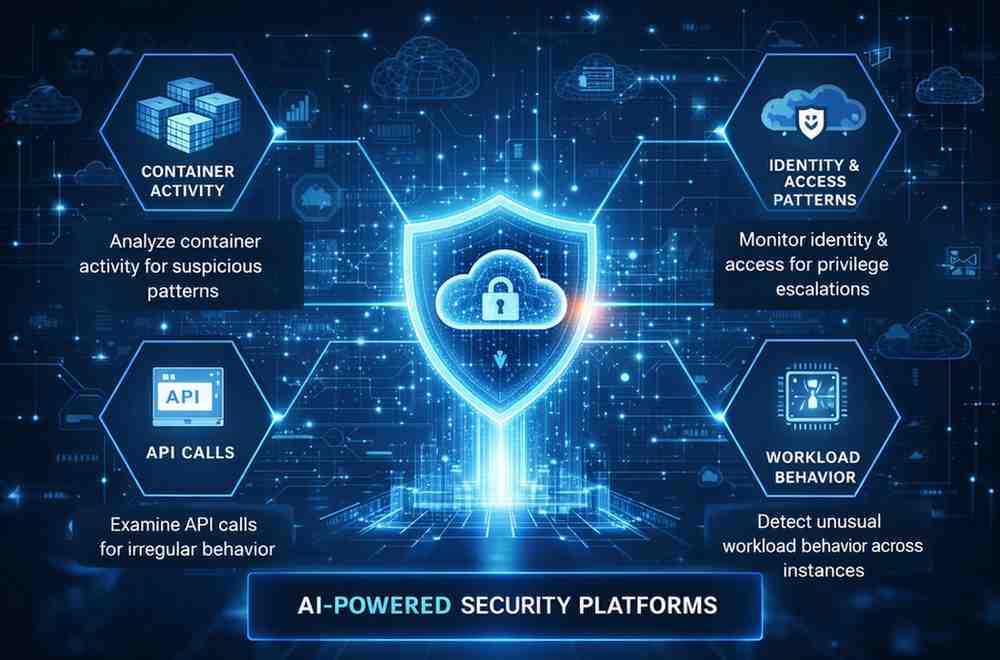
The expansion of hybrid infrastructure, containerized workloads, and remote access models has significantly widened the enterprise attack surface. The growth of cloud computing has accelerated this shift, introducing complex identity layers, API exposure, and multi-tenant architectures.
Security platforms that leverage AI, for example, can now examine container activity, identity and access controls (IAC) patterns or workload behavior in order to determine lateral movement or privilege escalation. Zero-trust frameworks depend on dynamic risk scoring to deliver adaptive access control.
To build the next generation of threat defense, artificial intelligence must be integrated into cloud monitoring platforms, DevSecOps pipelines and identity governance design. Security also needs to work across environments, which means we can no longer think protection by the perimeter.
Countering AI-Driven Adversarial Techniques
Threat actors are now leveraging generative AI to automate reconnaissance, craft targeted phishing campaigns, and generate adaptive malware variants. This introduces adversarial AI challenges, including model evasion and data poisoning attempts.
Defensive strategies must include adversarial testing of detection models, tuning for anomaly resilience, and simulation-based validation. Security teams must evaluate how AI detection behaves under manipulated inputs and continuously retrain models using updated threat intelligence.
Software-driven red team simulations and attack emulation frameworks provide valuable insights into detection blind spots. Continuous model evaluation becomes a critical component of next-generation defense.
Automation, Orchestration, and Intelligent Response
AI does not replace security engineers; it augments them through automation. Modern SOAR platforms leverage AI to prioritize alerts based on contextual risk analysis and historical patterns. Automated workflows execute containment strategies while maintaining audit logs for compliance and forensic analysis.
Security platforms that leverage AI, for example, can now examine container activity, identity and access controls (IAC) patterns or workload behavior in order to determine lateral movement or privilege escalation. Zero-trust frameworks rely on dynamic risk scoring to enable adaptive access control.
To build the next generation of threat defense, artificial intelligence must be integrated into cloud monitoring platforms, DevSecOps pipelines and identity governance design. Security also needs to work across environments, which means we can no longer think of protection by the perimeter.
Governance, Observability, and Responsible AI Implementation
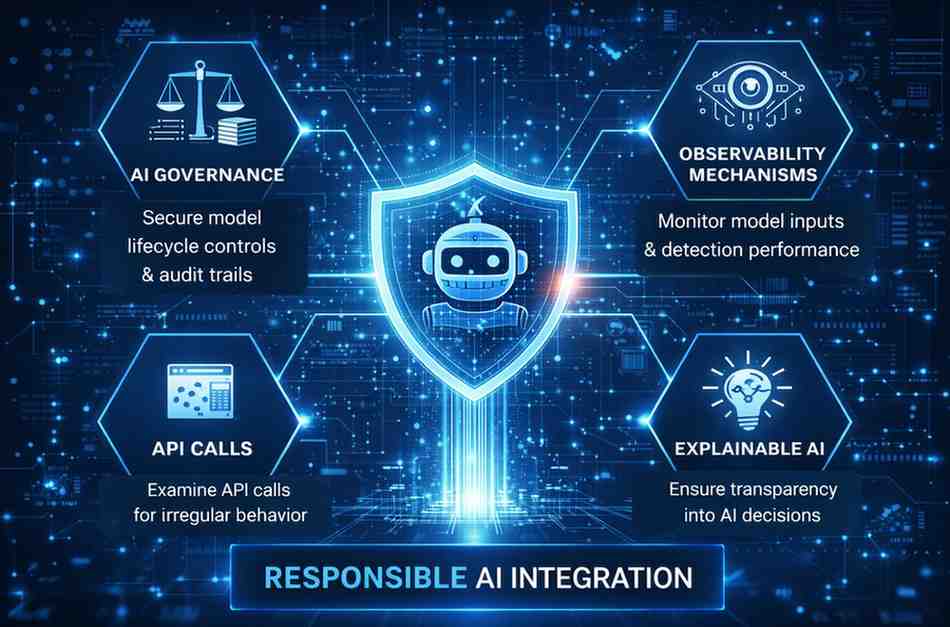
With AI models playing a larger role in security decisions and actions, the need for transparency and explainability is even more important. To ensure appropriate usage, the models must be accompanied by observable indicators that monitor the model decisions and quality of input data, as well as the detection performance metrics.
Monitoring of false positive rate, drift and bias guarantee long lasting reliability. Governance models need to have features such as secure model lifecycle management, versioning, and auditability for compliance support.
Respectable implementation of AI supports operational security and regulatory adherence.
Building Adaptive and Scalable Security Ecosystems
Next-generation threat defense is not a static deployment; it is an evolving software ecosystem. It requires scalable telemetry ingestion, high-performance analytics engines, adaptive policy enforcement, and continuous model retraining.
Organizations that invest in AI-centric cybersecurity architectures achieve:
- Reduced detection latency
- Automated threat containment
- Improved security telemetry visibility
- Stronger cloud and endpoint protection
- Enhanced resilience against advanced persistent threats
Ultimately, developing next-generation threat defense capabilities means architecting intelligent, software-defined security systems that evolve as rapidly as the threat landscape itself.