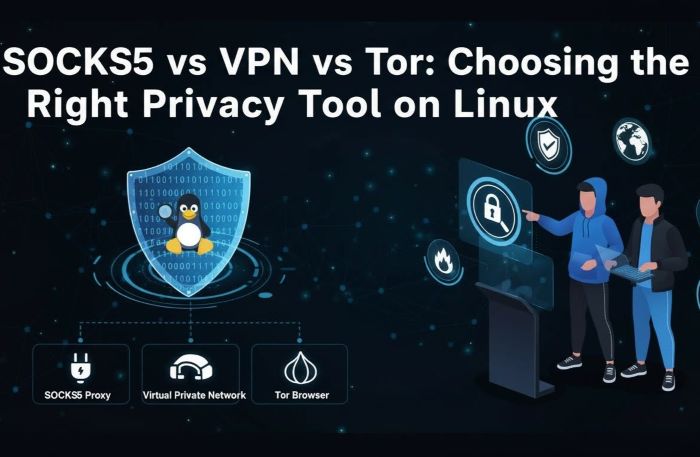
Linux users typically want control, transparency, and security with their internet browsing. As such, it’s not uncommon to use network tools such as SOCKS5, VPNs, and Tor – but many people don’t understand how these privacy tools work or what protection they actually offer.
A common mistake is thinking that SOCKS5, VPNs, and Tor are basically the same thing – just different ways to keep your IP address secret while you’re surfing the web. However, each one serves a specific purpose and has its own strengths and weaknesses; they don’t all do exactly the same job.
Table of contents
Threat Models: What Are You Actually Defending Against?
A threat model explains who you are trying to protect yourself from and why. In the case of most VPN services, this is typically local network snooping, such as ISPs and public Wi-Fi hackers. Tor is all about anonymity: its threat model assumes that its users are trying to avoid surveillance and traffic analysis.
SOCKS5 proxies don’t do much in the way of anonymizing internet connections; instead, their main function is traffic rerouting. The advantage of using SOCKS5 on Linux is that you can set which specific services and ports use the proxy – it’s more flexible than VPNs, which typically work at the system level.
This is useful on a server that may have a number of daemons, scripts, and containers all making outgoing network requests. SOCKS5 lets you set which of these go through the proxy and which don’t.
Visibility, Logging, and the Question of Trust
With proxies, privacy is mostly about who you’re trusting. SOCKS5 doesn’t encrypt anything by default, so it can hide your IP from a website, but it doesn’t hide your traffic from the proxy operator — and they can log more than most people assume. According to an analysis from simplynode SOCKS5 guide, SOCKS5 is best understood as a routing layer: it forwards traffic efficiently and supports multiple protocols, but it isn’t designed to provide encryption or “privacy by default.”
VPNs reduce what your local network can see, but you’re still trusting the VPN provider to handle traffic responsibly and not keep records. Tor spreads that trust out across many relays, which avoids relying on one company, but it also adds complexity and more points where things can break.
On Linux, the practical takeaway is simple: a tool can work perfectly and still leak information if you assume it provides privacy by default.
How SOCKS5 Actually Works Under the Hood
SOCKS5 is not an interpreter; it’s a traffic forwarder. It establishes a TCP connection with authentication, but that is all. It doesn’t inspect headers or payloads. This is also why SOCKS5 works regardless of the protocol being used — HTTP, FTP, P2P, or something else. And that, of course, is why on Linux you can use SOCKS5 to send traffic from the command line, a daemon, or even a container without having to modify the application itself. Sometimes the simplest solutions are the best ones.
VPNs on Linux: Encryption First, Flexibility Second
A VPN provides an encrypted tunnel for all Internet traffic to and from your device. The VPN may slow down your access since all traffic is encrypted, and the decryption is done at a remote server. In addition, using a VPN makes debugging any networking issues more difficult. On Linux systems, VPN configuration can interfere with how you manage your routing tables and DNS resolution. While this works well for providing security when you are on untrusted networks, using a VPN can be too heavy-handed. Often, you don’t want all your network traffic going over the VPN.
Tor: Maximum Anonymity, Maximum Tradeoffs
Tor sends your web use through a bunch of volunteers in order to keep where you are using it and what you are using it for secret. This works, but it also means speeds can be slow– plus lots of services don’t like traffic coming from Tor exit points.
Lots of people on Linux use Tor because they want to do research or blow the whistle on something without being found out, or get around government filters.
But don’t expect it to make online games run any better, and automation can be tricky, too. One thing that does happen is your trust gets shifted over to this huge network of random people, which is impressive but also a bit unpredictable when things go wrong!
Performance Tradeoffs You Cannot Ignore
Performance is where theoretical privacy meets reality. VPNs encrypt everything, which adds CPU overhead and latency. Tor multiplies latency by design. SOCKS5 avoids both issues because it does not encrypt or inspect traffic. According to multiple proxy benchmarks, SOCKS5 often outperforms HTTP proxies and VPN tunnels for raw throughput. This matters for scraping, gaming, VoIP, and large file transfers. On Linux systems running multiple services, these differences compound quickly.

When SOCKS5 Is the Right Tool
SOCKS5 shines when you need precision instead of invisibility. It is ideal for internal routing, app-specific proxying, and segmented network architectures. You can route one service through a proxy and leave others untouched. This is especially useful in containerized Linux environments. SOCKS5 is also popular for security testing and server management, where isolating traffic paths matters more than encrypting everything. It is not a privacy silver bullet, but it is a powerful routing primitive.
One Clear Comparison List
To make the differences concrete, here is a single focused comparison list:
- SOCKS5: No encryption, high speed, app-level routing, depends on operator trust
- VPN: Full encryption, system-wide routing, moderate speed loss, provider trust required
- Tor: Strong anonymity, very high latency, limited compatibility, decentralized trust
This distinction helps avoid mismatched expectations and misuse.
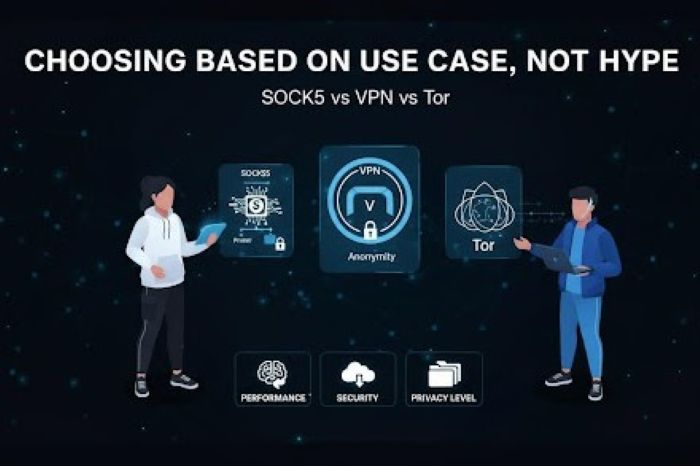
Choosing Based on Use Case, Not Hype
Don’t pick a tool based on a slogan. If you need selective routing, “military-grade encryption” isn’t going to help. And if your goal is to avoid timing attacks, then “total anonymity” isn’t much use.
The major advantage of Linux is that you’re not stuck with all-or-nothing solutions. You can combine VPNs with SOCKS5 proxies or make Tor only proxy certain applications. In other words, on Linux, you can use the right tool for the job — rather than trying to find a single tool that does everything you need it to.
Final Thoughts for Linux Users
Privacy tools on Linux systems depends on both intent and design. Each tool has its own role and helps ensure privacy in its own way – VPNs protect networks, Tor keeps identities hidden, and SOCKS5 proxies control the path network traffic takes. There isn’t a single “best” tool for the job at hand; each one has its strengths and weaknesses. SOCKS5 is often overlooked, but it might be the most “Linux-like” privacy tool available – it’s simple, flexible, and works well in a modular environment where you can pick and choose exactly how you want your network to behave.
FAQ
Can SOCKS5 fully replace a VPN on Linux?
No. A VPN secures the whole system, while SOCKS5 targets specific apps. On Linux, SOCKS5 is better for fine-grained routing, not full tunnel protection.
Is SOCKS5 pointless without encryption?
The answer is no, as most current applications utilize TLS. SOCKS5 Proxy prioritizes transparent routing along with speed. This means it leaves encryption to the application level.
Why is SOCKS5 so common in Linux CLI tools?
This is because system routes are not modified by it. Any tool or process that wants the new behavior can ask for it specifically. Existing scripts and programs, containers, and background services will not be affected.
Does using Tor with SOCKS5 actually help?
Sometimes. This may help improve traffic isolation. It also adds latency and complexity. It is useful for workload compartmentalization but not for typical workloads.