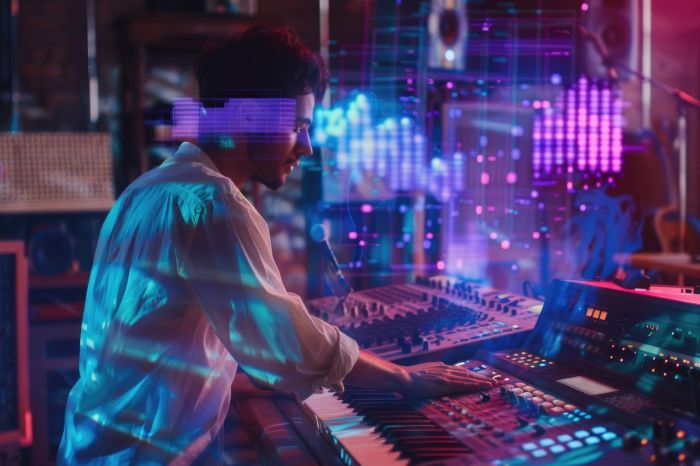
The production of music has been altered significantly in the last twenty years. What would have been done in fancy studios, huge crews, and heavy hardware can now be accomplished with a laptop and studio headphones. Modern beats are recorded in bedrooms, home studios and even on the road. The instruments have evolved, but the concept has stayed the same to make a rhythm, a mood, and energy that would go well with the listeners. The modern music production process reflects this shift. Understanding beat production today provides a better insight into creativity and technology that form contemporary music.
Key Takeaways
- The modern music production process has shifted from studios to home setups using laptops and DAWs.
- DAWs like Ableton Live and FL Studio enable easy recording, editing, and arranging of sounds.
- Producers layer beats with drums, create melodies using virtual instruments, and employ sampling for depth.
- Sound design and effects enhance the identity of a beat, while collaboration via digital platforms speeds up the creative process.
- Producers typically follow steps like choosing tempo, creating patterns, and mixing to finalize their beats.
Table of contents
The Foundation: Digital Audio Workstations
The Digital Audio Workstation, commonly known as a DAW, is at the centre of contemporary beat-making. A DAW software is a program which can help producers to record, edit and arrange the sounds within one environment. FL Studio, Ableton Live, Logic Pro and Pro Tools are some of the common DAWs. Each provides a different workflow, but all serve as the primary workspace for producers.
A beat in a DAW is built up out of patterns, tracks, and timelines. The beats emanated by the drum are placed carefully in order to produce a rhythm, and the tunes, together with the bass tracks, are overlaid. The tempo, key, and structure can be easily edited by the producer. This flexibility enables rapid experimentation, and this will make it easier to mold a distinctive sound in the modern music production process.
Creating Rhythm: Drums and Percussion
Most of the beats are supported by drums. Contemporary producers combine digital drum machines, sampled recordings, and live recordings. Kicks, snares, hi-hats, and claps are shaped using the help of drum machines and software instruments.
There are several producers who begin by laying a simple drum pattern. Then, some variations are introduced to form the movement and interest. Swing, tempo alterations, and slight timing variations make beats come out more natural, not mechanical. After this stage, producers may explore advanced tools like an AI music creator to spark new rhythm ideas or speed up experimentation, blending human creativity with smart technology.
Building Melody and Harmony
When the beat is established, melody and harmony add sensation to the beat. Virtual instruments help producers to create melodies, chords and textures. These instruments have the capacity to recreate actual sounds, such as the piano and guitar or can create completely new sounds with their synthesis.
Tunes are usually uncomplicated and easy to catch. Chord progressions establish the mood, be it fast, gloomy or calm. Overlapping several sounds is used to produce depth, and the effects, such as reverb and delay, provide space. A sense of balance is important because music should not drown out the beat.
The Role of Sampling
Modern beat-making is still significantly dominated by sampling. A sample is a fragment of audio borrowed from an existing recording, e.g., a song, movie, or sound effect. The producers tear, stretch and play with samples to come up with something new.
The tools available today have simplified sampling. Time-stretching and pitch-shifting enable the samples to fit entirely in a beat. Other producers put much emphasis on digging up rare sounds, whereas others come up with their own samples. Sampling adds depth and tradition and connects the present with the past.
Sound Design and Effects
Sound design is an important element of creating the identity of a beat. The sound is usually adjusted by filters, distortion, and modulation used by the producers. These instruments transform the feel of a sound into being softer, sharper, or more aggressive.
Everything is also glued using effects. Equalization ensures that all sounds occupy their own space, whereas compression regulates the dynamics. Reverb and delay are atmospheric, and beats get even bigger or even smaller. Considerable application of effects distinguishes between refined beats and rough concepts.
Collaboration in the Digital Age
Teamwork has been simplified through web platforms and file-sharing software. Producers are able to collaborate even in other cities or nations. Beats are exchanged to and fro, refined one beat at a time and finished, never seeing each other.
The international style enables various styles and influences to blend. A beat can be a blend of a rhythmic tune of a certain culture with another. Teamwork is also faster in the learning process, because the techniques and feedback are exchanged among the producers.
Common Steps in Modern Beat-Making
Although each producer has its own process, most of them have a similar direction. Some of the beats made nowadays follow a straightforward list, as shown below:
- Choosing a tempo and style
- Creating a drum pattern
- Adding bass and melody
- Layering sounds for depth
- Effect and sound design.
- Organizing the beat format.
- Mixing and basic mastering
These phases can be rearranged or repeated, yet they offer a rough guide to the process of idea-to-final beat in the modern music production process.
Mixing provides compatibility of all sounds. The levels are set in such a way that there is neither too much sound nor too little. Panning disseminates sounds in the stereo field, making it wide. This step is concerned with clarity and balance.
Conclusion
The beat-making of the present is a combination of creativity and mighty technology. The creation of music has been transformed through the use of digital tools, sampling, sound design, and collaboration. The modern music production process shows that although the instruments have been updated, beat-making continues to be all about human expression and emotion. Knowing the contemporary manufacturing process, it is easy to see that the current beats are not merely created, but planned and created with previous knowledge, imagination and creativity.