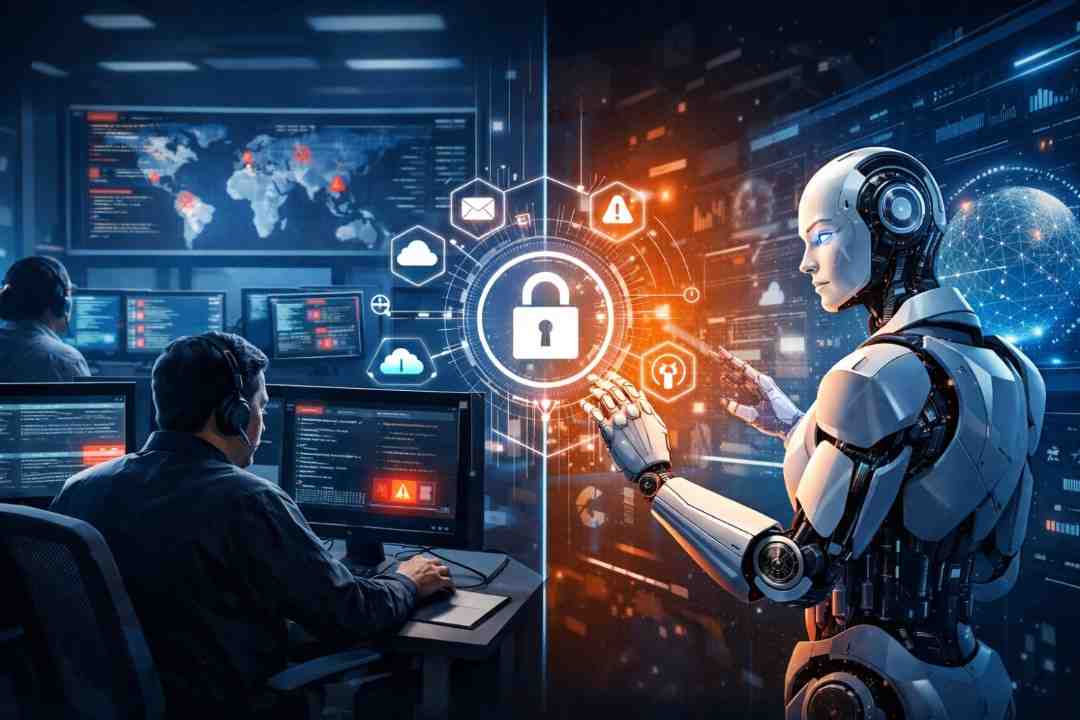
In recent years, cybersecurity has become one of the most pressing concerns for organizations worldwide. With cyber threats growing in sophistication and frequency, the traditional security operations center (SOC) model, relying heavily on human analysts manually triaging alerts and investigating incidents, is increasingly struggling to keep pace. Organizations face a perfect storm of challenges: escalating alert volumes, talent shortages, and the complexity of modern IT environments. Against this backdrop, the emergence of the AI SOC is transforming how security operations are executed, providing faster, more intelligent, and scalable solutions. In fact, about 57 % of organizations using AI in cybersecurity apply it to anomaly detection, roughly 50.5 % to malware detection, and around 49 % to automate incident response tasks, highlighting how AI is becoming central to modern threat detection and response.
Table of contents
The Limitations of Traditional SOC Teams
Traditional SOC teams have long been the backbone of enterprise cybersecurity. Analysts monitor alerts, investigate incidents, and respond to threats, often working in shifts around the clock. Despite their importance, traditional SOCs face several structural limitations:
- Alert Overload: Modern security environments generate thousands of alerts daily. Traditional SOC teams often struggle to triage and prioritize these alerts effectively. Many alerts turn out to be false positives, which leads to wasted time and effort.
- Talent Shortage: The global cybersecurity workforce gap is well-documented. Millions of unfilled positions exist, leaving existing teams overstretched. This shortage exacerbates fatigue and increases the risk of missed threats.
- Manual Processes: Much of traditional SOC work is repetitive and manual. Analysts spend countless hours gathering context, correlating data, and documenting incidents. These tasks, while necessary, can slow down response times and reduce overall efficiency.
- Scaling Challenges: As organizations adopt cloud-native architectures, hybrid IT environments, and remote workforces, the attack surface expands dramatically. Scaling a human-centric SOC to match this growth is both costly and impractical.
These limitations have created a need for a smarter, more automated approach to security operations enter the AI SOC.
What Makes the AI SOC Different
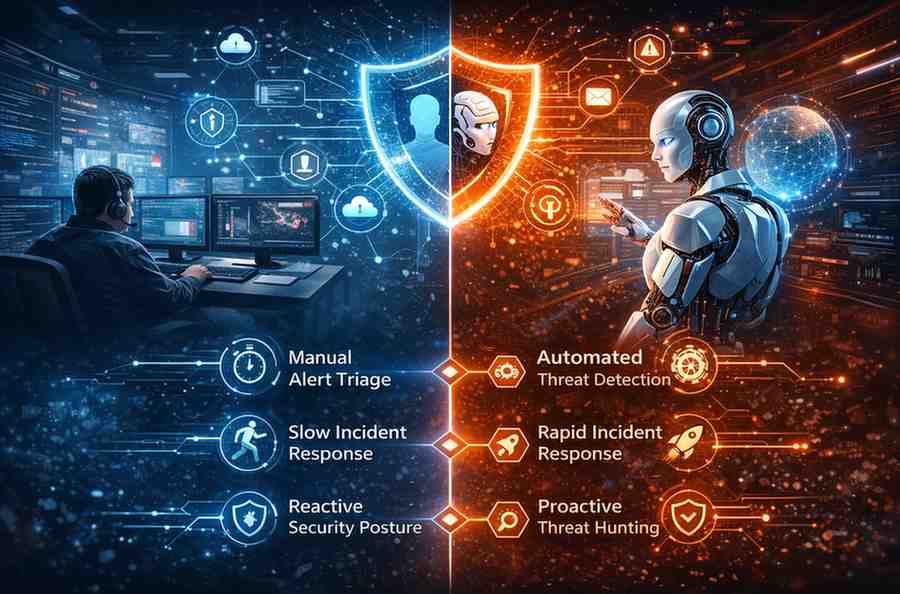
An AI SOC is not simply a traditional SOC augmented with a few automation tools. It is a fundamentally new model in which artificial intelligence and machine learning drive core operations. Here’s how it differs:
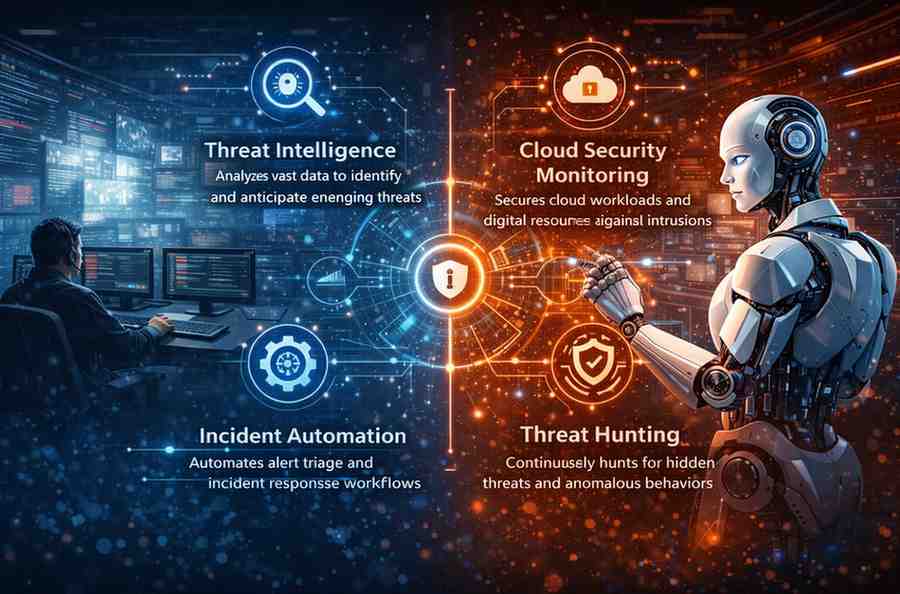
- Intelligent Alert Triage: AI can sift through thousands of alerts in real time, distinguishing between true threats and false positives with remarkable accuracy. This reduces the workload on human analysts and ensures that only actionable alerts reach their desks.
- Automated Investigations: AI SOCs can autonomously investigate alerts, collecting context from multiple sources, correlating logs, and identifying attack patterns. This automation drastically reduces mean time to respond (MTTR), allowing organizations to mitigate threats before they escalate.
- Predictive Threat Detection: Traditional SOCs often react to threats after they occur. AI SOCs, however, leverage predictive analytics and threat intelligence to anticipate attacks, enabling proactive defense strategies.
- Continuous Learning: AI systems constantly learn from new data, adapting to emerging threats faster than human teams alone. This continuous improvement ensures that security operations remain effective against evolving adversaries.
- Scalability and Efficiency: By automating routine tasks and intelligently prioritizing incidents, AI SOCs can scale effortlessly to meet the needs of growing organizations without increasing headcount in proportion.
Why Organizations Are Making the Shift
Modern IT environments generate an overwhelming number of security alerts every day, often burying analysts under low-value tasks such as filtering false positives and manually preparing incident reports. This growing volume and complexity make it difficult for teams to focus on truly critical threats. AI-powered SOCs address this challenge by automatically triaging alerts, correlating events, and prioritizing high-risk incidents so that human expertise is directed where it matters most.
Even highly skilled analysts are susceptible to errors, particularly when working long hours under pressure. Fatigue, stress, and information overload can lead to missed signals or delayed responses. AI systems, however, apply consistent, data-driven reasoning across all alerts, helping to reduce the likelihood of human error. This reliability is especially important when defending against sophisticated attacks that exploit small gaps in attention or judgment.
At the same time, organizations worldwide face a significant shortage of qualified cybersecurity professionals. Recruiting, training, and retaining skilled analysts is both time-consuming and costly. AI SOCs help bridge this talent gap by augmenting existing teams, enabling fewer analysts to manage larger, more complex security environments without compromising effectiveness.
From a financial perspective, operating a traditional SOC with round-the-clock staffing is expensive. Automation through AI SOCs reduces operational costs by handling routine monitoring, investigation, and reporting tasks, enabling leaner teams to maintain continuous coverage. This efficiency makes advanced security capabilities more accessible, even for mid-sized and smaller organizations.
Finally, speed is a decisive factor in cyber defense. The longer a threat remains undetected, the greater the potential damage. AI SOCs significantly improve response times by rapidly analyzing incidents, delivering real-time insights, and recommending or executing remediation actions. By accelerating detection and response, organizations can contain attacks earlier, minimize impact, and strengthen their overall security posture.
Real-World Applications of AI SOCs
Organizations across industries are already realizing the benefits of AI SOCs:
- Financial Services: Banks and fintech companies face constant threats from ransomware and phishing attacks. AI SOCs help these organizations detect fraudulent activity in real time, reducing potential losses and protecting sensitive customer data.
- Healthcare: Hospitals and clinics handle highly sensitive patient data. AI SOCs monitor medical devices, electronic health records, and network activity to prevent data breaches while ensuring compliance with strict regulations such as HIPAA.
- Manufacturing and Industrial IoT: Connected manufacturing environments are vulnerable to operational technology (OT) attacks. AI SOCs can detect anomalies in OT systems that human analysts might miss, preventing costly disruptions.
- Retail: Retailers managing e-commerce platforms and point-of-sale systems face constant attacks targeting customer payment information. AI SOCs automate threat detection and incident response, safeguarding both revenue and reputation.
The Human Role in an AI-Driven SOC
Analysts are freed from repetitive, low-value tasks and can instead concentrate on higher-level, strategic functions such as investigating complex or previously unseen threats, defining and fine-tuning AI models to align with specific organizational environments, driving cybersecurity strategy and policy development, and conducting proactive threat hunting and advanced adversary simulations. This shift allows security professionals to spend more time on critical thinking, cross-team collaboration, and continuous improvement of detection and response capabilities.
By reducing alert fatigue and automating routine analysis, the AI-powered SOC enhances situational awareness, speeds up decision-making, and strengthens overall resilience against evolving cyber risks. In this way, the AI SOC amplifies human expertise, enabling security teams to operate more efficiently, respond more intelligently, and deliver greater strategic impact across the organization.
Challenges and Considerations
While AI SOCs offer numerous advantages, organizations should be mindful of certain considerations:
- Data Quality: AI systems are only as good as the data they process. Organizations must ensure that logs, telemetry, and threat intelligence feeds are accurate and comprehensive.
- Model Transparency: Some AI models operate as “black boxes,” making it difficult to understand decision-making processes. Ensuring explainable AI is critical for compliance and trust.
- Integration: Effective AI SOCs require seamless integration with existing security tools, cloud environments, and IT infrastructure. Poor integration can limit the benefits of automation.
- Governance: Organizations must define policies governing AI decision-making, including when automated responses are appropriate and when human approval is required.
Looking Ahead
The shift toward AI SOCs is not a passing trend it reflects a fundamental change in how organizations approach cybersecurity. As threats continue to evolve and IT environments become more complex, AI-driven operations will increasingly become the standard.
Organizations that embrace AI SOCs gain several strategic advantages: faster detection and response, reduced human error, improved efficiency, and scalability without a proportional increase in headcount. More importantly, they empower human analysts to focus on tasks that require creativity, judgment, and strategic insight rather than repetitive manual processes.
Ultimately, the AI SOC represents the future of security operations: a model that combines machine intelligence with human expertise to deliver superior protection against today’s and tomorrow’s cyber threats.