
I spent three years bouncing between hosting solutions before I realized I’d been asking the wrong question. The debate isn’t really about bare metal versus dedicated servers. It’s about what you actually need from your infrastructure and how much control you’re willing to manage.
Here’s what nobody tells you upfront: bare metal servers and dedicated servers often refer to the same thing. Both give you exclusive access to physical hardware. No neighbors, no resource sharing, no virtualization layer sitting between you and the CPU. But the way providers package and deliver that hardware can differ significantly.
Key Takeaways
- The debate isn’t bare metal versus dedicated servers; it’s about control and specific infrastructure needs.
- Bare metal servers offer more freedom and granular control over configurations compared to traditional dedicated servers.
- Use bare metal hosting for high-performance applications, like real-time analytics and resource-heavy workloads.
- Bare metal deployments typically lead to higher transaction rates and better network performance than virtualized environments.
- Choose bare metal for custom setups and compliance, but start with solutions that meet immediate performance needs.
Table of contents
What Actually Separates These Two
Traditional dedicated hosting locks you into fixed configurations. You choose from a menu of preset options, sign a contract, and the provider manages most backend infrastructure. Root access is yours, but the server operates within their managed environment using their standard setup.
Bare metal server hosting strips away more of those layers. You’re getting closer to raw hardware with fewer assumptions built in. Most providers give you granular control over everything from BIOS settings to network configurations. The hardware is still dedicated to you, but you have more freedom to modify the underlying system.
When exploring budget-friendly options, you’ll notice this flexibility immediately. Their 36-Core Bare Metal Server configurations let you customize specifications that would be locked in traditional setups. You can mix AMD Bare Metal Servers with specific storage arrays or choose Intel Bare Metal Servers optimized for single-threaded workloads. These custom servers give you that control when your application has unusual requirements.

When Bare Metal Makes More Sense
I switched to a dedicated bare metal server after realizing my database performance was bottlenecked by virtualization overhead. Even though my previous dedicated server was powerful on paper, the hypervisor layer added latency I couldn’t tolerate.
The power of Bare Metal Servers really shows up in three scenarios. First, high-frequency trading or real-time analytics, where microseconds matter and even brief network issues like a DNS server not responding can cause costly delays. Second, resource-intensive workloads such as machine learning training or video rendering need sustained CPU access. Third, compliance situations where you need provable isolation at the hardware level.
Bare metal deployments can show 30-40% higher transaction rates compared to virtualized environments.
The Real Cost Calculation
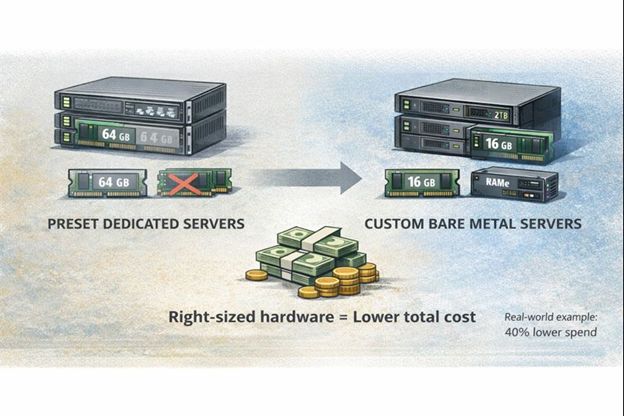
Here’s where most comparisons get it wrong. They focus on monthly pricing without accounting for what you’re actually getting. A cheaper dedicated server with preset specs might seem attractive until you realize you’re paying for RAM you don’t need, but can’t get the NVMe storage you do need.
When you buy Bare Metal Server Hosting, you’re typically paying for precision. Dedicated bare metal servers cost more upfront, but you’re not subsidizing unused capacity. One client I worked with cut their hosting bill by 40% after moving from an oversized dedicated server to a properly configured bare metal setup.
USA Bare Metal Server Hosting providers have gotten aggressive with pricing recently, particularly for businesses that need data sovereignty without compromising performance.
Performance Differences That Actually Matter
The performance advantage isn’t just theoretical. When you remove the hypervisor, you eliminate context switching overhead, memory page table walks, and I/O translation layers. For most web applications, this won’t make a noticeable difference. For databases processing thousands of transactions per second, it absolutely will.
I ran PostgreSQL benchmarks on identical hardware configurations, one virtualized, and one bare metal. The bare metal setup consistently delivered 25% higher transaction throughput under load.
Network performance gets better, too. Dedicated setups connect straight to network interfaces without the extra hop through virtual bridges. Network latency can be up to 15-20% lower on bare metal versus virtualized cloud environments.
Which One Should You Actually Choose
If your application runs fine on shared hosting or a VPS, you probably don’t need either option yet. But when you hit the ceiling on virtualized resources, the choice becomes clearer.
Choose traditional dedicated hosting if you want a managed experience with preset configurations and don’t need extensive customization. It works well for standard web applications and moderate database workloads.
Choose bare metal when you need absolute performance, custom hardware configurations, or compliance requirements that demand physical isolation. It’s the right move for high-frequency applications, large-scale data processing, or workloads with unpredictable resource spikes.
Most businesses overestimate what they actually need. Start with whatever fixes your immediate performance problem. Just make sure you’re solving something real, not chasing specs that sound good but don’t actually help your users.