Today’s digital teams compete in a world where speed, accuracy, and scalability are merely table stakes. Organizations have extended their digital footprint from the cloud to customer channels and internal systems, and operational complexity has grown significantly: Manual processes that were once manageable at a small scale now lead to delays, errors, and under-the-radar rework.
This shift has accelerated interest in AI-driven automation, a technology category designed to streamline workflows, reduce repetitive tasks, and enable teams to focus on higher-value work. Rather than replacing human decision-making, these systems are increasingly used to augment it. In fact, 80% of executives believe automation can be applied to any business decision, highlighting the growing confidence in AI’s role in driving strategic operations.
Table of contents
- The Growing Cost of Manual Digital Processes
- What AI-Driven Automation Does Differently
- Core Capabilities of Intelligent Workflow Platforms
- Why Technology Teams Are Adopting Automation Faster
- The Role of Explainability and Control
- Measuring the Impact on Digital Operations
- Looking Ahead: Automation as Infrastructure
The Growing Cost of Manual Digital Processes
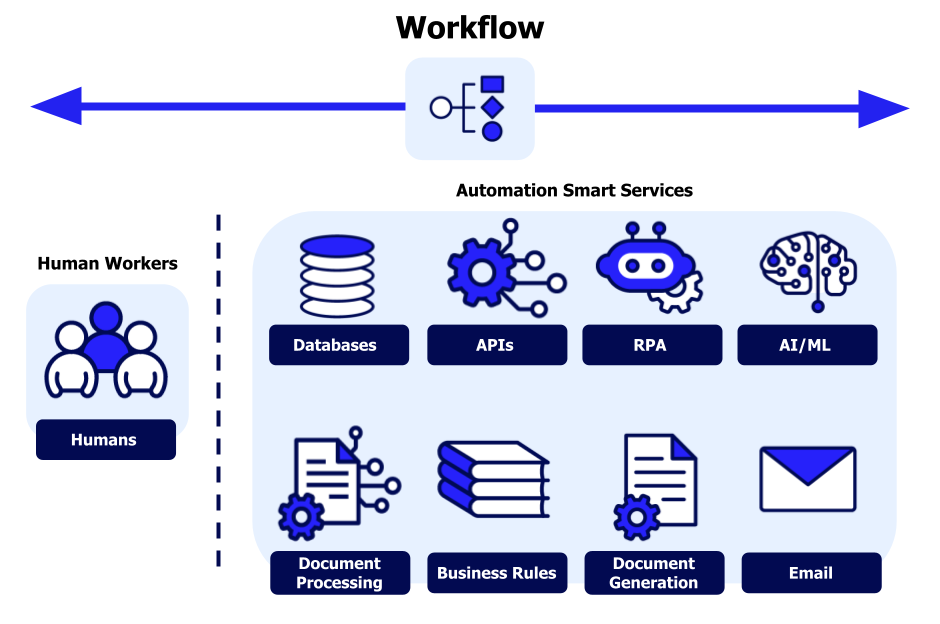
In industry after industry, digital operations have humans and a set of software tools working together. Manual lead routing by marketing teams, data reconciliation across disparate systems of record by operations teams , and fragmented system orchestration for product releases. Each handoff introduces friction.
Digital operations research consistently shows that knowledge workers spend a lot of time on routine administrative tasks. This not only delays delivery but also increases the chances of variance and overlooks. These inefficiencies follow as organizations grow.
The problem is not the absence of tools, but the lack of coordination. A lot of these teams have robust software that’s severely underutilized because systems aren’t interoperating with one another.
What AI-Driven Automation Does Differently
Traditional automation follows fixed rules. AI-based automation brings in the additional dimension of context, learning and adaptability. These systems can learn data patterns to adapt workflows on the fly and become smarter with time.
For instance, rather than using simple heuristics to route tasks in unchanging ways, AI can optimize task assignment based on urgency or importance of the action and historical performance of an agent (human or machine), or projected impacts. Within data-rich environments, machine learning models can spot anomalies or optimization opportunities that no human would identify.
This is what we mean by intelligent process automation. It lies at the confluence of AI, workflow orchestration, and systems integrations.
Core Capabilities of Intelligent Workflow Platforms
While implementations vary, most modern automation platforms share several technical foundations. They integrate with existing software stacks through APIs, process data in real time, and provide centralized visibility into operations.
Machine learning models are typically used for classification, prediction, or recommendation tasks. Natural language processing allows systems to interpret unstructured inputs such as text or user requests. Over time, feedback loops enable continuous refinement.
A practical example is platforms like Nano Banana, which focus on applying automation across digital workflows rather than limiting it to a single function. By acting as a connective layer between tools, such platforms aim to reduce fragmentation without requiring teams to rebuild their tech stacks from scratch.
Why Technology Teams Are Adopting Automation Faster
Engineering and product teams are often early adopters of automation technologies because they feel operational friction first. Deployment pipelines, testing environments, and monitoring systems generate massive amounts of data that must be interpreted quickly.
AI‑driven automation helps by filtering out noise, highlighting critical issues, and automatically triggering responses. This reduces downtime and frees engineers to focus on architecture and innovation instead of constant maintenance. According to Gartner research, 80% of executives believe automation can be applied to any business decision, showing broad confidence in automation’s strategic role across functions, not just IT or operations.
Beyond engineering, data teams use automation to standardize data pipelines, while customer-facing teams apply it to support workflows and personalization engines.
The Role of Explainability and Control
A common problem with AI systems is transparency. Companies must know why decisions are made, especially in regulated or risk-prone scenarios. Explainability features that display how and why actions were taken are becoming a staple of modern automation platforms.
Control mechanisms are equally important. Human in the loop approach. Many organizations are looking for alternative human-in-the-loop models rather than fully autonomous ones. These enable AI to recommend or prepare actions while leaving final decision authority in the hands of humans. This equilibrium fosters trust and maintains the automation on track to achieve organizational objectives as well as ethical standards.”
Measuring the Impact on Digital Operations
The advantage of AI-derived automation is perhaps most readily apparent in operational terms. Companies often see decreased cycle times, reduced manual errors and increased consistency across processes. Over the long term, these enhancements add up to faster delivery, stronger customer experiences, and more resilient systems.
Crucially, this is not just a question of cost. With this recaptured time, organizations free up creative and strategic capacity that is hard to measure but vital to long-term success.
Looking Ahead: Automation as Infrastructure
With the digital ecosystems increasingly interconnected, automation is moving beyond a productivity solution to foundational infrastructure. If cloud computing abstracts away hardware complexity, then intelligent automation certainly abstracts away operational complexity.
The next “stage” is likely more integration, better context-awareness, and closer alignment with the business. Mission-critical to this shift will be platforms that are able to flex across departments and scale with the business.
In this scenario, AI-based workflow automation is no longer science fiction. It is an underlying fabric for how digital companies function, compete and innovate.