Introduction
In New York’s highly competitive manufacturing environment, profit margins are being eroded by invisible production inefficiencies. Many companies unknowingly bear the high costs associated with improper process selection. The root of this waste often lies in a lack of systematic understanding of the technical characteristics and application scenarios of Precision CNC Turning and milling, leading to decisions based on habit rather than data.
This article will deconstruct a five-step decision-making framework based on international manufacturing standards to help enterprises accurately match part requirements with the optimal machining process. To unlock this potential, it is essential first to thoroughly understand why these two fundamental processes are engines of technological innovation.
Table of contents
- Introduction
- What Are Precision CNC Turning and Milling, and How Do They Drive Technological Innovation?
- Why is Choosing the Correct CNC Process Crucial for Business Solutions?
- How to Make an Informed Choice Between CNC Turning and Milling Based on Product Needs?
- How Does Precision CNC Machining Drive Innovation and Sustainable Development in New York Manufacturing?
- How Can Enterprises Ensure CNC Machining Results Through Certification and High-Quality Services?
- Conclusion
- FAQs
What Are Precision CNC Turning and Milling, and How Do They Drive Technological Innovation?
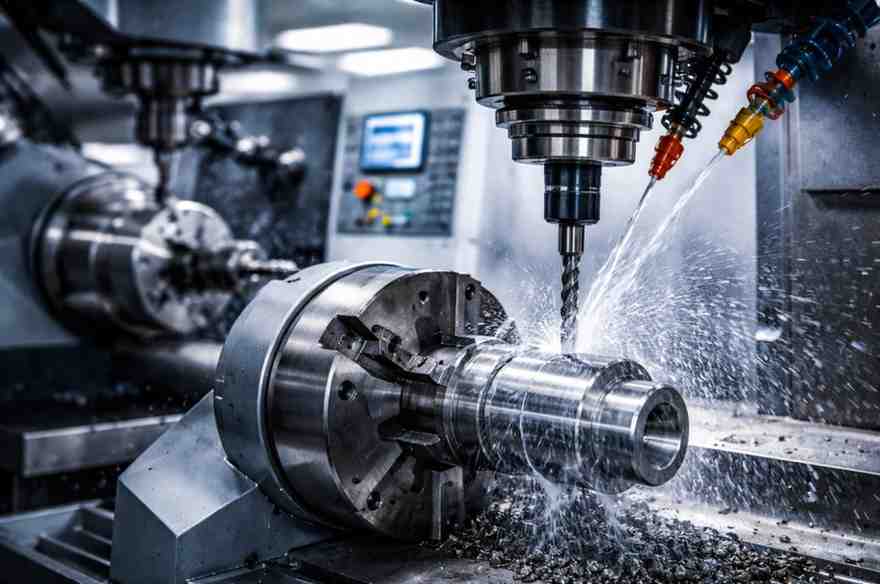
Precision CNC Turning is a manufacturing process in which the workpiece rotates and the cutting tool moves linearly, making it suitable for machining axisymmetric parts. In contrast, CNC milling is characterized by a rotating tool and a fixed workpiece, making it well-suited for complex contour machining. These two fundamental processes form the cornerstone of modern precision manufacturing.
Under ISO machine tool testing standards (such as ISO 230 and ISO 10791), high-end precision CNC turning centers are typically capable of positioning accuracy in the micron range, often around ±0.005mm. This standard ensures part reliability in high-end fields such as medical devices and aerospace. In terms of Technology Innovation, advancements in CNC technology have shortened Design & Prototyping cycles from traditional weeks to just days.
In one documented New York–based medical device project, the prototype development time for orthopedic implants was reduced by 70% with the adoption of a five-axis precision turning center, while maintaining surface roughness below Ra 0.4 μm. This case demonstrates the accelerating effect of precision CNC machining waste technology on product innovation.
Why is Choosing the Correct CNC Process Crucial for Business Solutions?
The Cost Impact of Incorrect Process Selection
In many manufacturing environments, improper process selection can contribute to significant waste, often estimated in industry studies to range between 20–30%. An industrial equipment manufacturer in Queens once incorrectly chose CNC milling for a batch of axisymmetric parts, resulting in a 40% increase in unit cost and a three-week delivery delay. This hidden cost not only affects short-term profits but also damages customer relationships and market competitiveness.
Data-Driven Value Optimization
Industry analyses from firms such as Grand View Research suggest that manufacturers using data-driven process optimization often achieve higher margins than less-optimized peers. The specialized selection of precision cnc turning services becomes an important part of Business Solutions. Using the Long Island automotive parts cluster as an example, optimizing CNC process routes increased enterprises’ average material utilization rate from 75% to 88%.
Building Supply Chain Resilience
Practice in Industry & Manufacturing shows that the selection of scientific processes can significantly enhance supply chain resilience. This is reflected in three aspects:
- Technical Standardization Level
- Unified process specifications reduce quality risks when switching suppliers.
- Standardized machining parameters ensure batch production consistency.
- Digital process documentation facilitates knowledge transfer and optimization.
- Cost Control Dimension
- Direct costs: Tool life, equipment energy consumption, and labor hour efficiency.
- Indirect costs: Quality inspection, logistics coordination, and inventory turnover.
- Strategic costs: Loss of competitiveness due to lagging technological upgrades.
How to Make an Informed Choice Between CNC Turning and Milling Based on Product Needs?
Five-Step Decision Framework
Based on international manufacturing standards, we have developed a practical five-step decision framework to help New York manufacturers systematically select CNC processes:
- Part Geometric Feature Analysis
Axisymmetric parts such as shafts and sleeves should prioritize CNC turning, while parts with complex surfaces and cavity features are better suited for milling. A marine equipment manufacturer on Staten Island, New York, improved its process selection accuracy to 95% by establishing a geometric feature classification system.
- Material Property Matching
The optimal machining parameters vary significantly for different materials. For example, titanium alloys require lower cutting speeds and special tool geometries, whereas aluminum alloys enable higher machining efficiency. This differentiated approach reflects professional technical service.
- Production Batch Evaluation
For large-scale production, the efficiency advantage of turning is more pronounced; whereas for small-batch, high-variety production environments, the flexibility of milling is more necessary. A drone component supplier in the Bronx achieved annual cost savings of over $350,000 through a hybrid process strategy.
Composite Machining Technology Application
When a part contains both precision rotational features and eccentric structures, CNC milling and turning composite machining can significantly improve accuracy by reducing setups. As detailed in the professional guide CNC turning vs. CNC milling, understanding the essential differences between these two processes is the foundation for making informed decisions.
An optical equipment manufacturer in Manhattan adopted a turn-mill compound center to integrate the core component of a laser, assembled initially from five separate parts, into a single piece. The cumulative error was reduced from ±0.1mm to ±0.02mm, while the assembly process was eliminated, resulting in a total cost reduction of 40%.
How Does Precision CNC Machining Drive Innovation and Sustainable Development in New York Manufacturing?
New York manufacturing is undergoing an intelligent transformation, and precision CNC machining technology supports this process in multiple ways. In the Industry 4.0 demonstration zone at the Brooklyn Navy Yard, manufacturers use high-precision CNC equipment to produce innovative components such as smart sensor housings and robotic joints, supporting the development of localized high-end manufacturing.
In the context of sustainable development, precision machining technology significantly improves the efficiency of resource utilization. Advanced CNC optimization techniques have been shown to reduce energy consumption by 15–25% in some facilities, depending on equipment and operating conditions. In suitable applications, some manufacturers have significantly reduced or eliminated cutting fluid usage through dry or near-dry machining.
Suppliers like JS Precision, certified with the ISO 14001 Environmental Management System, ISO 9001 Quality Management System, IATF 16949 Automotive Standard, ISO 13485 Medical Device Standard, and AS9100D Aerospace Standard, ensure process reliability. These certifications require systematic monitoring of energy efficiency, CNC Machining waste management, and carbon footprint, which aligns closely with New York State’s clean energy standards.
How Can Enterprises Ensure CNC Machining Results Through Certification and High-Quality Services?
The Technical Value of International Certification
A high-precision CNC turning center requires rigorous capability verification, including key indicators such as positioning accuracy, repeatability, and thermal deformation error. The ISO 9001 Quality Management System requires establishing a complete quality control process to ensure the process capability index (Cpk) remains above 1.33.
Taking the IATF 16949 standard, commonly used in the automotive industry, as an example, this certification requires implementing Statistical Process Control (SPC) to ensure continuous control of key characteristics of mass-produced parts. Certified suppliers typically demonstrate very high qualification rates, often exceeding 99.9% in controlled production environments.
Differentiating Factors in Technical Services
When selecting a CNC turning services supplier, manufacturers need to focus on the following technical capabilities:
- Equipment accuracy grade and stability indicators.
- Completeness of quality inspection equipment and methods.
- Professional qualifications and experience level of technical personnel.
- Responsiveness and quality of after-sales technical support.
A New York medical device manufacturer improved the quality consistency of surgical robot joint parts to 99.98% by introducing an AS9100D-certified supplier, while reducing supplier audit costs by 30%. This case illustrates the value of professional precision cnc turning parts suppliers.
Conclusion
This article systematically analyzes the technical characteristics, selection strategies, and application value of precisionCNC turning and milling in New York manufacturing. By implementing a scientific process decision-making framework, companies can avoid up to 30% of hidden waste while improving product quality and market competitiveness. Against the backdrop of intelligent transformation in manufacturing, precision CNC machining waste technology has become a vital component of core corporate competitiveness.
Manufacturers may benefit from consulting qualified CNC service providers to evaluate manufacturing feasibility and process optimization opportunities.
FAQs
Q1: What is the main application of Precision CNC Turning?
A: Precision CNC Turning is mainly used to produce axisymmetric parts, such as shafts and bolts, applicable in the automotive and medical industries, ensuring high precision and surface finish, with typical tolerances reaching ±0.025mm.
Q2: What is the cost difference between CNC milling and turning?
A: CNC milling is generally more costly and suitable for complex geometries, while turning is more economical for rotational parts; the choice depends on part design, and an incorrect choice can lead to CNC Machining waste.
Q3: How to ensure quality consistency in CNC machining?
A: Through international certifications such as ISO 9001 and IATF 16949, companies can standardize processes and conduct regular audits, thereby reducing variation and improving part reliability.
Q4: How does precision CNC machining support rapid prototyping?
A: It allows for rapid design iteration, shortening development cycles through numerical control precision, especially within New York’s startup ecosystem, helping products to be tested and brought to market quickly.
Q5: Why should enterprises prioritize certified CNC service providers?
A: Certification ensures compliance with industry standards, reduces risk, increases customer trust, and supports sustainable development goals, such as managing environmental impact through ISO 14001.